What Is Agentic AI and Why It Is Not Just “Smarter Automation”

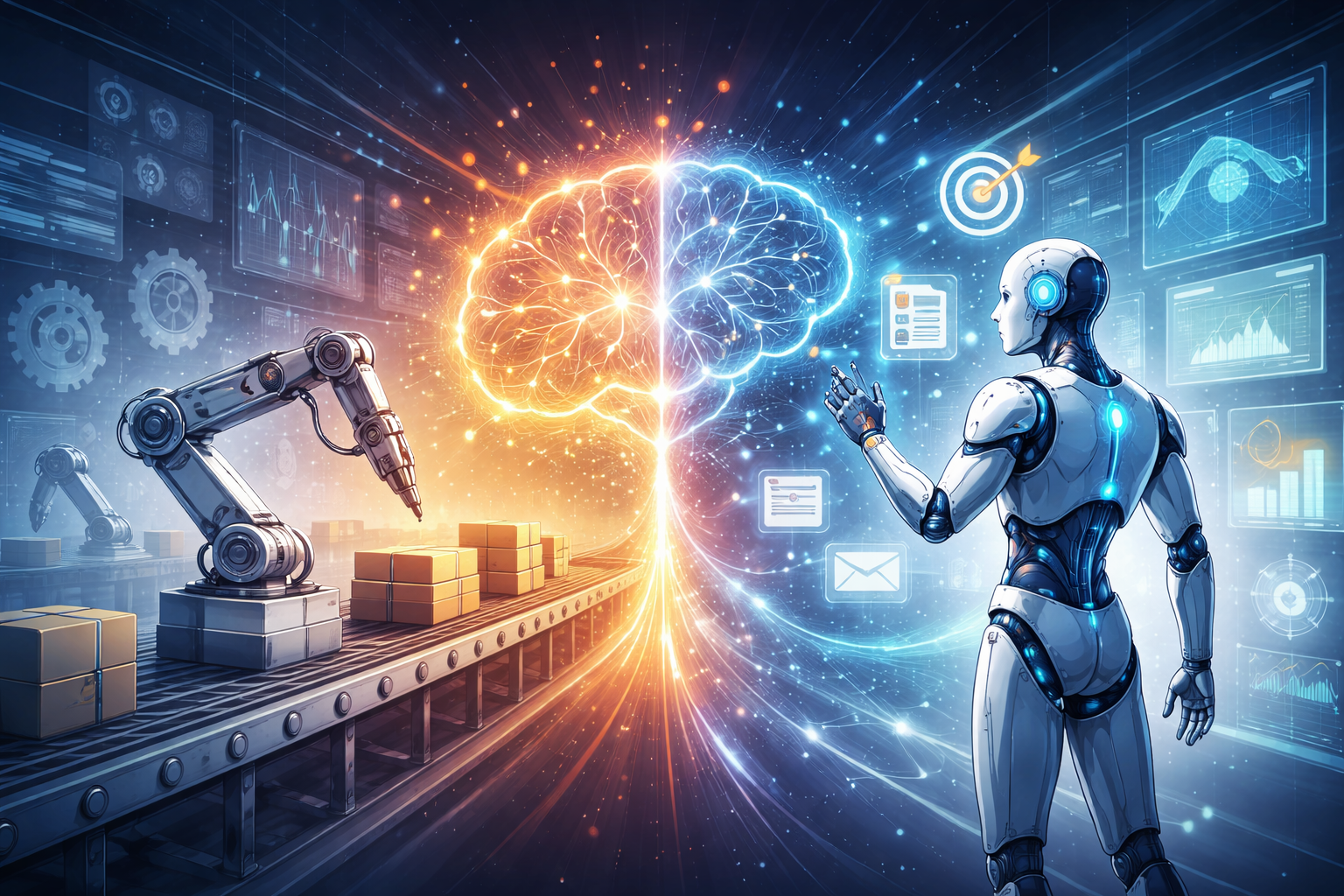
For decades, enterprises have invested heavily in automation. Rules engines, workflows, scripts, RPA bots, decision tables, and even machine-learning models have steadily reduced human effort. So when leaders hear the term Agentic AI, the natural reaction is skepticism:
“Is this just automation with better AI models?”
The answer is no. And misunderstanding this difference is the fastest way to design the wrong systems, set the wrong expectations, and expose the enterprise to unnecessary risk.
Agentic AI is not the next incremental step in automation.
It represents a categorical shift in how software behaves inside an organization.
This article explains what Agentic AI actually is, why it is fundamentally different from automation, and why that distinction matters at a strategic, architectural, and organizational level.
The Automation Mental Model (And Its Limits)
To understand Agentic AI, we must first understand the implicit assumptions of automation.
Traditional automation systems share a common structure:
- A human defines the process
- Rules and conditions are specified upfront
- The system executes predefined steps
- Exceptions are escalated to humans
- Accountability remains clearly human
Even advanced automation follows this logic.
Smarter Automation Still Obeys the Same Contract
Adding AI to automation does not change the underlying contract:
- Machine learning may predict
- AI may recommend
- Optimization algorithms may select
- NLP systems may interpret
But the system still:
- Waits to be triggered
- Operates within rigid workflows
- Defers responsibility to humans
- Does not initiate action on its own
In short:
Automation executes what we already understand.
This is precisely where automation breaks down.
Where Automation Fails in the Real World
Modern enterprises do not fail because they lack workflows. They fail in the spaces between workflows where reality refuses to follow predefined paths.
These failures emerge in environments where:
- Conditions change continuously
- Data is incomplete, delayed, or contradictory
- Trade-offs must be made in real time
- Multiple systems must be coordinated simultaneously
- Waiting for human intervention is operationally expensive
Common examples include:
- Incident response and recovery
- Supply chain disruptions
- Fraud detection and mitigation
- Revenue leakage prevention
- Customer churn intervention
- Operational risk management
In such environments:
- Rules become brittle under variation
- Workflows multiply until they are unmanageable
- Exceptions stop being rare and become the norm
- Humans turn into the primary bottleneck
Automation struggles here because it was never designed to decide. It was designed to execute what was already understood.
This gap between execution and decision-making is where automation consistently breaks down, and where Agentic AI becomes necessary.
The Core Shift: From Execution to Agency
Agentic AI introduces agency into software systems — a shift far more profound than adding intelligence or automation. Traditional software executes instructions. Agentic systems own behavior. This distinction changes how systems are designed, governed, trusted, and scaled.
Agency means the ability to operate with intent rather than instruction. An agent does not merely respond when triggered; it continuously interprets its environment and acts in pursuit of goals. This requires several tightly coupled capabilities working together:
An agent must interpret goals, not just follow steps. Goals describe what outcome matters, not how to achieve it. This allows the system to adapt when conditions change without requiring explicit reprogramming.
An agent must perceive context. Real-world environments are noisy, incomplete, and dynamic. Agents continuously absorb signals, events, and state changes rather than relying on static inputs or predefined conditions.
An agent must evaluate options. Instead of executing a single prescribed path, it considers multiple possible actions, weighs trade-offs, and assesses consequences relative to its goals and constraints.
An agent must decide actions. Decision-making is the critical boundary. At this point, responsibility shifts from human designers to the system itself—within limits that leadership defines.
An agent must execute those actions across tools, systems, and workflows, often coordinating multiple components and handling partial failures along the way.
An agent must learn from outcomes. It observes the results of its actions, adjusts future behavior, and improves over time—closing the loop that traditional automation leaves open.
This collection of capabilities is not a feature that can be toggled on or off. It is a behavioral capability that emerges from system design, governance, and intent.
This is why Agentic AI cannot be reduced to models or tools.
An agent is not defined by:
- The use of a large language model
- The sophistication of its algorithms
- The complexity or elegance of its code
These elements may enable agency, but they do not create it.
An agent is defined by ownership of action.
Ownership of action means the system is entrusted within explicit boundaries to choose what to do next and to be accountable for the consequences of that choice. This is what separates agents from assistants, predictors, or automation scripts.
When software owns action, it stops being a passive component of a workflow and becomes an active participant in the operating model. At that point, questions of trust, accountability, and governance are no longer optional—they are fundamental.
This is the true shift from execution to agency. And it is why Agentic AI demands a different way of thinking about software altogether.
A Simple Definition of Agentic AI
Agentic AI refers to systems that can independently decide and act in pursuit of goals, within defined constraints, while remaining accountable to human governance.
Three aspects of this definition matter deeply:
- Independently decide: The system does not merely follow instructions — it chooses among alternatives.
- Act in pursuit of goals: The system is goal-directed, not step-directed.
- Within defined constraints: Autonomy is bounded, not absolute.
Without all three, the system is not agentic.
Why Agentic AI Is Not “Smarter Automation”
The fundamental difference between automation and Agentic AI is not intelligence. It is intentionality.
Automation can be made faster, cheaper, and even more accurate. It can incorporate predictive models and sophisticated rules. But regardless of how advanced it becomes, automation remains instruction-bound. It does not act with intent; it merely reacts.
Agentic AI, by contrast, operates with purpose. It acts in pursuit of outcomes rather than in response to triggers. This distinction reshapes how systems behave in real-world environments where clarity is rare and change is constant.
Automation: Reactive and Instruction-Bound
Traditional automation is fundamentally event-driven. Something happens, and the system responds according to predefined logic.
Automation is triggered externally. A request arrives, a threshold is crossed, or a schedule fires. Until then, the system is inert.
It executes predefined steps. The logic is written in advance, often optimized for efficiency and repeatability. When conditions match expectations, automation performs well.
However, when conditions deviate, automation escalates uncertainty rather than resolving it. Edge cases, exceptions, and ambiguity are pushed upward to humans or parked in queues.
Automation has no concept of success beyond completion. If the workflow ran to the end, it is considered successful even if the outcome was undesirable, suboptimal, or actively harmful.
In short, automation answers the question:
“Did we do the steps?” It cannot answer: “Did we achieve the right outcome?”
Agentic AI: Proactive and Goal-Directed
Agentic AI systems behave fundamentally differently because they are organized around goals, not procedures.
An agent continuously perceives the environment. It does not wait passively for triggers. It monitors signals, observes state changes, and updates its understanding of the situation in real time.
It chooses actions based on current context, not static rules. The same goal may require different actions depending on timing, constraints, risk tolerance, or downstream impact.
Agentic AI is designed to handle ambiguity and trade-offs. It accepts that information will be incomplete, that objectives may conflict, and that there may be no “correct” answer—only better or worse choices.
Most importantly, an agent measures success by outcomes, not steps. If the goal is not being met, the agent adapts—even if it technically “followed the process.”
Agentic systems answer a different question altogether:
“What should I do next to move closer to the goal?”
You do not get agency by optimizing execution. You get agency by designing systems that can own decisions.
That is why Agentic AI is not the next generation of automation — it is a different category of system entirely.
Why Large Language Models Alone Are Not Agents
This distinction is critical, and it is frequently misunderstood even by experienced technology leaders.
The recent success of large language models (LLMs) has created the impression that intelligence alone is sufficient for agency. Because LLMs can reason, plan, explain, and converse fluently, they appear agent-like. This surface resemblance has led many organizations to label LLM-powered systems as “agents” long before they actually are.
This misunderstanding is not merely semantic. It leads directly to unsafe designs, false confidence, and fragile systems.
What LLMs Are Exceptionally Good At
Large language models are powerful reasoning engines. They excel at pattern recognition across vast amounts of text and can generate coherent, context-aware responses.
They are exceptional at language understanding and generation. They can interpret intent, summarize complex information, translate across domains, and communicate in ways that feel natural to humans.
LLMs are also useful for interpretation, planning, and explanation. They can:
- Analyze a situation
- Propose a plan
- Explain trade-offs
- Justify decisions in human-readable terms
These capabilities make LLMs invaluable building blocks for intelligent systems.
But none of these capabilities constitute agency.
What LLMs Fundamentally Do Not Do
Despite their sophistication, LLMs lack several properties that are non-negotiable for agency.
LLMs do not own goals. They respond to prompts, instructions, or contexts provided to them. They do not independently pursue objectives over time, nor do they evaluate success relative to outcomes.
LLMs do not perceive live environments. They do not observe real-world state changes unless explicitly fed information. They lack continuous situational awareness.
LLMs do not execute actions. They generate text. Any action taken in the real world—calling an API, changing a system state, triggering a workflow—must be orchestrated by something else.
LLMs do not maintain accountability. They cannot be held responsible for consequences. They do not track long-term impact, nor do they bear ownership for results.
These limitations are not flaws. They are simply a reflection of what LLMs are designed to be.
Why This Distinction Matters So Much
An agent is defined not by intelligence, but by responsibility.
Agency requires:
- Persistent goals
- Continuous perception
- Decision authority
- Action execution
- Feedback and learning loops
- Clear accountability
LLMs provide reasoning support within this loop but they do not close it. That is why an LLM is best understood as a component of an agent, not the agent itself.
Just as a calculator does not become a financial system, an LLM does not become an agent simply by being intelligent.
The Hidden Risks of Treating LLMs as Agents
When enterprises treat LLMs as agents, several predictable failures follow.
They confuse reasoning with responsibility. The system may explain a decision eloquently, but no component actually owns the decision or its consequences.
They overestimate safety. Fluent explanations create a false sense of reliability, masking the absence of guardrails, constraints, and oversight.
They under-design governance. Leaders assume intelligence implies judgment, and judgment implies trustworthiness. Governance is treated as optional or postponed.
They create brittle systems disguised as autonomy. These systems work impressively in demos but collapse under real-world variability, ambiguity, and scale.
In effect, organizations build theatrical autonomy — systems that look agentic but behave unpredictably.
Agentic AI Is a System Design Problem
True Agentic AI does not emerge from choosing the “right” model.
It emerges from system design:
- How goals are defined and enforced
- How context is perceived and updated
- How decisions are bounded and audited
- How actions are executed safely
- How humans intervene and remain accountable
Models including LLMs are enablers within this system. They are not the system itself.
This is why Agentic AI should be approached as an architectural and organizational challenge, not a procurement exercise.
The Core Insight Leaders Must Grasp
Intelligence makes agency possible. Design makes agency safe.
LLMs increase what systems can reason about. Agentic architecture determines what systems are allowed to do.
Enterprises that understand this distinction will build durable, trustworthy agentic systems. Those that do not will mistake eloquence for autonomy and pay the price.
The Agent Loop: How Agentic Systems Actually Work
At a conceptual level, every agentic system — regardless of domain, scale, or implementation — operates as a closed loop. This loop is not an implementation detail; it is the defining structure that distinguishes agents from automation.
Where automation executes, agents operate. Where workflows move forward, agents adapt.
The agent loop is what enables systems to function in environments that are dynamic, ambiguous, and only partially observable.
1. Perception: Continuous Awareness of the Environment
Perception is the agent’s ability to observe signals, events, and state changes from its environment.
These signals may include:
- System metrics and logs
- Business events
- User behavior
- External data feeds
- Temporal changes and trends
Crucially, perception is continuous, not episodic. The agent does not wait to be triggered by a predefined condition; it remains aware of evolving context.
Automation typically relies on static triggers — a threshold crossed, a message received, a job scheduled. Agents, by contrast, maintain situational awareness across time.
Without perception, a system is blind. With perception, a system becomes context-aware.
2. Interpretation: Making Sense of Signals in Context
Raw signals alone are meaningless without interpretation.
Interpretation is the agent’s ability to understand what observed signals mean within a broader context:
- Is this anomaly normal or exceptional?
- Is this change temporary or systemic?
- Does this event matter relative to current goals?
This step involves synthesis, not pattern matching. It requires combining:
- Historical data
- Current state
- Business intent
- Environmental constraints
LLMs are particularly valuable here — not because they are agents, but because they excel at contextual reasoning and semantic understanding.
Automation rarely interprets; it categorizes. Agents interpret, infer, and reassess.
This is where ambiguity is reduced without being eliminated.
3. Decision-Making: Choosing Under Constraints
Decision-making is the core of agency.
Here, the agent evaluates possible actions relative to goals, constraints, risks, and trade-offs. It asks:
- What outcomes matter most right now?
- What options are available?
- What are the costs and consequences of each?
- What uncertainty remains—and is it acceptable?
Unlike automation, which follows a predetermined path, agents choose among alternatives.
Importantly, decision-making does not require perfect information. Agents are designed to act under uncertainty, using heuristics, policies, and learned behavior. This is where intentionality enters the system. The agent is not just reacting — it is selecting.
4. Action: Executing Decisions in the Real World
Action is where reasoning becomes impact.
Agents execute decisions through tools, APIs, workflows, and systems:
- Triggering or modifying processes
- Coordinating across multiple services
- Engaging humans when necessary
- Adjusting system configurations
Action is not merely execution; it is commitment. Once an agent acts, the environment changes and responsibility follows.
Automation often ends here. It executes a step and considers the job done.
Agents do not.
5. Feedback & Learning: Closing the Loop
This is the most frequently overlooked and most critical—stage.
Feedback is the agent’s ability to assess the outcomes of its actions:
- Did the desired result occur?
- Were there unintended consequences?
- Did the environment respond as expected?
Learning is the process of adjusting future behavior based on that feedback:
- Refining decision policies
- Updating confidence thresholds
- Escalating earlier or later
- Changing strategies over time
This is what closes the loop.
Without feedback, systems repeat mistakes. With feedback, systems evolve.
Automation typically has no memory of outcomes. Agents do.
Why Automation Stops Short and Agents Do Not
Traditional automation usually operates as:
Trigger → Execute → Stop
It assumes:
- Stable conditions
- Known paths
- Predictable outcomes
Agentic systems operate as:
Observe → Decide → Act → Learn → Repeat
They assume:
- Change is constant
- Information is incomplete
- Trade-offs are unavoidable
This structural difference is why automation breaks down in complex, real-world environments and why agents continue to function.
Agentic AI is not defined by tools, models, or frameworks.
It is defined by a closed behavioral loop.
Automation executes steps. Agents own outcomes.
The Strategic Implication: A New Operating Model
When agents operate at scale:
- Decisions happen continuously, not periodically
- Coordination replaces handoffs
- Exceptions are handled in real time
- Organizations become more adaptive
This is why Agentic AI is best understood as:
A new enterprise operating model, not a technology upgrade.
Enterprises that treat it as smarter automation:
- Build fragile systems
- Fail to scale
- Erode trust
- Eventually retreat
Enterprises that treat it as an operating shift:
- Design governance early
- Invest in clarity
- Scale safely
- Create durable advantage
Final Thought
Agentic AI is not about replacing humans. It is about changing how work gets done when speed, complexity, and uncertainty exceed human capacity.
Automation executes instructions. Agentic AI takes responsibility within limits we define.
Understanding that difference is the foundation upon which every successful Agentic AI strategy is built.
Disclaimer: This post provides general information and is not tailored to any specific individual or entity. It includes only publicly available information for general awareness purposes. Do not warrant that this post is free from errors or omissions. Views are personal.