Agentic AI versus AI Agent - A Practical and Insightful Comparison

· 11 min read
Sanjoy Kumar Malik
Solution/Software Architect & Tech Evangelist
Agentic AI versus AI Agent - A Practical and Insightful Comparison

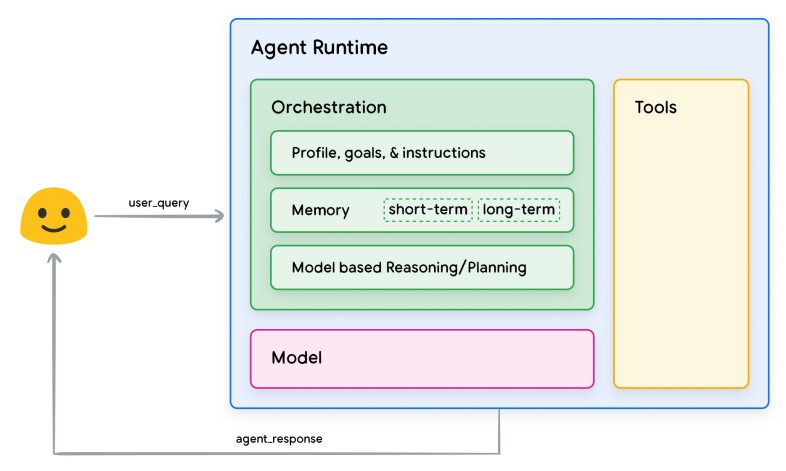
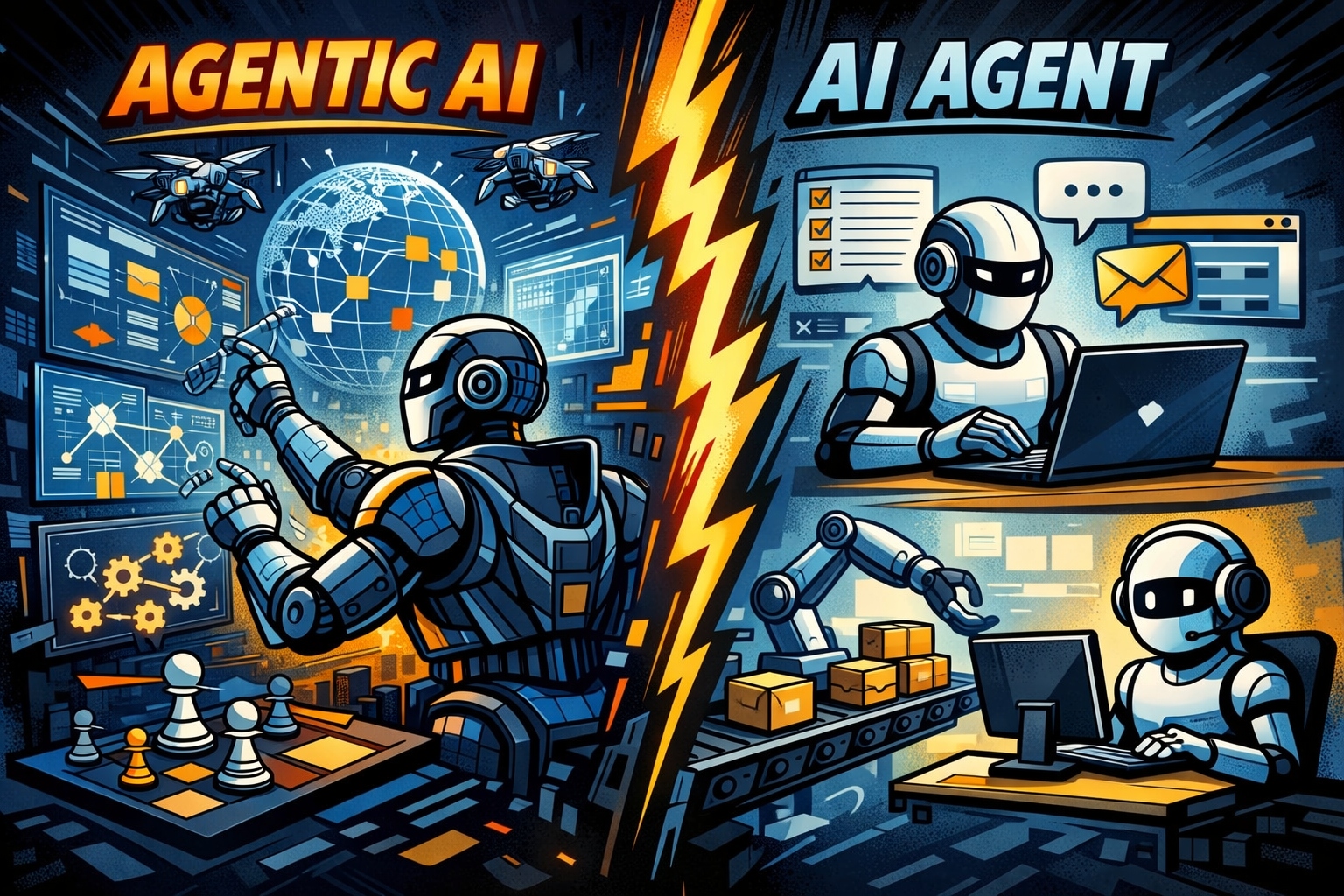
Artificial Intelligence (AI) continues evolving beyond generative models like text or image generators to fully autonomous systems that can act, plan, adapt, and orchestrate outcomes across complex workflows. Two related but distinct paradigms in this evolution are AI Agents and Agentic AI. Although the terms are often used interchangeably in industry discussions, they represent different design philosophies, operational capabilities, and practical implications for enterprises and developers. While they sound nearly identical, they represent a fundamental shift in how we interact with technology: the transition from software that talks to software that acts.

To understand their roles, strengths, and limitations, it is essential to clearly distinguish between them, especially for technology leaders, architects, and practitioners designing real-world AI systems.

Definitions: What They Are

AI Agent

An AI Agent is a specific instance or "entity" of software powered by a Large Language Model (LLM) designed to perform a particular task. Think of it as a digital employee. An AI Agent might be a "Customer Support Agent" or a "Coding Assistant." It is the container for the AI’s persona and its specific toolkit.

  • Scope: Narrow, task-focused.
  • Behavior: Typically reactive — acts in response to specific triggers or inputs.
  • Learning: Limited; may improve through retraining but usually static between iterations.

This aligns with definitions from multiple industry sources characterizing AI Agents as task executors with bounded autonomy.


Agentic AI Ethics, Safety, and Alignment

· 4 min read
Sanjoy Kumar Malik
Solution/Software Architect & Tech Evangelist
Agentic AI Ethics, Safety, and Alignment

Agentic AI changes the ethical conversation in a fundamental way. Traditional AI systems suggest. Agentic systems decide and act. Once systems are allowed to pursue goals autonomously, ethics, safety, and alignment stop being abstract principles and become operational requirements.

The central leadership question is no longer, “Can the model do this?” It is, “Should the system ever do this—under these conditions, at this scale, without human approval?”

Ethics in Agentic AI: From Values to Executable Constraints

Ethics in Agentic AI cannot rely on post-hoc review or good intentions. Autonomous systems act too quickly and too consistently. Ethical boundaries must therefore be encoded as executable constraints within the system.

Core Agent Capabilities - Perception, Planning, and Action

· 5 min read
Sanjoy Kumar Malik
Solution/Software Architect & Tech Evangelist
Core Agent Capabilities - Perception, Planning, and Action

Agentic AI systems are often described in terms of autonomy, speed, or intelligence. In practice, none of these qualities matter unless the agent can reliably perceive its environment, plan coherent courses of action, and execute those actions within defined boundaries. These three capabilities — Perception, Planning, and Action — form the irreducible core of every agentic system, regardless of domain or sophistication.

For leaders and architects, understanding these capabilities is not an academic exercise. Each capability introduces distinct architectural choices, operational risks, and governance responsibilities. Weakness in any one of them destabilizes the entire system.

Perception: Constructing a Trustworthy View of Reality

Perception is the agent’s ability to observe, interpret, and contextualize signals from its environment. This includes structured data, unstructured inputs, system events, user interactions, and external signals such as APIs or sensors.

In human organizations, perception is filtered through experience and judgment. In agentic systems, perception is mechanized and therefore brittle if poorly designed.

Why Speed is a Distraction - The Power of Scalable Alignment

· 4 min read
Sanjoy Kumar Malik
Solution/Software Architect & Tech Evangelist
Why Speed is a Distraction - The Power of Scalable Alignment

Imagine you're in a race. You have the fastest car on the track, a gleaming marvel of engineering that can hit unbelievable speeds. But what if, instead of heading towards the finish line, you're constantly veering off course, making detours, or even driving in the wrong direction? The speed becomes irrelevant, even detrimental.

This vivid image perfectly captures a common misconception about the latest wave of Artificial Intelligence, specifically Agentic AI. Many assume its primary competitive advantage is raw speed — how quickly it can process data, generate text, or execute a task. While Agentic AI is undeniably fast, focusing solely on velocity is a distraction. The real "magic" lies not in how quickly it moves, but in how precisely it moves towards your exact intentions, every single time, whether it’s performing one task or a thousand.

Alignment vs. Efficiency: A Crucial Distinction

To truly grasp Agentic AI, we need to shift our focus from efficiency (doing things quickly) to alignment (doing the right things, correctly and consistently).

The Three Building Blocks of an AI Agent - Models, Tools, and Orchestration

· 4 min read
Sanjoy Kumar Malik
Solution/Software Architect & Tech Evangelist
General agent architecture and component

Image Source: Google Agents Whitepaper

AI agents are often described in abstract terms — “autonomous,” “intelligent,” or “goal-driven.” In practice, however, an AI agent is not a monolithic entity. It is a composed system, built from three foundational components:

  • The Model – the reasoning and language engine
  • The Tools – the agent’s means of acting on the world
  • The Orchestration Layer – the control system that governs behavior over time

Understanding these components and their boundaries is essential for designing reliable, scalable, and governable agentic systems.

At the core of every AI agent sits a foundation model (typically a large language model, or LLM). Its responsibilities are precise and limited:

  • Interpret inputs (user prompts, system messages, state summaries)
  • Reason about goals, constraints, and next steps
  • Generate structured outputs (plans, decisions, tool calls, responses)

What Is Agentic AI and Why It Is Not Just “Smarter Automation”

· 15 min read
Sanjoy Kumar Malik
Solution/Software Architect & Tech Evangelist
What Is Agentic AI

For decades, enterprises have invested heavily in automation. Rules engines, workflows, scripts, RPA bots, decision tables, and even machine-learning models have steadily reduced human effort. So when leaders hear the term Agentic AI, the natural reaction is skepticism:

“Is this just automation with better AI models?”

The answer is no. And misunderstanding this difference is the fastest way to design the wrong systems, set the wrong expectations, and expose the enterprise to unnecessary risk.

Agentic AI is not the next incremental step in automation.

It represents a categorical shift in how software behaves inside an organization.

This article explains what Agentic AI actually is, why it is fundamentally different from automation, and why that distinction matters at a strategic, architectural, and organizational level.

The Automation Mental Model (And Its Limits)

To understand Agentic AI, we must first understand the implicit assumptions of automation.