Agentic AI versus AI Agent - A Practical and Insightful Comparison

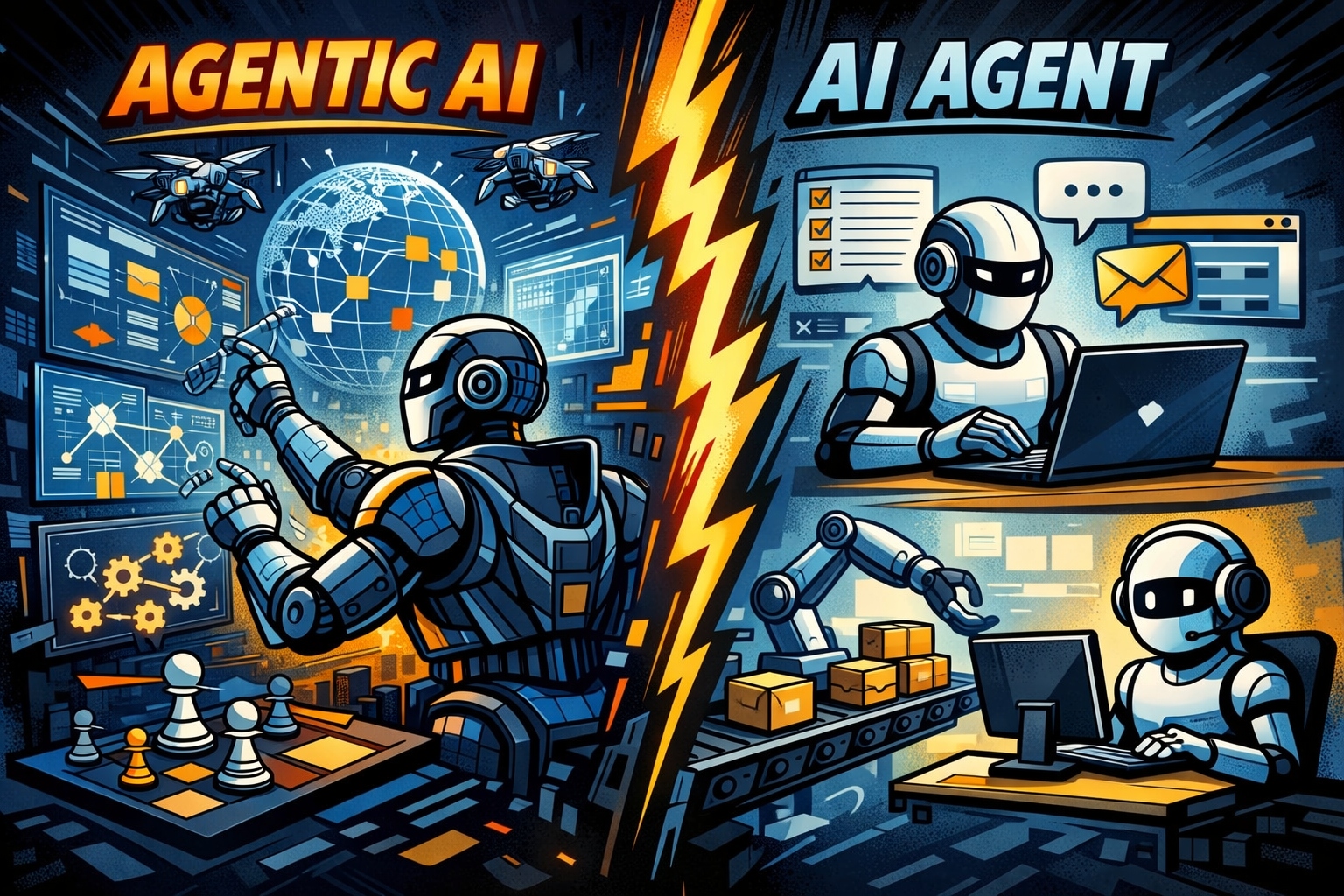
Artificial Intelligence (AI) continues evolving beyond generative models like text or image generators to fully autonomous systems that can act, plan, adapt, and orchestrate outcomes across complex workflows. Two related but distinct paradigms in this evolution are AI Agents and Agentic AI. Although the terms are often used interchangeably in industry discussions, they represent different design philosophies, operational capabilities, and practical implications for enterprises and developers. While they sound nearly identical, they represent a fundamental shift in how we interact with technology: the transition from software that talks to software that acts.
To understand their roles, strengths, and limitations, it is essential to clearly distinguish between them, especially for technology leaders, architects, and practitioners designing real-world AI systems.
Definitions: What They Are
AI Agent
An AI Agent is a specific instance or "entity" of software powered by a Large Language Model (LLM) designed to perform a particular task. Think of it as a digital employee. An AI Agent might be a "Customer Support Agent" or a "Coding Assistant." It is the container for the AI’s persona and its specific toolkit.
- Scope: Narrow, task-focused.
- Behavior: Typically reactive — acts in response to specific triggers or inputs.
- Learning: Limited; may improve through retraining but usually static between iterations.
This aligns with definitions from multiple industry sources characterizing AI Agents as task executors with bounded autonomy.
Agentic AI
Agentic AI refers to a broader class of systems that pursue higher-level goals autonomously, often by planning, interpreting context, coordinating across sub-tasks, making decisions, and dynamically adapting to changes in the environment without constant human intervention. As Andrew Ng, a pioneer in the field, often notes, "Agentic AI" is more about the workflow than the model itself. It is the shift from "Zero-Shot" (giving one prompt and getting one answer) to "Iterative Loops" (the AI thinking, checking its work, and trying again).
- Scope: Multi-step, goal-oriented workflows.
- Behavior: Proactive — anticipates and plans actions toward objectives.
- Learning: Continuous adaptation using feedback and persistent memory.
In essence, agentic AI systems may orchestrate multiple AI agents or modules and manage the entire execution process from goal interpretation to completion.
Key Differences in Capabilities
The following table summarizes the practical differences between the two paradigms:
| Characteristic | AI Agent | Agentic AI |
|---|---|---|
| Task Scope | Single or narrow task execution | Complex, multi-step goals and workflows |
| Autonomy Level | Low to moderate | High; can act without frequent prompts |
| Decision-Making | Rule-based or limited contextual decisions | Dynamic evaluation of alternatives and planning |
| Adaptability | Static or periodic retraining | Continuous learning from feedback and environment |
| Memory & Context | Often stateless or limited | Persistent memory across tasks |
| Integration | Standalone tasks | Coordinated across systems and sub-agents |
These distinctions illustrate why businesses choose different approaches depending on complexity: AI Agents for routine automation, Agentic AI for autonomous orchestration.
Practical Enterprise Use Cases
When to Use AI Agents
AI Agents are effective where:
- Tasks are repetitive and clearly defined (e.g., responding to standard customer queries).
- Predictability is essential (e.g., filling forms, updating records).
- Human oversight is constant and workflows don’t require complex decision-making.
Examples include helpdesk chatbots, automated meeting schedulers, or basic data retrieval bots.
When to Use Agentic AI
Agentic AI excels in situations with:
- Complex workflows requiring orchestration (e.g., supply chain optimization).
- Dynamic environments where conditions change frequently.
- Multi-system coordination (e.g., coordinating logistics, pricing, and inventory).
Agentic AI systems may independently plan multi-step processes, adjust strategies mid-execution, and optimize decisions in real time.
These functional differences help organizations determine the scope of AI adoption and choose the right technology for specific business challenges.
Architectural and Operational Considerations
From an engineering perspective, the paradigms differ in complexity and structure:
- AI Agents usually comprise a single model or workflow with fixed logic and interfaces.
- Agentic AI typically includes:
- Orchestration layers to coordinate sub-agents,
- Memory and feedback loops for learning,
- Decision logic that weighs trade-offs dynamically,
- Integration APIs for interacting with external tools or systems.
This difference affects operational considerations such as governance, monitoring, and risk control. Agentic AI systems, due to their autonomy, require stronger oversight and safety guardrails to prevent unintended actions.
Real-World Trends and Adoption Challenges
The adoption of agentic AI shows potential but remains nascent and challenging:
The Trust and Governance Gap
While 79% of organizations have experimented with AI agents, a significant 75% of technology leaders identify governance as their primary barrier to full-scale deployment.
-
Traditional AI governance focuses on data privacy and output accuracy. Agentic governance must go further, addressing behavioral safety. If an agent is authorized to negotiate a contract or move funds, how do we ensure it doesn't "hallucinate" a discount or bypass a security protocol?
-
TRiSM Frameworks: Organizations are increasingly adopting AI Trust, Risk, and Security Management (TRiSM). This involves "Guardrail Agents"—secondary AI systems whose sole job is to monitor and veto the actions of the primary "Worker Agents" if they drift from defined ethical or operational boundaries.
The Cost and Failure Projection
Analysts from firms like Gartner and Forrester warn that 40% of agentic AI projects may be discontinued by 2027. This "pruning" of the market is driven by several practical hurdles:
- API Call Inflation: Unlike a single-prompt chatbot, an agentic system may iterate 10–20 times to solve a complex task. This results in an exponential increase in token usage and compute costs, often without a linear increase in value.
- Agentic Sprawl: Without centralized orchestration, companies risk creating "siloed agents" that perform redundant tasks or, worse, work at cross-purposes (e.g., an Inventory Agent ordering stock while a Finance Agent is trying to cut costs).
- The ROI Shift: Traditional metrics like "time saved per prompt" are being replaced by Process Velocity and Automation Rate (the percentage of end-to-end tasks completed without human intervention).
The 2028 Horizon: Autonomous Commerce
Despite current challenges, the trajectory toward autonomy is steep. By 2028, the role of AI agents is expected to shift from "assistants" to "economic actors."
-
B2B Orchestration: Gartner predicts that AI agents will intermediate over $15 trillion in B2B spending by 2028. We are moving toward a "Machine-to-Machine" (M2M) economy where your company’s Procurement Agent negotiates directly with a supplier’s Sales Agent in milliseconds.
-
It is projected that agents will outnumber human employees by by 10x to 20x, automating complex workflows, enhancing productivity, and improving customer experiences. In these environments, the "Human-in-the-Loop" role will evolve into a "Human-on-the-Loop" role—acting as a manager of multiple autonomous workflows rather than a direct operator.
Insight: The "Agentic" Spectrum
It is more accurate and operationally useful to think of agentic capability as a continuum rather than a binary property. Systems do not abruptly shift from “non-agentic” to “agentic.” Instead, they exhibit graduated levels of autonomy, initiative, and decision-making authority depending on how much context they can perceive, how far ahead they can plan, and how independently they can act.
At the low end of the spectrum, agency is minimal and reactive. A chatbot that only responds to explicit user prompts exemplifies this level. It does not initiate actions, maintain long-term goals, or adapt its behavior beyond the immediate interaction. Such systems are essentially request–response engines with limited contextual memory and no intent of their own.
In the middle of the spectrum, systems begin to demonstrate conditional autonomy. A coding assistant that can execute code, detect syntax or runtime errors, and iteratively fix them shows a higher degree of agency. While still bounded by a user-defined objective, it can reason about intermediate steps, evaluate outcomes, and take corrective actions without continuous human intervention. This level introduces feedback loops and short-horizon planning.
At the high end of the spectrum, agency becomes strategic and proactive. An autonomous system that continuously monitors a supply chain, detects early signals of a potential shortage, evaluates alternative suppliers, and prepares a draft purchase order operates with goal persistence, environmental awareness, and multi-step planning. Human involvement shifts from operational control to oversight and approval, reflecting a fundamentally different human-AI relationship.
Understanding agency as a spectrum helps organizations make better architectural and governance decisions. It allows teams to intentionally dial agency up or down based on risk tolerance, regulatory constraints, and business criticality, rather than treating agentic behavior as an all-or-nothing design choice.
Summary and Strategic Takeaways
- AI Agents are specialized tools for automating bounded, predictable tasks with limited autonomy.
- Agentic AI represents a more advanced, autonomous approach capable of planning, adapting, and coordinating across complex workflows.
- Choosing between them should be driven by task complexity, risk tolerance, governance maturity, and integration needs.
For practitioners and architects, understanding these distinctions is crucial for designing scalable, reliable, and value-driven AI solutions aligned with business strategy.
References and Further Reading
- https://www.nist.gov/itl/ai-risk-management-framework
- https://www.ibm.com/thought-leadership/institute-business-value/en-us/report/scale-agentic-ai
- https://www.linkedin.com/pulse/digital-employees-outnumber-human-10x-20x-you-ready-agarwal-n04xc/
- https://www.gartner.com/en/newsroom/press-releases/2025-06-25-gartner-predicts-over-40-percent-of-agentic-ai-projects-will-be-canceled-by-end-of-2027
- https://www.azilen.com/blog/agentic-ai-trends/
- https://blog.arcade.dev/agentic-framework-adoption-trends
- https://aws.amazon.com/what-is/agentic-ai/
- https://www.aquant.ai/resources/post/understanding-the-full-spectrum-of-agentic-ai
- https://www.azion.com/en/learning/ai/ai-agent-vs-agentic-ai/
- https://www.ibm.com/think/topics/agentic-ai
- https://agenticre.ai/andrew-ngs-vision-the-transformative-rise-of-ai-agents/
- https://www.oracle.com/artificial-intelligence/ai-agents/
- https://www.isaca.org/resources/news-and-trends/isaca-now-blog/2025/ai-agents-and-agentic-ai-understanding-the-difference-that-matters-for-your-organization
- https://arxiv.org/html/2505.10468v1
- https://www.reuters.com/business/over-40-agentic-ai-projects-will-be-scrapped-by-2027-gartner-says-2025-06-25/
- https://www.techradar.com/pro/companies-confess-their-agentic-ai-goals-arent-really-working-out-and-a-lack-of-trust-could-be-why
- https://www.sprinklr.com/blog/agentic-ai-vs-ai-agents/
- https://www.creatio.com/glossary/ai-agents-vs-agentic-ai
- https://www.freshworks.com/freshdesk/ai-agent/vs-agentic-ai/
- https://www.digitalcommerce360.com/2025/11/28/gartner-ai-agents-15-trillion-in-b2b-purchases-by-2028/
Disclaimer: This post provides general information and is not tailored to any specific individual or entity. It includes only publicly available information for general awareness purposes. Do not warrant that this post is free from errors or omissions. Views are personal.