The Three Building Blocks of an AI Agent - Models, Tools, and Orchestration

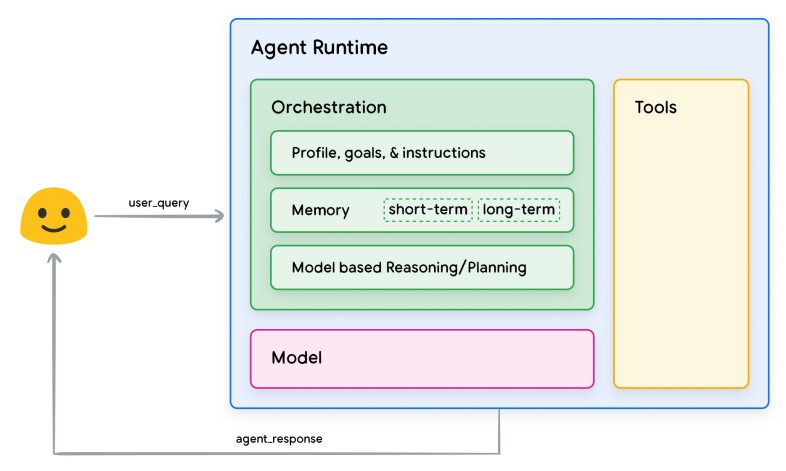
Image Source: Google Agents Whitepaper
AI agents are often described in abstract terms — “autonomous,” “intelligent,” or “goal-driven.” In practice, however, an AI agent is not a monolithic entity. It is a composed system, built from three foundational components:
- The Model – the reasoning and language engine
- The Tools – the agent’s means of acting on the world
- The Orchestration Layer – the control system that governs behavior over time
Understanding these components and their boundaries is essential for designing reliable, scalable, and governable agentic systems.
At the core of every AI agent sits a foundation model (typically a large language model, or LLM). Its responsibilities are precise and limited:
- Interpret inputs (user prompts, system messages, state summaries)
- Reason about goals, constraints, and next steps
- Generate structured outputs (plans, decisions, tool calls, responses)
What the model does well
- Pattern recognition over language and symbols
- Multi-step reasoning when properly prompted
- Decision-making under uncertainty, given context
What the model does not do
- It does not execute actions
- It does not maintain long-term state reliably on its own
- It does not enforce business rules, safety policies, or permissions
This distinction is critical. Treating the model as the “brain” is acceptable, but treating it as the system is a design error. Models are probabilistic predictors, not deterministic controllers.
In production-grade agents, models are replaceable components — they can be upgraded, swapped, or specialized (e.g., planner models vs. summarization models) without rewriting the entire system.
Tools: Controlled Interaction With the World
If the model is the reasoning engine, tools are the hands.
A tool is any external capability the agent can invoke, such as:
- APIs (databases, CRMs, ticketing systems)
- Code execution environments
- Search and retrieval systems
- Internal microservices
- Workflow engines
Tools convert intent into impact.
Why tools matter
Without tools, a model can only talk. With tools, an agent can:
- Fetch real-time data
- Create or modify records
- Trigger workflows
- Interact with other systems
The design principle: tools are explicit
Well-designed agents never allow the model to “improvise” actions. Instead:
- Tools have defined schemas
- Inputs and outputs are structured
- Permissions and scopes are enforced outside the model
For example, an agent may decide to issue a refund but the refund logic, limits, approvals, and audit logging live in the tool, not in the model’s reasoning.
This separation ensures:
- Safety
- Auditability
- Predictable behavior
Orchestration: The Most Underrated Component
The orchestration layer is what turns a model-with-tools into an agent.
Orchestration governs:
- When the model is called
- Which model is used for which task
- How state is stored and updated
- How decisions evolve across steps
- How errors, retries, and escalations are handled
In practical terms, orchestration is responsible for control flow.
Key orchestration responsibilities
a. State management
Agents operate over time. Orchestration maintains:
- Conversation state
- Task progress
- Intermediate decisions
- Memory summaries
This state must be external to the model to be reliable.
b. Planning and execution loops
Most agents follow a loop:
- Observe state
- Reason (model)
- Act (tool)
- Observe result
- Decide next step
Orchestration enforces this loop and prevents runaway behavior.
c. Policy and guardrails
Business rules, safety constraints, rate limits, and human approval points live here—not in prompts alone.
d. Multi-agent coordination
In advanced systems, orchestration manages:
- Role separation (planner, executor, reviewer)
- Message passing between agents
- Conflict resolution
Without orchestration, autonomy becomes chaos.
Why These Components Must Be Separated
Separation of model, tools, and orchestration enables:
- Replaceability (swap models without rewriting tools)
- Governance (audit actions independently of reasoning)
- Reliability (deterministic control over execution)
- Scalability (parallel agents with shared infrastructure)
This mirrors established software architecture principles:
- Models resemble decision services
- Tools resemble bounded capabilities
- Orchestration resembles workflow engines
Agentic AI is not a departure from systems engineering—it is an extension of it.
A Practical Mental Model
If you are designing or evaluating an AI agent, ask three concrete questions:
- Model: What decisions is the model responsible for and what decisions is it not allowed to make?
- Tools: Which real-world actions are exposed, and how are they constrained?
- Orchestration: Who controls the sequence, state, and authority of actions over time?
If any one of these answers is vague, the system is fragile.
The future of agentic AI will not be determined by larger models alone but by how rigorously we design the boundaries between reasoning, action, and control.
Disclaimer: This post provides general information and is not tailored to any specific individual or entity. It includes only publicly available information for general awareness purposes. Do not warrant that this post is free from errors or omissions. Views are personal.