Agentic AI versus AI Agent - A Practical and Insightful Comparison

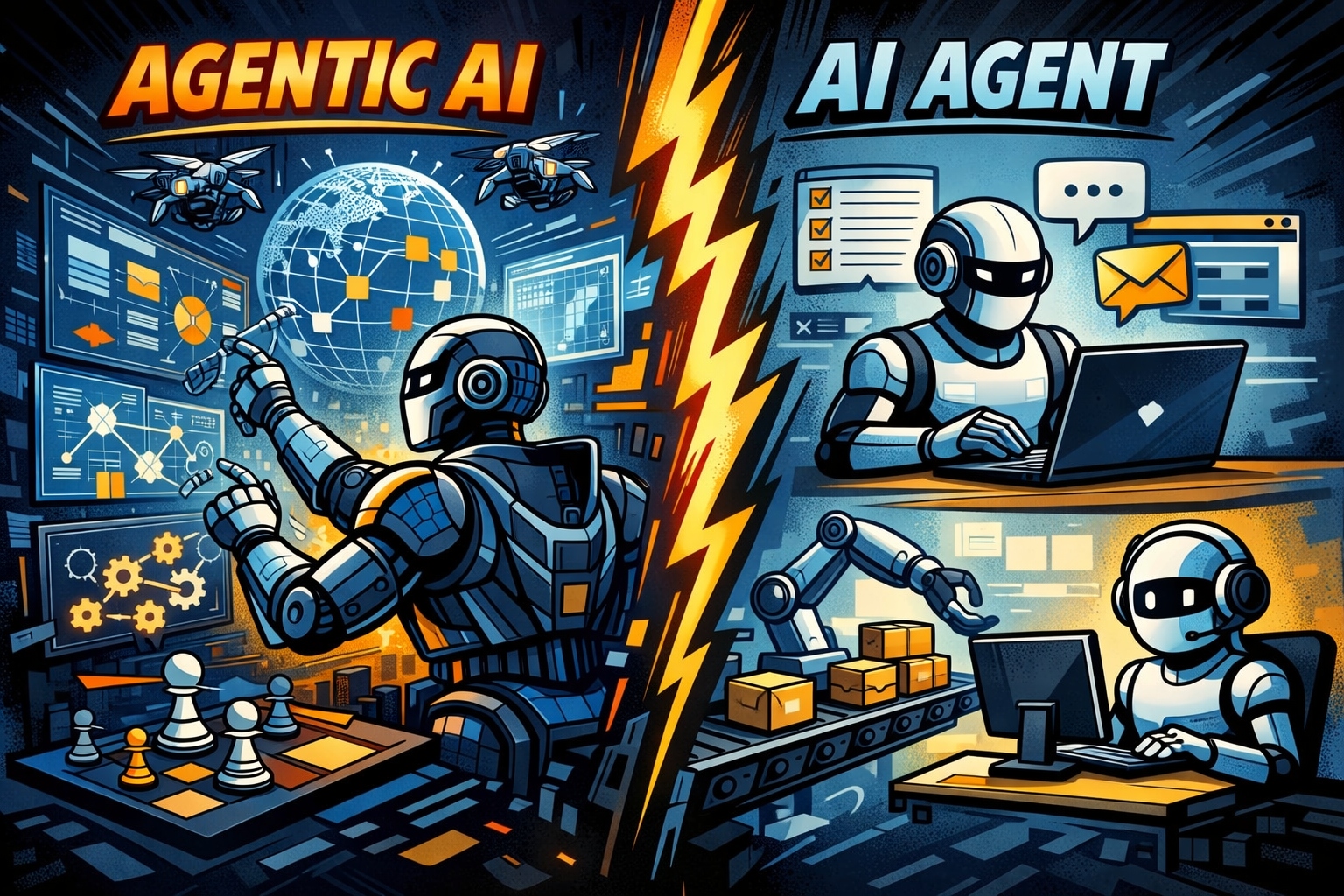
Artificial Intelligence (AI) continues evolving beyond generative models like text or image generators to fully autonomous systems that can act, plan, adapt, and orchestrate outcomes across complex workflows. Two related but distinct paradigms in this evolution are AI Agents and Agentic AI. Although the terms are often used interchangeably in industry discussions, they represent different design philosophies, operational capabilities, and practical implications for enterprises and developers. While they sound nearly identical, they represent a fundamental shift in how we interact with technology: the transition from software that talks to software that acts.
To understand their roles, strengths, and limitations, it is essential to clearly distinguish between them, especially for technology leaders, architects, and practitioners designing real-world AI systems.
Definitions: What They Are
AI Agent
An AI Agent is a specific instance or "entity" of software powered by a Large Language Model (LLM) designed to perform a particular task. Think of it as a digital employee. An AI Agent might be a "Customer Support Agent" or a "Coding Assistant." It is the container for the AI’s persona and its specific toolkit.
- Scope: Narrow, task-focused.
- Behavior: Typically reactive — acts in response to specific triggers or inputs.
- Learning: Limited; may improve through retraining but usually static between iterations.
This aligns with definitions from multiple industry sources characterizing AI Agents as task executors with bounded autonomy.