Mapping Agentic AI to Product Strategy - Part 1 - The Strategic Inflection Point - From Tools to Autonomous Systems

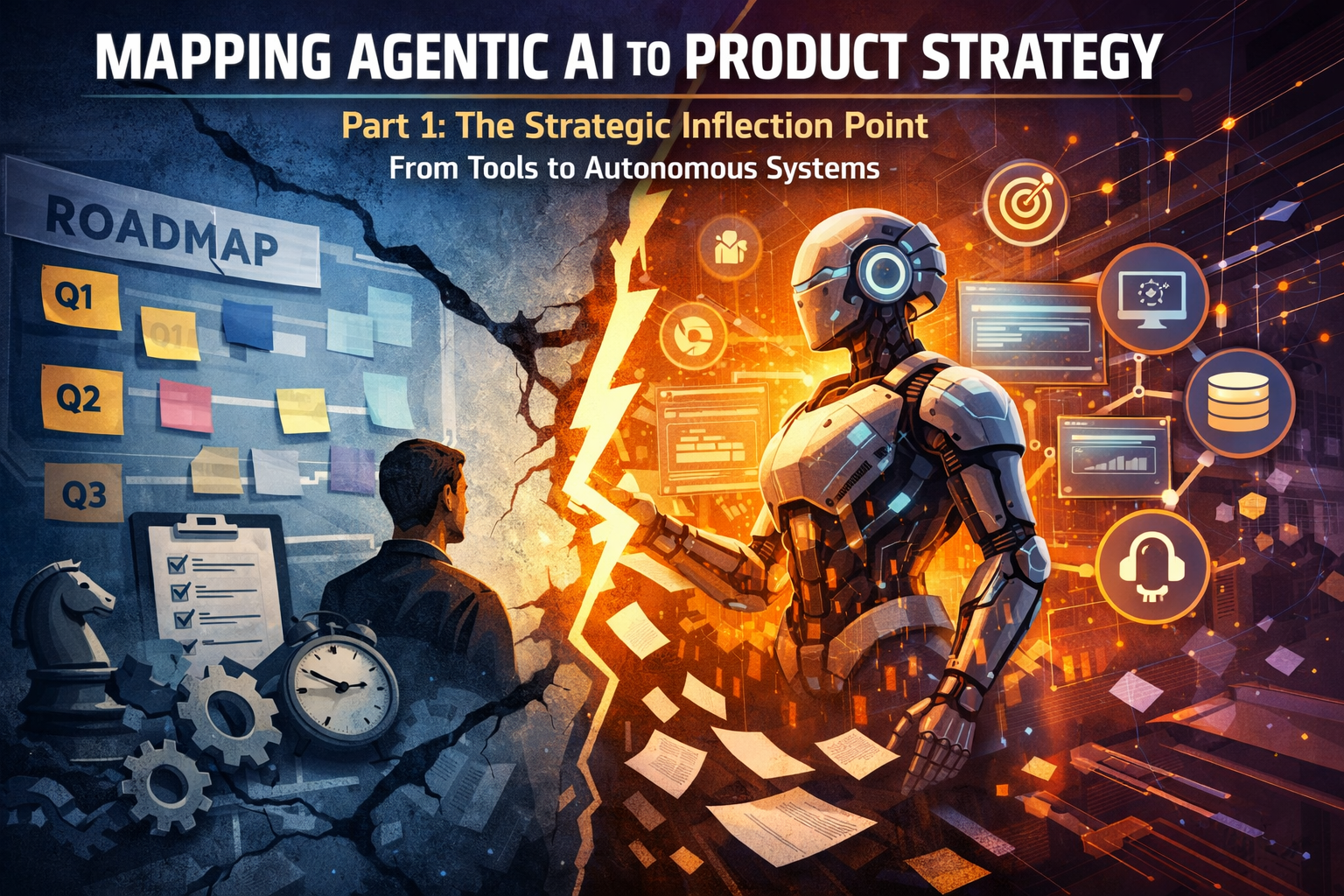
This is the first article in the comprehensive series on the Mapping Agentic AI to Product Strategy.
The Moment Strategy Broke
Every decade has a breaking point.
A moment when old playbooks stop working.
Product management is at that moment now.
For years, strategy followed a rhythm.
Quarterly planning.
Backlog grooming.
Roadmap alignment.
Feature releases.
Post-launch reviews.
It felt structured.
It felt controlled.
It felt predictable.
But markets stopped moving quarterly.
They now move very fast.
Sometimes weekly or daily.
User expectations evolve in real time.
Competitors ship continuously.
Data signals never stop flowing.
Yet most product teams still operate in cycles designed for slower eras.
The result is tension.
Roadmaps age before they ship.
Customer insights arrive after decisions are made.
Features solve yesterday’s problems.
This tension exposes a deeper truth.
Traditional product strategy assumes control.
It assumes planning precedes execution.
It assumes human analysis is the primary engine of adaptation.
That assumption is collapsing.
AI entered products as assistance.
First as automation.
Then as prediction.
Then as generation.
Now it enters as agency.
Not as a tool that waits for instruction.
But as a system that pursues goals.
This is the inflection point.
When the product no longer waits.
When the system learns continuously.
When optimization happens without explicit prompts.
Consider the evolution of OpenAI.
Early interactions with large language models were prompt-based.
Users asked.
The model responded.
That interaction was reactive.
But the direction is shifting toward autonomous agents.
Systems that can plan tasks.
Use tools.
Call APIs.
Maintain memory.
Adjust strategies.
That shift is not cosmetic.
It is structural.
When systems act toward goals, product strategy changes.
The product is no longer static.
It is no longer a container of features.
It becomes a living system.
A system that learns.
Adapts.
Optimizes.
The central question changes.
Not “What features should we build next?”
But “What goals should the system pursue?”
This Part 1 marks the beginning of that shift.
From tools to autonomy.
From roadmaps to goal architectures.
From control to constrained agency.
The break has already happened.
Many leaders just have not recognized it yet.
The Evolution of AI in Products
Technological change is rarely sudden.
It compounds.
Layer by layer.
AI in products followed a clear progression.
Understanding this progression is essential.
Because strategy evolves with capability.
The Rule-Based Era
The earliest intelligent systems were deterministic.
If condition A occurred, trigger action B.
If threshold exceeded, send alert.
These systems followed rules.
They did not learn.
They did not adapt.
Strategy in this era focused on process optimization.
Reduce friction.
Automate workflows.
Increase efficiency.
Value came from predictability.
Product managers defined flows.
Engineers encoded logic.
Systems executed exactly what was specified.
Control was centralized.
But adaptability was limited.
The Predictive Intelligence Era
Machine learning changed the equation.
Systems began to detect patterns.
They learned from data.
They made predictions.
Recommendation engines became common.
Fraud detection improved.
Personalization scaled.
Consider the evolution of Amazon.
Its recommendation engine moved beyond static rules.
It learned from behavior.
It adapted to browsing history.
It improved with scale.
Predictive systems created competitive advantage.
But they still operated within narrow boundaries.
They optimized specific metrics.
They required retraining cycles.
They did not reason across multiple goals.
They predicted.
They did not plan.
Strategy during this phase centered on data advantage.
More data meant better predictions.
Better predictions meant better performance.
Yet the system still waited for defined objectives.
Humans set the goals.
Humans defined optimization targets.
The system remained a sophisticated calculator.
The Generative Era
Then came generative AI.
Large language models.
Image generators.
Code assistants.
They expanded creative capacity.
Users could draft documents.
Generate designs.
Write code.
Copilots entered productivity tools.
The role of AI shifted from prediction to creation.
This increased speed.
It increased output.
It reduced friction.
But it was still reactive.
The user initiated.
The model responded.
It was augmentation.
Not autonomy.
Strategy during this phase focused on productivity gains.
How can AI help users work faster?
How can AI reduce effort?
Important questions.
But still incremental.
The Agentic Era
Now a deeper transformation unfolds.
AI systems begin to pursue objectives.
They plan.
They sequence actions.
They call tools.
They monitor outcomes.
They adjust strategies.
They do not wait for every prompt.
They operate within defined constraints.
But they exercise bounded autonomy.
This is Agentic AI.
Generative AI responds.
Agentic AI acts.
Generative AI creates content.
Agentic AI executes strategy.
This is not feature enhancement.
It is structural transformation.
When systems act toward goals, products become dynamic. When products become dynamic, strategy must evolve.
The shift from assistance to agency forces a new mental model.
You are no longer building features.
You are designing goal-seeking systems.
That is the inflection point.
What Makes AI Agentic?
Clarity matters.
The term “agentic” is often misused. It must be defined precisely.
Agentic AI is not simply automation.
It is not just prediction.
It is not only generation.
It has five defining characteristics.
1. Goal Orientation
An agentic system operates toward objectives.
These objectives may be revenue targets.
Engagement thresholds.
Conversion improvements.
Risk minimization.
The system evaluates actions against goals.
It does not merely execute commands.
2. Persistent Memory
Agentic systems maintain context.
They remember past interactions.
They retain historical signals.
They adapt based on accumulated learning.
Without memory, autonomy collapses.
Memory enables continuity.
3. Tool Use
Agentic systems do not operate in isolation.
They access APIs.
Query databases.
Trigger workflows.
Retrieve external data.
They extend beyond static model outputs.
They act in the environment.
4. Multi-Step Reasoning
Tasks often require sequencing.
Research precedes action.
Action precedes evaluation.
Evaluation precedes adjustment.
Agentic systems chain reasoning steps.
They plan before acting.
5. Feedback Loops
The defining characteristic is feedback.
Actions generate outcomes.
Outcomes inform future decisions.
Learning becomes continuous.
Without feedback loops, autonomy stagnates.
With feedback loops, adaptation accelerates.
Strategic Implications
When these characteristics converge, product strategy changes.
The product is no longer static.
It becomes a self-adjusting system.
The product manager’s role shifts.
From defining flows.
To defining goals.
From specifying behavior.
To specifying boundaries.
Strategy becomes constraint architecture.
You design objectives.
You encode guardrails.
You monitor feedback velocity.
The system operates within that framework.
Automation follows instructions.
Agentic systems interpret goals.
Automation reduces effort.
Agentic systems pursue outcomes.
This difference is foundational.
Why Traditional Product Strategy Fails
Most product organizations still rely on static constructs.
Roadmaps.
Backlogs.
Quarterly OKRs.
These tools worked in slower markets.
They fail in agentic environments.
The Roadmap Fallacy
Roadmaps assume foresight.
They assume the team can anticipate user needs months in advance.
But user behavior shifts quickly.
AI systems generate insights in real time.
If your roadmap cannot adapt continuously, it becomes a liability.
Static commitments create inertia.
Agentic systems thrive on flexibility.
The two models conflict.
The Backlog Illusion
Backlogs create comfort.
They imply clarity.
They imply progress.
But feature sequencing is not strategy.
It is execution planning.
Strategy defines direction.
Backlogs list tasks.
Agentic environments demand dynamic prioritization. Not fixed sequencing.
KPI Myopia
Lagging metrics dominate dashboards.
Monthly revenue.
Quarterly retention.
Annual growth.
But agentic systems operate at higher resolution.
They respond to micro-signals.
Session-level behaviors.
Real-time feedback.
If leadership monitors only lagging indicators, it reacts too slowly.
Consider how some companies integrate AI into growth experimentation.
Continuous experimentation replaces static planning.
Data flows constantly. Adjustments happen rapidly.
Traditional KPI cycles cannot keep pace.
The New Strategic Equation
Agentic systems require a new framework.
Here is the core equation.
Strategy = Goals + Constraints + Feedback Velocity
This equation is simple.
But it is powerful.
Goals
Goals define direction.
They must be measurable.
They must be prioritized.
They must align with enterprise outcomes.
Ambiguous goals create drift.
Clear goals create coherence.
Constraints
Constraints define boundaries.
Ethics.
Compliance.
Brand voice.
Legal limitations.
Budget limits.
Constraints prevent chaos.
Without constraints, autonomy becomes risk.
With constraints, autonomy becomes leverage.
Feedback Velocity
Feedback velocity determines adaptation speed.
How quickly does the system learn?
How quickly does it adjust?
High feedback velocity compounds advantage.
Low feedback velocity creates stagnation.
In static models, feedback is periodic.
In agentic systems, feedback is continuous.
This equation reframes product leadership.
You are not defining tasks.
You are designing adaptive systems.
Embedded AI as Strategic Core
AI must not remain an add-on.
It must become structural.
Notion offers a relevant example.
AI is embedded within the workspace.
It assists writing.
It summarizes content.
It organizes knowledge.
But more importantly, it integrates into workflows.
Users do not leave the product to access intelligence.
Intelligence resides inside the product.
This creates compounding advantage.
Data accumulates within the system.
Personalization improves.
Switching costs rise.
The product evolves into a collaborative partner.
The lesson is clear.
AI must integrate at the core.
Not at the edges.
Surface-level AI features generate novelty.
Core-level AI generates defensibility.
Strategy must reflect this distinction.
Strategic Risks of Misunderstanding Agentic AI
Every structural shift introduces risk.
Agentic AI is no exception.
It expands leverage.
It also expands exposure.
Power without discipline creates instability.
Misunderstanding the nature of agentic systems can create silent vulnerabilities.
These risks are not theoretical.
They are structural.
Leaders must confront them directly.
Over-Autonomy
Granting autonomy without oversight invites exposure.
Autonomy must be earned.
It must be tiered.
It must be monitored.
Decisions may conflict with regulations.
Actions may violate brand integrity.
Systems may optimize aggressively without context.
Unchecked autonomy accelerates mistakes.
Small errors compound quickly.
Edge cases become systemic patterns.
Confidence thresholds must be defined.
scalation pathways must be explicit.
Human override must remain accessible.
Governance is not optional.
It is structural reinforcement. It is protection against unintended consequences.
Autonomy without accountability is instability.
Feature-Layer Thinking
Adding AI chatbots does not create transformation.
Surface-level AI creates illusion of progress.
If AI does not influence core workflows, impact remains shallow.
If discovery remains manual, intelligence stagnates.
If prioritization remains static, agility collapses.
If governance remains reactive, risk accumulates.
Agentic AI must penetrate decision loops.
It must influence capital allocation.
It must inform portfolio prioritization.
It must refine operational execution.
Feature-layer thinking produces cosmetic innovation.
Structural integration produces competitive advantage.
Transformation requires architecture.
Not decoration.
Ethical Drift
Autonomous systems optimize what they measure.
If metrics ignore ethics, behavior may degrade.
Short-term engagement may increase.
Long-term trust may erode.
Bias can amplify.
Manipulation can emerge.
Vulnerable users can be disproportionately affected.
Ethical erosion often begins subtly.
Small metric distortions.
Minor incentive misalignment.
Over time, drift becomes visible damage.
Ethical guardrails must be encoded.
Fairness audits must be continuous.
Transparency logs must be accessible.
Impact assessments must be periodic.
Ethics cannot be external review alone.
It must be architectural principle.
Trust once broken is expensive to rebuild.
Data Fragility
Agentic systems amplify data quality.
They do not correct flawed foundations.
Good data improves outcomes.
Poor data magnifies errors.
Incomplete context produces distorted optimization.
Outdated data generates inaccurate predictions.
Data bias becomes decision bias.
Data lineage must be traceable.
Data validation must be automated.
Data ownership must be clear.
Data governance becomes strategic infrastructure.
It is not operational hygiene.
It is competitive prerequisite.
Memory fabric determines intelligence quality.
Ignoring these risks is reckless.
Responsible adoption requires discipline.
Discipline requires structure.
Structure requires leadership.
The Emerging Competitive Divide
Two categories of companies are forming.
AI-augmented organizations.
AI-orchestrated organizations.
AI-augmented firms use AI as support.
Teams remain central operators.
AI accelerates tasks.
AI-orchestrated firms design systems that optimize continuously.
Humans supervise.
Systems execute within constraints.
The second category compounds faster.
Because learning never pauses.
By 2030, the divide will be visible.
Organizations that embraced agency will operate at different speeds.
Others will struggle to adapt.
The difference will not be talent alone.
It will be architecture.
The New Role of the Product Manager
The product manager of the past coordinated delivery.
Defined features.
Aligned stakeholders.
Managed trade-offs.
Important responsibilities.
But insufficient in an agentic era.
The new PM becomes a goal architect.
They define objectives clearly.
They design constraints carefully.
They monitor feedback loops continuously.
They orchestrate human-AI collaboration.
They guard ethics.
They translate business intent into system behavior.
This is not a reduction of responsibility.
It is an elevation.
From operational manager to strategic orchestrator.
The PM becomes the designer of adaptive ecosystems.
Closing Provocation
Every architectural shift in computing reshaped organizations.
Mainframes centralized power.
Client-server distributed access.
Cloud decentralized infrastructure.
Agentic AI redistributes authority.
Not just how products are built.
But how decisions are executed.
How strategy evolves.
How value compounds.
In the past decade, strategy determined what teams built.
In the next decade, strategy determines what autonomous systems pursue.
The leaders who understand this shift will design the future.
The leaders who ignore it will react to it.
This series begins at the inflection point.
From tools. To autonomy.
From features. To goals.
From static roadmaps. To living systems.
The transformation has started.
The question is not whether Agentic AI will reshape product strategy.
It already is.
The real question is whether you will lead that transformation.
References & Further Reading
- Amazon’s AWS forms new group focused on agentic AI
- Kyndryl wants to help enterprises keep AI agents in line
- Ramco Systems pushes agentic automation suite
- What is Agentic AI? | UiPath
- 8 Real-World Examples of Agentic AI
- AI Agents: Evolution, Architecture, and Real-World Applications
- Agentic AI vs AI Agents vs Autonomous AI: Key Differences
- Agentic AI Examples: Real-World Use Cases
- AI Strategy in Product Management (Academic Article)
- The agentic organization: A new operating model for AI
- The Role of AI Agents in Automation Success
- Why IT needs framework for responsible agentic AI
- The Emergence and Evolution of AI Agents in the Digital Era
- Agentic Artificial Intelligence (AI): Architectures, Taxonomies, and Evaluation
Disclaimer: This post provides general information and is not tailored to any specific individual or entity. It includes only publicly available information for general awareness purposes. Do not warrant that this post is free from errors or omissions. Views are personal.