Mapping Agentic AI to Product Strategy - Part 2 - Redefining Product Strategy in the Age of Agency

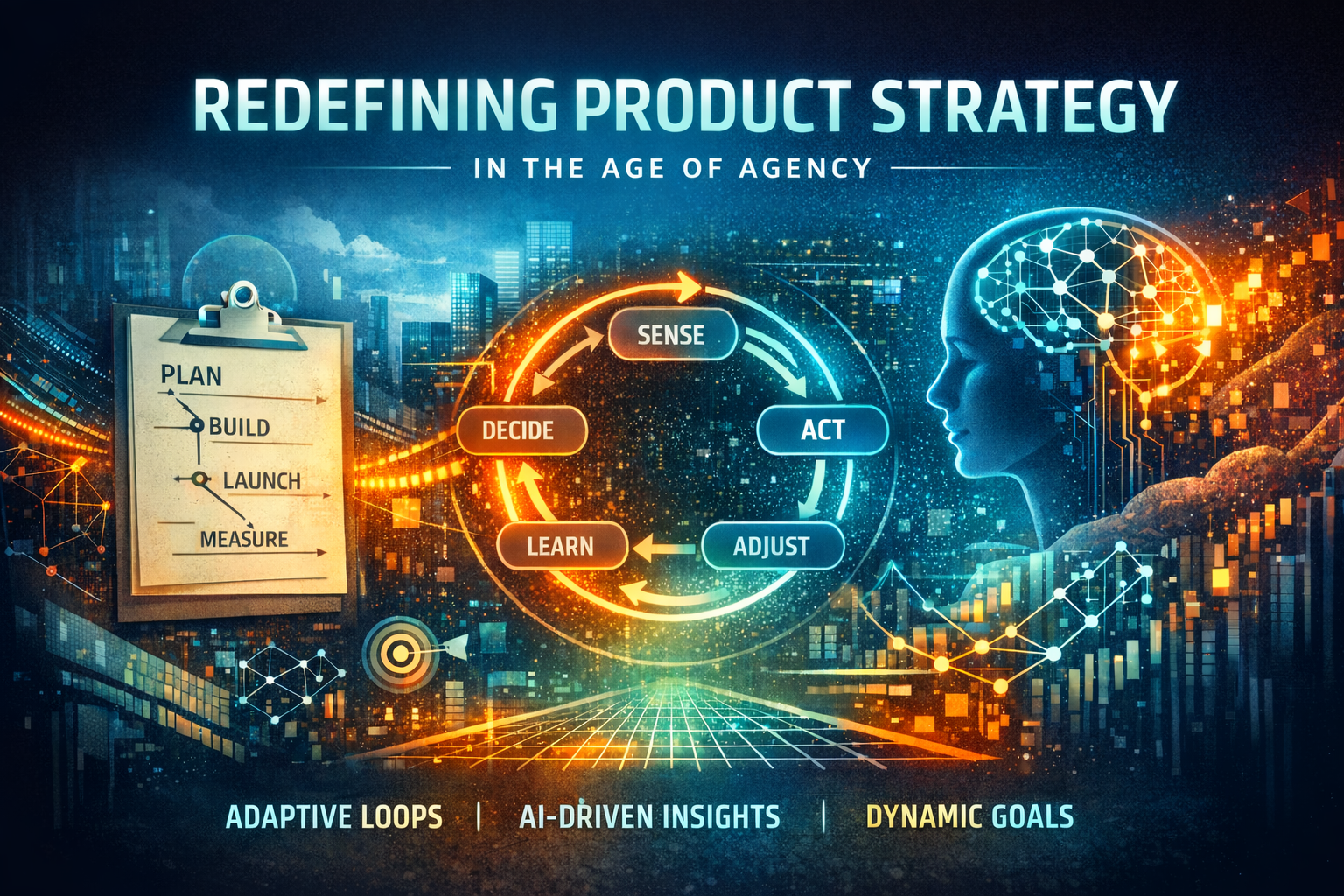
This is the second article in the comprehensive series on the Mapping Agentic AI to Product Strategy. You can have a look at the previous installation at the below link:
1. Why Traditional Strategy Models Break Under Autonomy
Every era of product management had a dominant model.
Waterfall emphasized control.
Agile emphasized iteration.
Lean emphasized learning.
Each model solved the constraints of its time.
Today the constraint has changed.
The constraint is no longer speed of delivery. It is speed of adaptation.
Traditional strategy follows a linear path.
Research.
Plan.
Build.
Launch.
Measure.
Repeat.
This model assumes clarity precedes action.
It assumes insight is episodic.
It assumes change happens between releases.
Agentic systems do not operate this way.
They sense continuously.
They decide continuously.
They act continuously.
They learn continuously.
There is no pause between planning and execution.
The loop never stops.
When you insert an always-learning system into a quarterly planning model, tension appears.
The system adapts faster than the governance model.
The roadmap becomes outdated before the sprint ends.
Leadership reviews lag behind system adjustments.
Strategy becomes reactive instead of directional.
The Linear Strategy Assumption
Linear strategy assumes stability.
It assumes the environment changes slowly.
It assumes competitors move predictably.
It assumes user preferences evolve gradually.
Those assumptions no longer hold.
AI-native startups release features weekly.
Pricing changes dynamically.
User behavior shifts in response to algorithmic nudges.
A linear model cannot manage a non-linear environment.
Autonomy introduces exponential dynamics.
Small optimizations compound quickly.
Minor signal shifts alter system behavior at scale.
Linear planning cannot anticipate exponential feedback.
Static Time Horizons vs Continuous Adaptation
Quarterly OKRs were designed for human coordination.
They align teams.
They define focus.
They create accountability.
But they were never designed to govern adaptive systems.
An agentic product does not wait for quarterly review.
It recalibrates daily.
If governance updates every 90 days and the system adapts every hour, misalignment grows.
Strategic drift becomes invisible.
The issue is not that OKRs are wrong.
The issue is cadence.
Human cadence is slow.
Machine cadence is fast.
Strategy must bridge the two.
Feature-Centric Thinking vs Outcome-Centric Systems
Traditional strategy organizes around features.
New dashboard.
New onboarding flow.
New pricing tier.
These are outputs.
Agentic systems organize around outcomes.
Increase activation.
Reduce churn.
Improve lifetime value.
Features become variables.
Not endpoints.
When AI dynamically adjusts flows, the concept of a fixed feature weakens.
The system experiments continuously.
It personalizes interfaces.
It modifies sequences.
You are no longer shipping static features.
You are supervising evolving behaviors.
Consider how HubSpot integrates AI into marketing automation.
Campaign sequences adjust based on user behavior.
Lead scoring updates in real time.
Optimization is continuous.
Strategy is no longer about which email to send.
It is about which objective the system optimizes.
That is the shift.
Strategy must move from feature roadmaps to adaptive control.
2. Strategy as a Control System
To understand agentic strategy, borrow from systems engineering.
A control system has inputs.
A processing core.
Outputs.
And feedback loops.
Product strategy must operate the same way.
Inputs
Inputs include market signals.
User interactions.
Retention curves.
Conversion rates.
Competitive moves.
Macroeconomic trends.
In the past, these inputs were reviewed periodically.
Now they stream continuously.
Every click is a signal.
Every drop-off is a signal.
Every pricing response is a signal.
Agentic systems absorb signals at scale.
The quality of inputs determines the intelligence of outputs.
Data governance becomes strategic infrastructure.
The Processing Layer
The processing layer transforms signals into insight.
Machine learning models detect patterns.
Reinforcement learning systems test variations.
Simulation engines predict outcomes.
Processing must align with goals.
If the goal is growth, models optimize acquisition and retention.
If the goal is risk reduction, models prioritize anomaly detection.
Processing without alignment creates noise.
Processing aligned to goals creates leverage.
Output Layer
Outputs are not static features.
They are system adjustments.
Interface changes.
Personalized recommendations.
Pricing shifts.
Notification timing.
Outputs affect users immediately.
When outputs improve outcomes, they reinforce goals.
When they degrade experience, feedback loops correct them.
Feedback Amplification
Feedback velocity determines competitive advantage.
If your system learns weekly and a competitor learns daily, you lose ground.
If your system experiments at small scale and adjusts globally, you compound faster.
Control systems thrive on rapid feedback.
Product strategy must be engineered for high-resolution learning.
The winner is not the team that builds the most features.
The winner is the team that learns the fastest.
3. From Roadmaps to Strategy Loops
Roadmaps create comfort.
They show direction.
They signal commitment.
They reassure stakeholders.
But comfort is not adaptability.
Agentic environments require loops.
Continuous loops.
The Roadmap Illusion of Certainty
Roadmaps imply predictability.
They assume the future is knowable.
But in AI-driven markets, change accelerates.
User expectations rise quickly.
Competitors replicate features faster.
Certainty decreases.
Clinging to static plans increases fragility.
The Strategy Loop Model
Replace roadmaps with loops.
Discover.
Hypothesize.
Simulate.
Deploy.
Observe.
Refine.
This loop never stops.
Discovery feeds hypotheses.
Hypotheses inform simulation.
Simulation reduces risk.
Deployment tests reality.
Observation captures feedback.
Refinement adjusts direction.
Then the loop begins again.
This is not chaos.
It is disciplined adaptation.
Autonomous Prioritization
Backlogs ranked manually cannot keep pace.
Agentic systems can score initiatives dynamically.
Impact probability.
User relevance.
Revenue potential.
These scores update as data changes.
Prioritization becomes predictive.
Consider experimentation platforms used by Airbnb.
Search ranking adjustments.
Pricing experiments.
UI tests.
These experiments run continuously.
Results inform rapid iteration.
Strategy becomes fluid.
Not fixed.
Resistance will appear.
Teams may fear loss of control.
Executives may demand predictability.
But adaptation is not disorder.
It is structured learning.
4. Designing Goals for Autonomous Systems
In an agentic world, goal design is the highest leverage activity.
Poorly defined goals produce unstable systems.
Clear goals create alignment.
Hierarchical Goal Architecture
Goals must cascade.
Enterprise objectives define direction.
Product objectives refine focus.
Micro-metrics guide daily optimization.
For example:
Enterprise goal: Increase profitability.
Product goal: Improve customer lifetime value.
Micro goal: Increase repeat purchase frequency.
Alignment prevents drift.
Without hierarchy, local optimization harms global outcomes.
Measurable Objective Encoding
Agentic systems require quantifiable targets.
Increase engagement by 10 percent.
Reduce churn by 5 percent.
Ambiguity confuses optimization.
Clarity guides behavior.
Avoiding Metric Gaming
When AI optimizes one metric aggressively, side effects emerge.
Maximizing engagement may reduce trust.
Maximizing clicks may degrade quality.
Single-metric optimization is dangerous.
Multi-Objective Optimization
Balance is essential.
Revenue.
Retention.
Brand integrity.
Regulatory compliance.
These goals may conflict.
Agentic systems must manage trade-offs.
Consider Netflix.
It optimizes engagement.
But it must also manage content diversity and cost.
Goal design is not trivial.
It is strategic craftsmanship.
5. Constraint Architecture as Strategic Power
Constraints define identity.
They define what the system must never violate.
Autonomy without constraints creates risk.
Constraints include ethics.
Compliance.
Brand tone.
Budget limits.
Constraints are not restrictions of innovation.
They are enablers of sustainable innovation.
They shape how autonomy behaves under pressure.
They prevent short-term optimization from damaging long-term value.
Strong constraint architecture creates resilience.
Ethical Constraints
Bias mitigation rules.
Fairness thresholds.
Transparency requirements.
These are not optional.
They protect trust.
Ethical constraints define acceptable behavior.
They prevent systems from exploiting vulnerable segments.
They ensure equitable treatment across user groups.
Fairness metrics must be measurable.
Bias audits must be continuous.
Transparency must be explainable in simple language.
Ethical oversight cannot be periodic.
It must be embedded in the system logic.
When ethics are encoded structurally,
Trust compounds over time.
Without ethical constraints,
Optimization becomes dangerous.
Regulatory Constraints
Data privacy laws vary by region.
Systems must adapt to jurisdictional requirements.
Constraint encoding ensures compliance.
Regulations evolve continuously.
Enterprises must update constraints proactively.
Data residency requirements differ across geographies.
Consent mechanisms must align with local standards.
Automated compliance checks reduce legal exposure.
Audit logs provide evidence during review.
Regulatory discipline protects reputation.
It reduces financial penalties.
Compliance cannot be manual afterthought.
It must be architectural foundation.
Brand Constraints
Tone matters.
Experience matters.
An autonomous system must reflect brand identity.
Constraints encode values.
Brand personality must be consistent.
Voice must align with positioning.
Customer experience must remain coherent across channels.
Autonomous responses must follow defined tone guidelines.
Personalization must not compromise dignity.
Brand constraints prevent drift.
They preserve identity during rapid adaptation.
Without brand discipline,
Autonomy becomes inconsistent.
Consistency builds recognition.
Recognition builds loyalty.
Financial Constraints
Inference costs matter.
Infrastructure costs matter.
Optimization must consider margin.
Every automated decision has cost implications.
Compute cycles consume capital.
Data storage scales expense.
Financial constraints align autonomy with sustainability.
They prevent over-optimization at excessive cost.
Model tiering strategies manage expenditure.
Cost-performance trade-offs must be explicit.
Profitability remains strategic objective.
Autonomy must enhance efficiency, not erode it.
Freedom creates innovation.
Constraints create discipline.
Strategy balances both.
Discipline ensures that innovation endures.
6. Contextual Learning as Competitive Moat
Context compounds advantage.
The more context a system accumulates, the better it adapts.
Intelligence without memory is shallow.
Intelligence with deep context becomes strategic.
Context transforms raw data into insight.
Insight transforms interaction into relevance.
Over time, contextual depth becomes difficult to replicate.
That difficulty creates moat.
Persistent User Memory
User history reveals patterns.
Preferences.
Purchase cycles.
Engagement rhythms.
Persistent memory enables tailored experiences.
It captures long-term behavior trends.
It detects subtle shifts in interest.
It anticipates needs before explicit request.
Memory connects past interactions to present decisions.
It reduces friction across sessions.
Returning users feel recognized.
Recognition increases loyalty.
Memory also refines prediction accuracy.
Each interaction strengthens model confidence.
Without persistent memory, personalization resets every time.
With memory, personalization compounds.
Compounding relevance increases retention.
Retention increases lifetime value.
Market Contextualization
Economic shifts influence behavior.
Seasonality changes demand.
Agentic systems can incorporate macro signals.
Interest rates impact purchasing patterns.
Supply chain constraints influence availability.
Market sentiment alters engagement dynamics.
Contextualization integrates external intelligence with internal data.
Competitive pricing changes inform response strategies.
Industry trends shape feature prioritization.
Macro awareness prevents blind optimization.
Systems adjust proactively rather than reactively.
Context moves strategy from isolated analysis to ecosystem awareness.
Ecosystem awareness strengthens resilience.
Resilience sustains growth.
Adaptive Personalization
Personalization moves beyond static segments.
Interfaces adjust dynamically.
Offers adapt in real time.
Messaging changes based on interaction context.
Navigation reorganizes based on intent signals.
Consider Amazon.
Its recommendations evolve with browsing behavior.
Purchase history refines ranking precision.
Consider Spotify.
Playlists adapt to listening patterns.
Discovery algorithms surface emerging preferences.
Adaptive personalization increases perceived relevance.
Relevance increases engagement.
Context creates defensibility.
The deeper the contextual understanding,
The harder it becomes for competitors to replicate experience.
But caution is required.
Privacy violations erode trust.
Over-personalization fatigues users.
Excessive prediction feels intrusive.
Transparency preserves comfort.
Context must enhance experience.
Not overwhelm it.
Balance defines sustainable personalization.
7. AI-Driven Competitive Intelligence
Competition is no longer episodic.
Feature launches happen frequently.
Pricing changes rapidly.
Market narratives shift daily.
Customer expectations evolve continuously.
Agentic systems can monitor signals continuously.
They scan public releases.
They analyze digital footprints.
They detect weak signals before they amplify.
Competitive intelligence becomes real-time capability.
Not quarterly analysis.
Speed of awareness determines speed of response.
Signal Detection
Track competitor releases.
Analyze user sentiment.
Monitor pricing updates.
Observe hiring patterns.
Detect technology stack changes.
Track partnership announcements.
Automated surveillance reduces blind spots.
Natural language models scan press releases instantly.
Sentiment engines analyze social conversations at scale.
Anomaly detection flags unusual shifts.
Early signal detection prevents surprise.
Surprise creates disadvantage.
Preparedness creates leverage.
Continuous signal monitoring strengthens situational awareness.
Awareness fuels strategy.
Predictive Competitive Modeling
Systems can simulate competitor reactions.
If price decreases, how does retention change?
If feature launches, how does churn shift?
If marketing spend increases, how does acquisition cost respond?
Simulation informs preemptive action.
Predictive modeling tests scenarios safely.
It evaluates risk before capital deployment.
Multiple response paths can be compared quickly.
Confidence levels guide executive decisions.
Modeling reduces guesswork.
It improves clarity under uncertainty.
Simulation transforms strategy from instinct-driven to evidence-informed.
Evidence strengthens positioning.
Strategic Preemption
The advantage goes to the fastest learner.
Not the loudest marketer.
Not the largest team.
The organization that detects shifts early gains time.
Time enables preparation.
Preparation enables dominance.
Continuous monitoring and rapid adjustment create resilience.
Preemption means acting before threat matures.
It means strengthening retention before churn spikes.
It means refining pricing before revenue declines.
Proactive systems build defensive barriers.
They also create offensive opportunity.
Strategy becomes proactive.
Not reactive.
Proactivity compounds advantage.
Learning velocity becomes strategic weapon.
8. Dynamic Value Creation Models
Value is no longer static.
Product-market fit is temporary.
Markets evolve.
Users evolve.
Technology evolves.
What creates value today may become baseline tomorrow.
Competitive advantage erodes quickly without adaptation.
Value must be continuously rediscovered.
Continuously revalidated.
Continuously optimized.
Static propositions weaken over time.
Adaptive propositions strengthen.
From Fit to Adaptation
Fit is a moment.
Adaptation is a process.
Product-market fit reflects alignment at a point in time.
Market-product adaptation reflects ongoing alignment.
Agentic systems sustain adaptation.
They monitor behavioral shifts.
They detect declining engagement patterns.
They adjust experience accordingly.
Adaptation reduces decay.
It preserves relevance under pressure.
Instead of asking, “Do we have fit?”
Organizations ask, “How fast are we adapting?”
Adaptation speed becomes strategic asset.
Fit creates entry.
Adaptation sustains dominance.
Real-Time Monetization Optimization
Pricing can adjust dynamically.
Monetization models must reflect real usage patterns.
Usage-based billing aligns value with consumption.
Subscription tiers adapt to engagement intensity.
Consider Uber.
Surge pricing responds to supply and demand.
Dynamic pricing increases efficiency.
It balances incentives.
It smooths volatility.
Real-time monetization increases margin precision.
It reduces revenue leakage.
Monetization becomes adaptive dialogue with market.
Revenue strategy evolves alongside user behavior.
Static pricing models cannot keep pace with fluid demand.
Dynamic monetization protects profitability.
Self-Optimizing Engagement Loops
Retention tactics evolve automatically.
Notifications adjust timing.
Recommendations shift tone.
Content prioritization adapts to context.
Onboarding flows refine continuously.
Self-optimizing loops reduce churn silently.
Small improvements accumulate.
Accumulation creates durable engagement.
Value becomes fluid.
Products no longer deliver static utility.
They deliver evolving relevance.
Relevance increases perceived value.
Perceived value increases loyalty.
Loyalty strengthens lifetime economics.
Dynamic value creation transforms product from artifact to adaptive system.
And adaptive systems outlast static ones.
9. Case Study: AI-Embedded Strategy in SaaS
Consider Notion.
It began as a productivity workspace.
Users created pages.
Organized tasks.
Shared knowledge.
Then AI integrated into the core workflow.
Writing assistance appeared inside documents.
Summaries generated automatically.
Ideas expanded instantly.
This integration changed strategy.
AI was not a plugin.
It was embedded in the experience.
User behavior generated data.
Data improved personalization.
Personalization increased retention.
The loop reinforced itself.
Lessons emerge.
Start with constrained autonomy.
Instrument feedback deeply.
Align AI behavior with product goals.
Protect user trust.
Embedding AI transforms competitive position.
10. The New Strategic Competencies for Product Leaders
The role evolves.
Old competencies are insufficient.
Roadmap planning is no longer primary.
Goal system design becomes critical.
Feature prioritization shifts to autonomous scoring oversight.
Stakeholder alignment expands to AI-human orchestration.
Metrics tracking evolves into feedback loop engineering.
Release management transforms into continuous optimization governance.
The modern product leader must understand:
Systems thinking.
Data architecture.
Ethical governance.
AI capabilities.
This is not technical depth alone.
It is strategic literacy.
The product leader becomes a systems strategist.
They design goals.
They define constraints.
They supervise adaptive loops.
They govern autonomy.
That is the redefinition.
11. Closing Reflection
Every strategic era has a defining principle.
Industrial strategy focused on scale.
Digital strategy focused on speed.
Platform strategy focused on network effects.
Agentic strategy focuses on adaptive intelligence.
Not static plans.
Not fixed roadmaps.
But living control systems.
When autonomy enters products, strategy must evolve.
From planning to designing adaptive loops.
From shipping features to supervising outcomes.
This is not incremental improvement. It is structural redesign.
The leaders who internalize this shift will build resilient systems.
The leaders who cling to static models will struggle.
Product strategy in the age of agency is not a document.
It is a dynamic architecture.
And architecture defines destiny.
References & Further Reading
- Agentic AI for Product Management: Autonomy & Next-Level Strategy
- Introduction To AI In Product Management
- The Role of Agentic AI in Rethinking Product Strategy
- AI Product Management: Innovate, Strategize & Lead with AI
- Agentic AI: How Autonomous AI is Transforming Enterprise Strategy
- Seizing the Agentic AI Advantage
- AI & Automation for Product Managers
- Product Management in the Agentic AI Era (Market & Skills Outlook)
- AI-First Product Management: The Shift Toward Autonomous Decision Systems
- AI-Driven Product Strategy – Executive Education (Kellogg)
- AI in Product Management: Top Use Cases You Need to Know
- From Prompt-Response to Goal-Directed Systems: The Evolution of Agentic AI Software Architecture
- Multi-AI Agent System for Autonomous Optimization via Iterative Feedback Loops
- Qualtrics President on Agentic AI in the Workplace
- Intelligent Decision Support System (IDSS) — Decision Support and AI Integration
Disclaimer: This post provides general information and is not tailored to any specific individual or entity. It includes only publicly available information for general awareness purposes. Do not warrant that this post is free from errors or omissions. Views are personal.