Mapping Agentic AI to Product Strategy - Part 5 - Dynamic Roadmapping and Predictive Prioritization

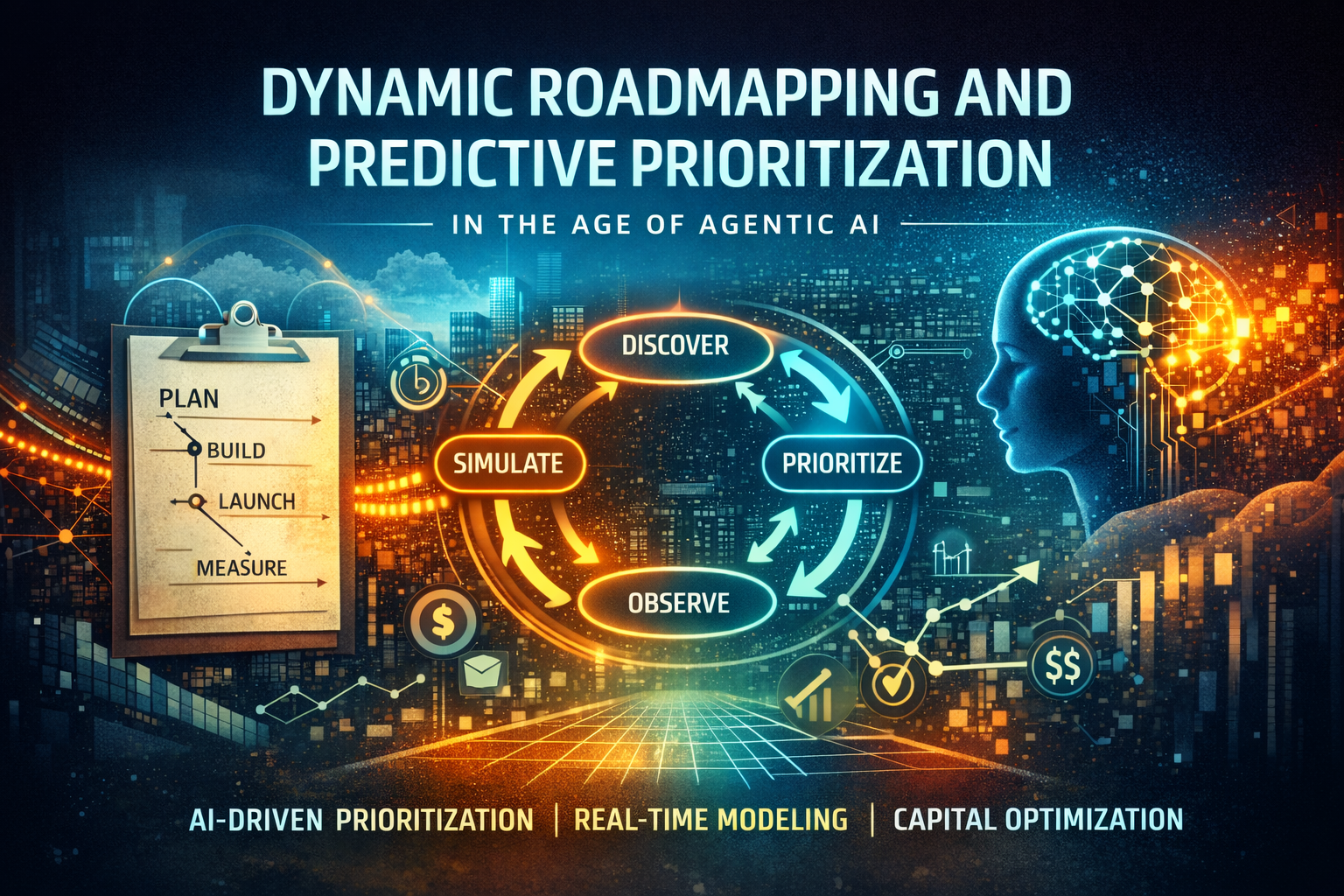
This is the fifth article in the comprehensive series on the Mapping Agentic AI to Product Strategy. You can have a look at the previous installation at the below link:
1. The Roadmap Illusion
Roadmaps create comfort.
They create slides.
They create timelines.
They create promises.
They signal control.
But comfort is not strategy.
Timelines are not certainty.
Promises are not probability.
In slower eras, roadmaps worked.
Markets moved gradually.
User expectations evolved slowly.
Competitors released features quarterly.
Today the landscape shifts weekly.
AI accelerates iteration.
Experimentation cycles shrink.
User behavior changes quickly.
Static roadmaps create hidden risk.
1.1 Roadmaps as Psychological Safety
Executives like predictability.
Investors like visibility.
Teams like clarity.
Roadmaps offer all three.
But predictability can be illusion.
A roadmap assumes stable assumptions.
Assumptions decay quickly in agentic markets.
When reality changes, static plans create friction.
Teams hesitate to pivot.
Stakeholders resist change.
Psychological safety becomes strategic rigidity.
1.2 The Predictability Myth
Forecasting functions well in stable systems.
It assumes relatively linear causality:
Past patterns extend into the future.
Agentic environments violate that premise.
Competitors detect signals instantly.
Users react in real time.
Algorithms adapt continuously.
One product move triggers cascading responses.
Feedback loops are exponential, not linear.
Linear projections fail in nonlinear systems.
A roadmap built on sequential assumptions cannot withstand compounding feedback.
In agentic markets, prediction without adaptation is fragility disguised as confidence.
1.3 Static Planning in Dynamic Markets
Quarterly commitments create lock-in.
Teams allocate resources months ahead.
Budgets freeze.
Capacity anchors.
But discovery continues. Signals evolve. Opportunities emerge unexpectedly.
Consider Amazon.
It commits to long-term themes. But execution adapts constantly.
Or Atlassian.
Experimentation informs iteration continuously.
Themes provide direction.
Flexibility enables adaptation.
Static roadmaps collapse under continuous intelligence.
Dynamic roadmaps evolve with it.
2. From Static Plans to Adaptive Roadmaps
Roadmaps must change form.
Not disappear.
But transform.
The objective is not to abandon planning. It is to modernize it.
Planning remains essential.
Rigidity does not.
In agentic markets, planning must become adaptive infrastructure instead of a static artifact.
2.1 Roadmaps as Hypotheses
Each initiative is a hypothesis.
A hypothesis about user behavior.
A hypothesis about revenue elasticity.
A hypothesis about retention dynamics.
A hypothesis about market timing.
Every backlog item embeds an assumption about cause and effect.
“If we build X, Y will improve.”
A roadmap, therefore, is not a delivery calendar.
It is a portfolio of structured bets.
Some bets will compound.
Some will stagnate.
Some will invalidate underlying assumptions.
The role of leadership is not to eliminate uncertainty. It is to manage it intentionally.
Agentic systems accelerate validation cycles.
They collect telemetry continuously.
They surface behavioral patterns in near real time.
They expose weak assumptions quickly.
In such an environment, initiatives must be framed with explicit success criteria, expected impact ranges, and confidence levels.
Roadmaps should communicate probability distributions instead of deterministic outcomes.
Confidence is earned through evidence, not asserted through timelines.
2.2 Theme-Based Roadmapping
Replace feature inventories with strategic themes.
Growth expansion.
Retention improvement.
Margin optimization.
Platform scalability.
Ecosystem leverage.
Themes express intent at the outcome level.
Features express implementation at the solution level.
Intent should remain stable longer than implementation.
Themes anchor direction.
They align teams around outcomes rather than outputs.
They create coherence across multiple initiatives.
Features remain fluid.
A feature is a tactic.
A theme is a strategic vector.
When signals change, tactics should evolve without destabilizing the overarching theme.
Themes endure because they are tied to durable business objectives.
Features evolve because they are experiments in achieving them.
This separation reduces emotional attachment to specific solutions while preserving strategic continuity.
2.3 Rolling Horizon Planning
Long-term vision remains stable.
Mission, positioning, and core differentiation should not oscillate with every signal.
However, execution must remain adaptive.
Rolling horizon planning introduces temporal stratification.
Commit firmly to near-term priorities.
Allocate resources with discipline over the next sprint or quarter.
Keep mid-term initiatives flexible.
Maintain optionality.
Refine based on emerging data.
Keep long-term plans directional, not prescriptive.
Long-term thinking defines ambition.
Short-term execution tests reality.
This layered structure prevents two common failure modes:
- Short-term reactivity that erodes strategy.
- Long-term rigidity that ignores evidence.
Rolling horizons create balance.
They provide clarity without rigidity.
Alignment without overcommitment.
Direction without delusion.
2.4 Feedback-Integrated Adjustments
Roadmaps must respond to telemetry.
In agentic ecosystems, telemetry is not a report.
It is a living stream of intelligence.
Discovery signals should not sit in dashboards.
They must influence prioritization.
If churn rises unexpectedly, reallocate effort toward retention drivers.
If engagement spikes within a niche workflow, accelerate investment.
If acquisition costs escalate, re-examine growth channels.
Feedback loops must be institutionalized.
Prioritization meetings should begin with signal analysis.
Resource allocation should reference behavioral data.
Strategic debates should incorporate real-time metrics.
Roadmaps must breathe.
Not quarterly recalibration.
Continuous refinement.
An adaptive roadmap behaves like a control system.
It senses.
It evaluates.
It adjusts.
In agentic markets, adaptability is strategic survival.
3. Predictive Prioritization Engines
Traditional prioritization frameworks rely heavily on estimation.
RICE.
ICE.
Weighted scoring spreadsheets.
Executive intuition.
These models assume humans can approximate impact with reasonable accuracy.
Sometimes they can.
Often they cannot.
Cognitive bias, political influence, incomplete data, and optimism distortion all influence scoring.
Agentic prioritization introduces predictive modeling into the equation.
Instead of estimating impact qualitatively, it models impact probabilistically.
Instead of debating opinions, it analyzes signals.
Prioritization evolves from negotiation to computation.
3.1 Predictive Impact Modeling
Impact should not be guessed.
It should be modeled.
Revenue uplift can be estimated probabilistically using historical elasticity patterns.
Retention shifts can be modeled through cohort behavior.
Adoption curves can be simulated using comparable feature launches.
Predictive impact modeling relies on:
- Historical analogues
- Behavioral telemetry
- Funnel conversion dynamics
- Marginal revenue contribution
- Sensitivity analysis
Instead of asking, “Do we think this will work?”
The system asks, “Based on prior signal patterns, what is the probability-adjusted expected value?”
Monte Carlo simulations can produce impact ranges rather than single-point forecasts.
Confidence intervals replace binary optimism.
Prediction does not eliminate uncertainty.
It quantifies it.
Quantification reduces bias.
It surfaces hidden assumptions.
It exposes overconfidence.
Predictive modeling shifts prioritization from narrative persuasion to statistical reasoning.
3.2 Multi-Factor Scoring
Impact alone is insufficient.
Effort matters.
Strategic alignment matters.
Risk exposure matters.
Opportunity cost matters.
Dependency complexity matters.
Multi-factor scoring integrates these dimensions into a composite index.
Each dimension is weighted.
Weights are not arbitrary.
They reflect strategic posture.
In growth phases, impact and speed dominate.
In optimization phases, margin and efficiency rise in weight.
In stabilization phases, risk containment and reliability take precedence.
Dynamic weighting allows the organization to express strategy numerically.
This creates alignment between executive intent and portfolio prioritization.
Scoring becomes adaptive rather than static.
As corporate objectives shift, scoring models shift.
As market conditions change, weights recalibrate.
Prioritization becomes a reflection of strategic state, not a frozen spreadsheet.
3.3 Scenario Simulation
Before committing capital, simulate reality.
What if a competitor lowers price by 15%?
What if adoption is 40% slower than projected?
What if infrastructure cost scales faster than revenue?
Scenario modeling stress-tests initiatives before execution.
It identifies fragility.
It reveals sensitivity to external shocks.
It surfaces nonlinear risk exposure.
Simulation allows teams to evaluate downside risk and upside variance simultaneously.
Rather than debating worst-case scenarios abstractly, leadership can quantify potential loss ranges.
Confidence becomes evidence-backed.
Resource allocation becomes more rational.
Initiatives that appear attractive under base-case assumptions may collapse under moderate stress.
Others may demonstrate resilience across multiple scenarios.
Predictive simulation transforms commitment from hopeful optimism to informed conviction.
3.4 Continuous Recalibration
Prioritization cannot be an annual or quarterly event.
Scores must update automatically.
As new telemetry flows in, projections adjust.
As user behavior shifts, impact probabilities change.
As market conditions evolve, risk multipliers recalibrate.
A feature once ranked highest may decline as marginal returns diminish.
Another, previously underestimated, may rise due to emerging signal strength.
Predictive engines should ingest:
- Real-time engagement data
- Revenue performance deltas
- Churn indicators
- Competitive intelligence signals
- Operational cost metrics
Re-ranking becomes continuous.
Prioritization transforms from a meeting to a mechanism.
It becomes a living system.
Consider the experimentation culture at HubSpot.
Growth initiatives are adjusted rapidly based on engagement analytics and conversion data.
Decisions are informed by signal velocity, not hierarchical persuasion.
Predictive prioritization shortens reaction time.
It reduces strategic drift.
It increases capital efficiency.
In agentic markets, the advantage is not just making good decisions.
It is updating them faster than competitors.
4. Real-Time Backlog Re-Ranking
Traditional backlogs are static within sprint boundaries.
They are groomed periodically.
Prioritized manually.
Locked for execution.
This model assumes stability during the sprint window.
Agentic systems operate differently.
They ingest live signals.
They recalculate expected value continuously.
They adjust priority dynamically.
The backlog becomes an adaptive queue rather than a fixed list.
Prioritization evolves from periodic review to algorithmic recalibration.
4.1 Dynamic Scoring Algorithms
Every backlog item carries a composite score.
Expected impact.
Confidence level.
Effort estimate.
Risk exposure.
Strategic alignment coefficient.
In agentic environments, these variables are not static.
Impact probabilities shift as telemetry updates.
Feasibility changes as dependencies clear or constraints emerge.
Effort estimates evolve as technical discovery progresses.
Dynamic scoring algorithms ingest new data and recompute rankings automatically.
A feature with rising engagement signals may climb.
An initiative facing new regulatory risk may decline.
Re-ranking is continuous.
However, automation does not eliminate product judgment.
The Product Manager reviews shifts, validates assumptions, and investigates anomalies.
The system calculates.
The PM interprets.
This separation increases speed without sacrificing accountability.
4.2 Priority Volatility Management
Unconstrained dynamism creates operational instability.
If priorities shift hourly, teams lose focus.
If rankings oscillate excessively, delivery confidence erodes.
Agentic prioritization must incorporate volatility controls.
Stability thresholds prevent disorder.
For example:
If ranking shift remains within a defined margin, updates remain automated.
If impact probability changes beyond a predefined percentage, a review is triggered.
If cumulative portfolio variance exceeds tolerance, governance intervention activates.
Small signal-driven adjustments remain frictionless.
Large structural shifts require deliberate evaluation.
This prevents reactive thrashing while preserving responsiveness.
The objective is not constant movement.
It is intelligent movement.
Volatility management transforms adaptive prioritization from chaos into controlled responsiveness.
4.3 Stability Windows
Execution demands focus.
Engineering teams require uninterrupted delivery intervals.
Context switching reduces throughput.
Unstable priorities increase cognitive load.
Stability windows protect execution integrity.
Within active sprint cycles, ranking freezes for committed items.
Between cycles, recalibration occurs.
This creates a dual-speed system:
- Operational stability during execution.
- Strategic adaptability between execution windows.
Balance is essential.
Too much rigidity delays opportunity capture.
Too much fluidity damages delivery reliability.
Stability windows institutionalize disciplined agility.
They protect team morale while preserving strategic responsiveness.
4.4 Human Oversight Controls
Agentic systems propose rankings.
They calculate probability-adjusted value.
They detect signal shifts.
They surface anomalies.
But they do not own strategy.
AI recommends.
Product leadership decides.
For low-impact adjustments, automation may proceed autonomously.
For high-impact shifts — significant resource reallocation, major directional pivots, or reputational risk exposure — human approval remains mandatory.
Oversight ensures:
- Strategic coherence.
- Ethical alignment.
- Cross-functional synchronization.
- Long-term intent preservation.
The Product Manager’s role evolves.
Not spreadsheet operator.
Not backlog sorter.
The PM becomes a steward of intent.
A curator of trade-offs.
A governor of algorithmic recommendations.
In agentic roadmapping, human judgment does not disappear. It ascends from calculation to calibration.
5. Opportunity Cost Modeling
Every decision carries exclusion.
Capital deployed here is unavailable there.
Engineering capacity assigned to one initiative delays another.
Strategic focus directed toward one objective defers competing ambitions.
Opportunity cost makes absence visible.
It quantifies what the organization forgoes when it commits.
In agentic environments, ignoring opportunity cost creates invisible drag.
Modeling it transforms prioritization from preference-driven to economically disciplined.
5.1 Cost of Delay
Delay is not neutral.
It has measurable economic impact.
Lost revenue from deferred feature release.
Lost engagement from unmet user needs.
Lost market share from slower innovation.
Lost strategic positioning when competitors move first.
Cost of delay converts time into financial exposure.
Instead of asking, “Can this wait?”
The system asks, “What is the weekly value erosion if it does?”
Delay cost can be modeled across dimensions:
- Incremental revenue per week
- Retention impact per cohort
- Competitive advantage decay
- Brand perception lag
- Quantify impact weekly or monthly.
Model revenue leakage curves.
Estimate engagement decay trajectories.
Simulate compounding disadvantage.
Visibility sharpens urgency.
When cost of delay becomes explicit, prioritization discussions mature.
Time is no longer abstract.
It becomes quantifiable economic risk.
5.2 Strategic Window Detection
Not all opportunities persist indefinitely.
Some are structurally time-bound.
Seasonal demand spikes.
Regulatory transitions.
Technology inflection points.
Consumer trend accelerations.
These create strategic windows.
Windows open.
Windows narrow.
Windows close.
Agentic systems can detect early signal convergence.
Search trend velocity.
Behavioral shifts.
Competitive positioning changes.
Policy announcements.
Predictive models identify acceleration inflection points.
Act early and leverage compounds.
Act late and differentiation erodes.
Window detection transforms reactive strategy into anticipatory positioning.
It allows organizations to allocate capital when asymmetry is highest.
Speed in such moments is not tactical.
It is strategic advantage.
5.3 Portfolio Trade-Off Simulation
Resources are finite.
Capital is finite.
Engineering capacity is finite.
Leadership attention is finite.
Resource allocation is inherently zero-sum.
Choosing growth may defer risk mitigation.
Investing in scalability may delay monetization.
Optimizing margin may slow expansion.
Trade-offs are inevitable.
Simulation makes them explicit.
Agentic systems can model portfolio allocation scenarios:
Increase growth investment by 20%.
Reduce technical debt allocation.
Accelerate platform modernization.
Each scenario generates projected outcomes.
Revenue impact.
Risk exposure.
Operational resilience.
Customer experience effects.
Simulations clarify consequences before commitment.
Instead of debating abstract preferences, leadership evaluates modeled outcomes.
This elevates prioritization from opinion to scenario-based reasoning.
5.4 Resource Scarcity Optimization
Capacity constraints are structural realities.
Headcount limits velocity.
Budget caps constrain experimentation.
Infrastructure limits scalability.
Scarcity forces discipline.
Agentic prioritization allocates resources toward initiatives with highest probability-adjusted expected return.
Expected value becomes the allocation anchor.
This does not eliminate judgment.
It introduces economic logic.
Opportunity cost becomes explicit in dashboards.
If Initiative A receives funding, Initiative B’s deferred value is displayed.
If engineering bandwidth shifts, downstream impact is visible.
Clarity reduces political negotiation.
When trade-offs are quantified, influence shifts from hierarchy to data.
Data does not remove disagreement.
But it narrows it.
Prioritization evolves from persuasive rhetoric to economic optimization.
In agentic markets, disciplined allocation is not optional.
It is the difference between strategic intent and strategic drift.
6. Resource Allocation in an Agentic Environment
Prioritization without resource alignment is fiction.
A ranked list without committed capacity is aspiration, not execution.
Strategy materializes only when capital, talent, and time align with modeled priorities.
In agentic environments, allocation must track predictive intelligence.
If expected value shifts, resources must follow.
Otherwise, the organization creates strategic lag — insight without action.
6.1 Dynamic Team Allocation
High-impact initiatives should attract capacity proportionate to their expected return.
If probability-adjusted impact rises, additional engineering bandwidth flows toward it.
If impact probability declines due to signal decay or new risk exposure, capacity is reallocated.
This introduces mobility into team structure.
Rigid team boundaries slow responsiveness.
Fluid capacity models increase adaptability.
Dynamic allocation does not imply constant reshuffling.
It implies structured flexibility.
Cross-functional pods can be redeployed between themes.
Platform teams can temporarily embed within growth initiatives.
Specialized skill clusters can surge where leverage is highest.
Team mobility becomes a strategic instrument.
It reduces time-to-reaction.
It prevents overinvestment in declining bets.
It accelerates scaling of validated opportunities.
In agentic systems, capacity is not static inventory.
It is strategic energy — directed where expected return is greatest.
6.2 Capital Efficiency Modeling
Financial allocation must reflect expected ROI, not historical habit.
Budget distribution should follow modeled probability-adjusted value.
Predictive engines can suggest capital distribution scenarios across initiatives.
They can estimate marginal return curves.
They can identify diminishing return thresholds.
They can highlight capital inefficiencies.
Low-confidence initiatives receive smaller exploratory investments.
Stage-gated funding protects downside exposure.
High-confidence initiatives, validated through telemetry, scale rapidly.
Capital concentration follows evidence.
This introduces venture-style portfolio logic inside product organizations.
Small bets validate assumptions.
Validated bets receive amplification.
Capital efficiency modeling reduces sunk cost bias.
Past investment does not justify future allocation.
Only forward-looking expected value does.
6.3 AI-Assisted Capacity Planning
Workload forecasting is traditionally reactive.
Teams estimate effort manually.
Planning errors accumulate.
Overcommitment leads to burnout.
AI-assisted capacity planning improves realism.
Historical velocity data informs forecasting.
Task complexity patterns improve effort estimation.
Dependency mapping identifies bottlenecks early.
Agentic systems can forecast workload demand under multiple prioritization scenarios.
If initiative A accelerates, what is the downstream impact on QA?
If initiative B delays, how does platform utilization shift?
AI models can optimize workload distribution across teams.
They balance throughput and sustainability.
They identify overutilization risk before it manifests as attrition or missed deadlines.
Capacity planning becomes predictive rather than corrective.
This reduces burnout.
It increases delivery reliability.
It improves morale by aligning ambition with feasible output.
6.4 Core vs Innovation Balance
Every product organization operates across two imperatives:
- Core stability.
- Future growth.
Core systems sustain revenue, reliability, and customer trust.
Innovation initiatives create expansion, differentiation, and long-term advantage.
Agentic prioritization must balance both simultaneously.
Over-invest in innovation, and operational resilience erodes.
Over-invest in core optimization, and growth plateaus.
Dynamic models can allocate portfolio percentages across:
Run (core operations).
Grow (adjacent expansion).
Transform (new capabilities).
Signal strength influences distribution.
If churn rises, core stability weight increases.
If market opportunity accelerates, innovation weight expands.
Equilibrium is not static.
It shifts with strategic posture, competitive pressure, and lifecycle stage.
Dynamic allocation models manage this equilibrium continuously.
They prevent emotional swings between conservatism and overreach.
In agentic environments, balance is not achieved through intuition alone.
It is sustained through modeled trade-offs and disciplined recalibration.
7. Risk-Aware Prioritization
Impact without risk assessment is dangerous.
High expected value initiatives can conceal disproportionate downside exposure.
In agentic environments — where iteration speed is high and scale is immediate — unmanaged risk compounds quickly.
Predictive prioritization must therefore integrate risk weighting directly into scoring models.
Expected value alone is insufficient.
Risk-adjusted expected value is the true prioritization signal.
This ensures acceleration does not outpace governance.
7.1 Regulatory Risk Weighting
Not all initiatives operate in neutral regulatory space.
Some intersect with data privacy laws.
Some trigger financial reporting obligations.
Some create cross-border compliance exposure.
High compliance exposure should reduce autonomous priority weighting.
Even high-revenue initiatives must absorb regulatory friction costs.
Predictive engines can assign regulatory risk multipliers based on:
- Data sensitivity classification.
- Jurisdictional footprint.
- Historical audit findings.
- Enforcement trend signals.
Sensitive features require staged rollout.
Limited release environments.
Geographic gating.
Progressive exposure thresholds.
Regulatory risk weighting does not eliminate innovation.
It sequences it responsibly.
The objective is to prevent regulatory surprise from undermining strategic momentum.
In highly regulated industries, risk-aware prioritization is not optional governance.
It is existential protection.
7.2 Ethical Risk Scoring
Agentic systems influence user behavior at scale.
That influence carries ethical exposure.
Potential bias in algorithms.
Privacy intrusion risks.
Manipulative engagement mechanics.
Disproportionate impact on vulnerable segments.
Ethical risk scoring modifies priority ranking.
Initiatives with high bias probability require fairness validation before scale.
Features with sensitive personalization need privacy-preserving architecture.
Scoring models can incorporate:
- Fairness confidence scores.
- Data provenance quality indicators.
- Explainability thresholds.
- User consent robustness.
Ethical weighting ensures short-term gains do not compromise long-term legitimacy.
It embeds responsible AI principles directly into prioritization logic.
In agentic markets, ethical missteps amplify quickly.
Risk-aware prioritization reduces that amplification before it occurs.
7.3 Brand Impact Modeling
Brand trust compounds slowly.
It erodes rapidly.
Aggressive monetization experiments.
Excessive notification strategies.
Opaque algorithmic decisions.
All can generate short-term metrics while weakening long-term perception.
Brand impact modeling introduces reputation sensitivity into prioritization.
Predictive engines can analyze:
- Customer sentiment trends.
- Net Promoter Score fluctuations.
- Churn correlation to feature exposure.
- Public discourse velocity.
If projected engagement gains correlate with trust degradation, priority weight adjusts downward.
Brand impact weighting protects durable enterprise value.
It forces leadership to confront second-order effects.
Short-term optimization cannot override long-term brand equity without explicit acknowledgment.
Sustainable growth depends on perceived integrity.
Risk-aware prioritization defends that asset proactively.
7.4 Confidence-Weighted Decision Making
All projections carry uncertainty.
Some initiatives have deep historical analogues and strong signal correlation.
Others operate in unexplored territory.
Confidence-weighted decision making adjusts scale relative to certainty.
Low-confidence projections require phased validation.
Smaller capital deployment.
Limited user cohorts.
Measured exposure increments.
High-confidence initiatives scale quickly.
They receive concentrated resources.
They accelerate rollout velocity.
They compound advantage.
Confidence scores can be derived from:
- Data sufficiency levels.
- Model variance.
- Historical prediction accuracy.
- Assumption sensitivity analysis.
This creates a structured experimentation gradient.
High uncertainty leads to exploration.
High certainty leads to exploitation.
Risk-adjusted prioritization protects enterprise resilience.
It balances ambition with prudence.
In agentic environments, speed is power — but disciplined speed is durability.
8. Governance in Dynamic Planning
Dynamic planning without governance becomes instability.
Adaptive systems must remain intelligible to leadership.
If prioritization shifts are not explainable, confidence erodes.
Executives must understand not only what changed, but why it changed.
Transparency converts algorithmic movement into strategic clarity.
Governance ensures adaptability operates within defined guardrails.
8.1 Executive Transparency
Dashboards must do more than display rankings.
They must explain ranking logic.
Impact probabilities should be visible.
Risk factors should be explicit.
Confidence intervals should be displayed.
Weighting coefficients should be traceable to strategic objectives.
Executives need to see:
- What signals triggered a re-rank.
- Which assumptions changed.
- How projected ROI shifted.
- What risk multipliers were applied.
Visualizations should include trend trajectories, not just point-in-time scores.
Movement over time reveals systemic patterns.
Transparency builds trust.
When leadership understands the computational logic, they are more likely to support adaptive decisions.
Opaque AI recommendations create resistance.
Explainable prioritization fosters alignment.
In agentic environments, interpretability is governance.
8.2 Audit Trails
Every ranking shift should be logged.
Timestamped.
Attributed to signal change.
Linked to specific data inputs.
Decision rationale must be recorded automatically.
If a feature drops in priority, the system should document:
- Decline in projected adoption.
- Increase in regulatory exposure.
- Reduction in strategic alignment weight.
Traceability reduces uncertainty.
It enables retrospective analysis.
Leadership can evaluate:
- Were projections accurate?
- Did weighting logic perform as intended?
- Were shifts justified by signal strength?
Audit trails also strengthen compliance posture.
In regulated industries, being able to reconstruct decision logic is essential.
Governed adaptability ensures agility does not undermine accountability.
Every adaptive move leaves an analytical footprint.
8.3 Portfolio Oversight
While individual backlog items re-rank dynamically, aggregate portfolio distribution requires executive stewardship.
The CPO (or equivalent product executive) oversees macro-allocation across strategic categories:
- Growth allocation.
- Risk mitigation.
- Core platform investment.
- Innovation exploration.
- Operational resilience.
Dynamic prioritization should not distort portfolio balance unintentionally.
If growth initiatives dominate disproportionately, risk exposure may rise.
If risk mitigation absorbs excessive capacity, competitive momentum may decline.
Portfolio-level dashboards must track allocation percentages and trend shifts.
This ensures dynamic reprioritization remains strategically coherent.
Dynamic does not mean chaotic.
It means structured adaptability.
Governance provides that structure.
It defines thresholds.
It sets weighting principles.
It enforces review mechanisms.
In agentic planning, governance is not a brake.
It is the stabilizing architecture that enables safe acceleration.
9. Case Study: Adaptive Roadmapping in Practice
Consider Amazon.
Long-term themes remain consistent.
Customer obsession.
Operational excellence.
Execution adapts continuously.
Pricing experiments adjust quickly.
Recommendation algorithms refine constantly.
Themes stable.
Tactics fluid.
Or consider Atlassian.
Experimentation informs roadmap updates.
User feedback integrates into iteration loops rapidly.
Both demonstrate pattern.
Strategic direction anchored.
Operational prioritization dynamic.
Adaptive roadmapping increases resilience.
10. The Evolving Role of the Product Leader
The product leader changes profoundly.
Old role focused on roadmap ownership.
Defend priorities.
Negotiate trade-offs.
Manage delivery timelines.
New role becomes portfolio orchestrator.
Interpret signals.
Supervise predictive engines.
Balance risk and growth.
Competency Evolution
Data fluency becomes essential.
Financial modeling literacy increases influence.
Governance understanding ensures compliance.
Systems thinking replaces feature obsession.
The product leader becomes allocator of intelligence.
Not just allocator of tasks.
Closing Reflection
Roadmaps once defined product discipline.
In an agentic era, adaptability defines discipline.
Static commitments create fragility.
Dynamic prioritization creates resilience.
Hypotheses replace promises.
Probabilities replace certainty.
Signals drive ranking.
Governance ensures stability.
Opportunity cost becomes visible.
Resource allocation becomes strategic.
Dynamic roadmapping does not remove accountability.
It strengthens it.
It aligns execution with real-time intelligence.
When prioritization becomes predictive,
Strategy becomes adaptive.
And adaptive strategy defines enduring advantage.
References & Further Reading
- The Eight Essentials of Innovation – McKinsey & Company
- Agile Roadmaps – Atlassian
- What Is a Product Roadmap?
- Amazon Leadership Principles (Long-Term Thinking & Data-Driven Decisions)
- MLOps: Continuous Delivery and Automation – Google Cloud Architecture
- Best 5 AI Powered Prioritization Models For Product Roadmaps
- Why an effective AI product roadmap is needed and how to build one
- Product Roadmap 2025 Guide with Examples & Templates
- How to Create a Product Roadmap that Aligns with Your Strategy
Disclaimer: This post provides general information and is not tailored to any specific individual or entity. It includes only publicly available information for general awareness purposes. Do not warrant that this post is free from errors or omissions. Views are personal.