Agent Runtime Environment (ARE) in Agentic AI — Part 1 - The Operating Layer for Autonomous Intelligence

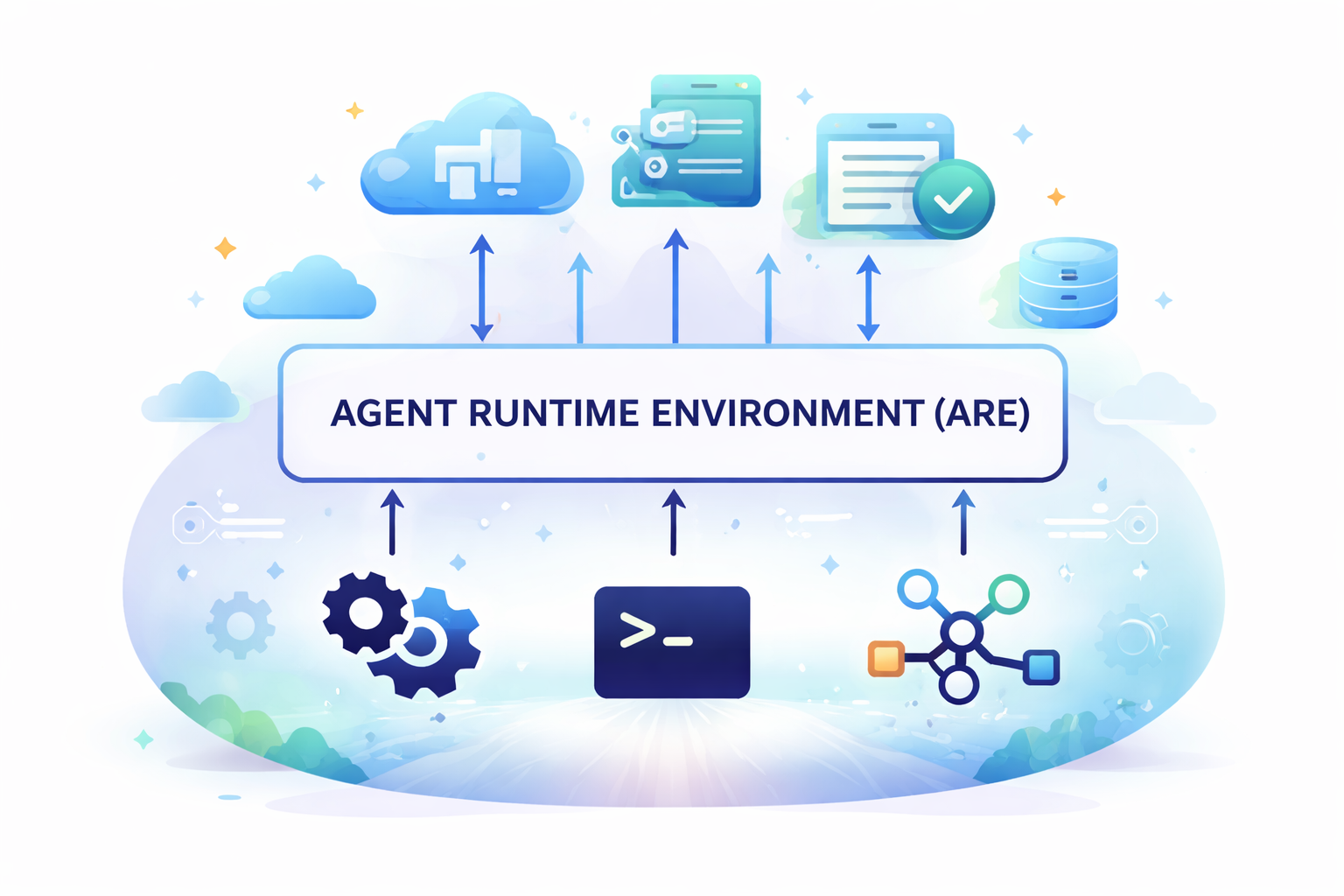 This article is the first in a multi-part series, Agentic AI – Agent Runtime Environment (ARE), which explores the architectural, operational, and governance foundations required to run AI agents safely and at scale.
As Agentic AI moves from academic novelty to enterprise reality, the Agent Runtime Environment (ARE) emerges as a foundational layer that determines whether autonomous agents operate reliably, safely, and at scale. Simply put, ARE is the execution substrate that turns static models into dynamic, goal-driven systems capable of prolonged action, composability, and interaction with systems outside themselves.
In the world of agentic AI — where autonomy, context, planning, and tool use replace one-shot prompt/response models — ARE is not optional infrastructure: it’s the runtime backbone that enables intelligent agents to live in production systems.
What is an Agent Runtime Environment?
At its core, an ARE is a software execution environment purpose-built for AI agents rather than traditional applications. It provides the services, operational guarantees, and governance primitives that let agents instantiate, run, communicate, access tools, and interact with external systems over extended periods. This goes far beyond the ephemeral execution models of classic serverless or microservices workloads.
“The Agent Runtime Environment (ARE) is the foundation where... AI agents operate and execute their tasks. It provides the necessary computational resources, interfaces, and security layers that allow agents to run smoothly, interact with users, and access required data securely.”
In distributed frameworks like AutoGen, a runtime also manages agent identities, lifecycles, and communication channels, effectively coordinating how agents interact with each other and the world.
ARE is not just a dispatcher — it’s the execution canvas for autonomous reasoning and action.
Why are runtimes critical for Agentic AI
Unlike stateless LLM interfaces, agentic AI systems:
- Run autonomously over long durations, reasoning across steps rather than answering in one shot.
- Maintain memory & context, required for coherent multi-step workflows.
- Invoke external tools, APIs, and unbounded operations, including code execution if permitted.
- Collaborate across multiple agents, forming multi-agent systems with emergent behaviors.
These characteristics introduce operational dimensions that no generic web framework, container cluster manager, or serverless platform can handle by default — hence the need for ARE.
Technical definers like OpenAI explicitly include runtime as one of four core agent components:
Agent = Model + Instructions + Tools + Runtime designed to support dynamic, continuous execution with statefulness and tool interactions.
Key responsibilities of an agent runtime environment
A production-grade ARE must support several essential domains:
Lifecycle & Resource Management
- Initialize, scale, and terminate agent instances safely.
- Provide dynamic resource allocation for CPU, memory, network, and storage.
- Ensure isolation and sandboxing so that one agent cannot crash others or consume unbounded resources.
This is far more sophisticated than simply spinning up processes — it requires real-time control loops, policy enforcement, and observability.
State, Memory & Context Management
Agents need long-lived context, not ephemeral token windows. AREs implement:
- Memory stores for context between steps.
- State checkpoints for durability and recovery.
- Consistency across distributed systems when multiple agents collaborate.
This addresses the key operational failure patterns enterprises see when deploying agents: state loss, inconsistent behaviors, and uncoordinated multi-agent interactions.
Tool Integration & Execution
AREs provide adapters or connectors for:
- Databases
- External APIs
- Custom enterprise systems
- Secure command execution sandboxes
Tool invocation must be safe and auditable — especially where agents can run real code or interact with critical systems.
Security, Governance & Compliance
Safety in agentic AI isn’t just encryption: it’s runtime governance.
This includes:
- Permission boundaries before invoking sensitive tools.
- Audit logging of actions and decisions.
- Policy engines enforcing risk controls.
- “Human-in-the-loop” approvals for high-impact actions.
These runtime-level safety controls are central to enterprise trust in autonomous agents.
Observability, Debugging & Telemetry
Real-world agent execution must be monitored with:
- Metrics on success/failure, latencies, tool usage.
- Traces for debugging agent decisions.
- Event logs for compliance auditing.
This transforms opaque AI behaviors into enterprise-grade observability pipelines.
Architectural Patterns in ARE
Two fundamental runtime patterns have emerged:
Standalone Runtime
It’s essentially a single execution context (like a Python script or a single Docker container).
The Nuance: In a standalone ARE, State is volatile. If the process crashes, the agent loses its "train of thought" unless you’ve manually built a checkpointing system.
Best Use Case: Single-user assistants, edge computing where latency must be near-zero, and "Disposable Agents" that perform a task and die.
Distributed Runtime
Agents may run on separate processes, languages, or machines, coordinated through a hosting orchestration layer. It treats agents like microservices.
The Nuance: This requires a State Store (like Redis or MongoDB) that sits outside the agents. If Agent A (the Researcher) crashes, Agent B (the Writer) can pick up the state from the external store without missing a beat.
The Orchestration Layer: In this pattern, you aren't just running agents; you're running a Message Broker. Agents communicate via "Asynchronous Events" rather than direct function calls.
There is an emerging middle ground that is becoming the industry standard for security:
The Sidecar/Isolated Execution Pattern
In this model, the Reasoning (the LLM logic) stays in a distributed orchestrator, but the Execution (the actual code running) happens in a "Sidecar" sandbox.
Why it matters: You don't want your "Finance Agent" running Python code on the same machine that holds your "Legal Agent's" memory.
Mechanism: The ARE spins up a micro-VM (like Firecracker or an E2B sandbox) for every single action. It’s distributed at the execution level but centralized at the logic level.
If you are building for an enterprise today, don't just go "Distributed" for the sake of it. Go Distributed for Persistence (so agents don't forget) and use Sidecars for Safety (so agents don't break things).
Enterprise Applications and Operational Guarantees
As agentic AI moves from experimentation into core business workflows, the runtime environment becomes the decisive enterprise control point. Platforms such as AWS Bedrock AgentCore exemplify this shift by treating the agent runtime as a first-class, serverless production service rather than a developer-side orchestration hack. In this model, agents execute within a managed runtime that provides native identity, scoped permissions, memory persistence, observability, and lifecycle isolation out of the box. The runtime is responsible not just for “running prompts,” but for enforcing execution boundaries, managing state across long-lived interactions, and ensuring that every action taken by an agent is attributable, auditable, and reversible. This reframes agent deployment from model hosting to operational systems engineering, where reliability, governance, and cost control are non-negotiable.
Industry consensus is increasingly converging on the idea that the Agent Runtime Environment is the operating system for autonomous digital workers. Just as modern enterprises would never deploy human employees without identity, access controls, process supervision, and performance monitoring, agentic systems cannot be deployed safely without a runtime that provides equivalent guarantees. Absent a robust ARE, agents risk nondeterministic execution, loss of contextual continuity across tasks, uncontrolled tool invocation, and violations of security or compliance policies. In production settings—where agents interact with financial systems, customer data, infrastructure, or regulated workflows—the runtime is the mechanism that converts probabilistic intelligence into predictable, governable execution. In this sense, ARE is not an implementation detail; it is the foundation that determines whether agentic AI remains a research curiosity or becomes a trusted, scalable enterprise capability.
The Five Design Principles of a Modern ARE
When evaluating or building an ARE, use the following criteria as your North Star.
| Design Principle | What It Means | Impact on the Business |
|---|---|---|
| Durable Execution | The ability to persist state through restarts, handle long-running retries, and recover from network timeouts. | Resilience: Agents don't "give up" or forget what they were doing during a glitch. |
| Security First | Permission boundaries (IAM), "Least Privilege" tool access, and immutable audit logs. | Trust & Compliance: Prevents "Confused Deputy" attacks and ensures every action is auditable. |
| Observability | Going beyond logs to include Distributed Tracing of the agent's reasoning steps and tool outputs. | Operational Insight: You can debug why an agent made a decision, not just what it did. |
| Interoperability | Support for standard APIs (like MCP) and flexible adapters for legacy internal tools. | Extensibility: Your agents aren't locked into one vendor and can grow with your tech stack. |
| Scalability | Distributed orchestration that handles thousands of concurrent agents without context collision. | Enterprise Throughput: Supports massive digital worker fleets (e.g., an agent for every customer). |
To move from research prototypes to production-grade agentic systems, an Agent Runtime Environment (ARE) must provide explicit operational guarantees. Without these guarantees, autonomy becomes operational risk. At minimum, three guarantees are non-negotiable.
-
Context Isolation (The "Clean Slate" Policy): Every task should trigger a fresh runtime environment. Never let "Session A" influence "Session B" through leftover local files. This prevents Prompt Injection Persistence, where a malicious user tricks an agent into writing a "permanent" instruction to its own local disk.
-
The "Human-in-the-Loop" (HITL) Gateway: Your ARE should have a built-in Escalation Protocol. If an agent's confidence score drops or if it attempts a "Level 1" risk action (like wire transfers or database schema changes), the runtime must pause and wait for a signed cryptographic token from a human supervisor.
-
Stateful Memory Management: Treat memory as a tiered system.
- L1 (Working): The agent maintains the immediate context required for reasoning within the current execution loop.
- L2 (Episodic): Captures the history and artifacts of the current task or project and is managed by the runtime to preserve continuity across steps
- L3 (Semantic): Represents long-term organizational knowledge, typically stored in a vector database, and is used to ground decisions in authoritative corporate context..
Together, these three guarantees—context isolation, HITL governance, and tiered memory—form the minimum operational contract an ARE must uphold to transform agentic AI from an experimental capability into a trustworthy enterprise system.
Conclusion
The future of agentic AI isn’t about better LLMs alone — it’s about robust operationalization. ARE is the runtime layer that transforms models into autonomous systems, bridging human goals with complex infrastructure.
In effect, ARE is the operating environment where intelligence meets application reality — a layer that must combine:
- operational rigor,
- safety and governance,
- long-horizon decision support,
- multi-agent collaboration,
- and enterprise reliability.
The maturity of your Agent Runtime Environment will directly determine whether your agentic AI initiative stays in demos or becomes a production-ready, enterprise-grade autonomous system.
References & Further Reading
- https://docs.mindcp.ai/agent-runtime-environment
- https://microsoft.github.io/autogen/0.5.5/user-guide/core-user-guide/core-concepts/architecture.html
- https://uxmag.com/articles/agent-runtime-a-guide-for-technical-teams
- https://www.daytona.io/dotfiles/ai-agents-need-a-runtime-with-a-dynamic-lifecycle-here-s-why
- https://www.griddynamics.com/blog/agentic-ai-deployment
- https://arxiv.org/abs/2508.03858
- https://www.techradar.com/pro/aws-looks-to-super-charge-ai-agents-with-amazon-bedrock-agentcore
- https://uxmag.com/articles/an-operating-system-for-organizations-why-every-business-product-and-design-leaders-need-agent-runtime-environments
- https://uxmag.com/articles/beyond-spreadsheets-why-ai-agent-runtimes-are-the-next-operating-layer
- https://www.nexastack.ai/platform/agent-runtime/
- https://architect.salesforce.com/fundamentals/agentic-enterprise-it-architecture
- https://www.geeksforgeeks.org/agent-environment-interface-in-ai/
- https://decisioninsights.ai/term/agent-runtime-environment-are/
- https://e2b.dev/docs
- https://aws.amazon.com/bedrock/agentcore/
- https://www.docker.com/blog/docker-e2b-building-the-future-of-trusted-ai/
- https://www.microsoft.com/en-us/security/blog/2026/01/23/runtime-risk-realtime-defense-securing-ai-agents/
Disclaimer: This post provides general information and is not tailored to any specific individual or entity. It includes only publicly available information for general awareness purposes. Do not warrant that this post is free from errors or omissions. Views are personal.