Agent Runtime Environment (ARE) in Agentic AI — Part 2 - Execution Engine/Context

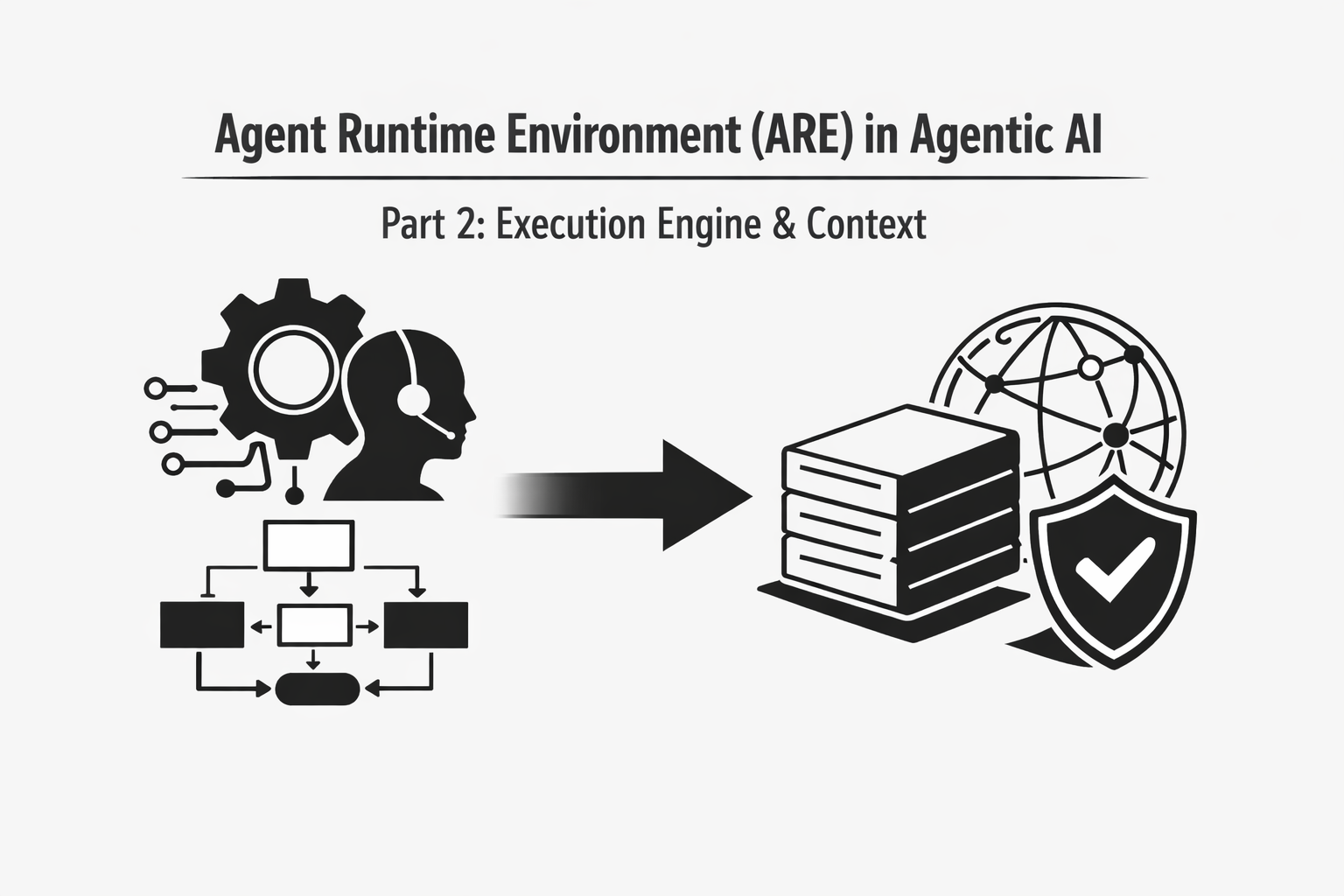
In Part 1 of this series, we introduced the Agent Runtime Environment (ARE) as the foundational layer that allows autonomous agentic systems to move beyond stateless LLM calls into stateful, long-running, and tool-enabled behaviors with persistent context, coordination, and governance primitives that make agents reliable and production-ready.
In this article — Part 2 — we peel back the curtain on two core pillars of ARE:
- the Execution Engine — where decisions transform into actions; and
- the Context Fabric — the substrate that grounds reasoning in situational reality.
Understanding both is essential to building agentic systems that are robust, safe, and scalable.
From Reasoning to Action: What the Execution Engine Really Is
If the agentic AI’s “brain” is reasoning and planning, then the Execution Engine is its motor system — the machinery that turns intent into operations across diverse digital endpoints.
In traditional LLM workflows, generation ends with text: “Here’s what you should do.” In an agentic system with an Execution Engine, planning is followed by controlled action. The engine does the heavy lifting of:
- Interpreting plans or goals from the reasoning layer
- Sequencing operations across APIs, services, and workflows
- Managing state transitions and side effects
- Handling errors, retries, and fallback paths
- Maintaining isolation and governance for untrusted code execution
Execution engines act as workflow interpreters, not mere function invokers. They ensure actions occur in the right order, with context, resource management, and safety controls — transforming decisions into reliable outcomes in real-world systems.
Why Execution Engines Are More Than Orchestration Frameworks
It’s tempting to equate the Execution Engine to traditional workflow or orchestration tools like Airflow, temporal schedulers, or AWS Step Functions. But agentic Execution Engines differ in key ways:
- Dynamic task decomposition: They don’t just follow predefined DAGs; they interleave planning with execution, adapting plans as results arrive, new context is integrated, or failures occur.
- Proactive control loops: Agents can loop, replanning, and self-correct mid-execution, reducing brittleness in long-horizon tasks.
- Tool integration at runtime: Beyond API calls, agents leverage tools (including code execution, database writes, or infrastructure actions) as first-class actuators, with fine-grained governance.
In short, the Execution Engine is a runtime control layer that sits between the reasoning component of an agent and the systems it manipulates — ensuring actions are executed with context, control, and recoverability.
The Glue That Makes Execution Meaningful: Context
An agent’s ability to make good decisions depends on the integrity and accuracy of its context — which the Execution Engine continually uses to interpret goals, actions, and environment state.
In agentic AI, context isn’t an ephemeral prompt history; it is a runtime substrate composed of multiple layers of structured knowledge and state:
What “Context” Really Means in ARE
At runtime, context includes:
- Instructional Context — high-level goals, rules, and task definitions that shape execution intent.
- Operational Context — recent actions, execution state, errors, and intermediate results that inform subsequent steps.
- Environmental Context — real-time data from external systems, including metrics, logs, or sensor/state information.
- Governance Context — permissions, policies, and boundaries that constrain actions to be safe and compliant.
This multi-dimensional context is continuously synchronized and validated so agents act on current truth, not stale snapshots — a necessity for safe and predictably autonomous execution.
Context Sync and Integrity
Context must be accurate, up to date, and scoped to avoid missteps, contradictions, or unsafe choices. This demands real-time context syncing mechanisms that pull updates from live systems, pipelines, logs, and state stores — ensuring agents reason with correct situational awareness.
For example, if an agent is automating a deployment pipeline, operational context includes current pipeline status, version drift, deployment history, policies, and authorization scopes. These are not static — they evolve as external systems change and as the agent executes tasks.
When context is stale, agents make decisions based on outdated assumptions — a key source of failure in autonomous systems.
The Interplay: Execution Engine + Context Fabric
Together, the Execution Engine and Context Fabric enable a runtime where agents act with both precision and prudence:
Deterministic Execution Flows
Execution engines consume context continuously, enabling:
- Stateful operations that persist across agent steps
- Decision branches contingent on real environment signals
- Automated recovery paths based on real-time failure diagnostics
For instance, if an agent’s API call fails due to a timeout, the Execution Engine can consult context (e.g., past success rates, current load) and decide whether to retry, escalate, or alternative route.
Safety and Policy Enforcement
Agents with direct access to production systems pose risks. The Execution Engine enforces sandboxed execution, resource limits, and governance constraints — always consulting the governance context to ensure decisions are within defined policies.
This is akin to how a language runtime enforces memory and process boundaries, except it includes permission controls, audit trails, logging, and access governance.
Looking Ahead: Runtime as a Coordinating Fabric
As agentic AI systems mature, the runtime can no longer be treated as a thin execution wrapper around a model. It becomes a coordinating fabric — the connective tissue that aligns cognition, action, and control into a coherent operational whole. When modular planning and reasoning layers are decoupled from execution, agents gain flexibility: plans can be revised, strategies swapped, and reasoning upgraded without destabilizing downstream systems. This modularity is what allows agentic systems to evolve continuously rather than being hard-wired to a single reasoning pattern.
At the same time, execution engines that translate intent into controlled action act as the stabilizing force. They impose structure on autonomy — sequencing steps, managing state transitions, handling failures, and enforcing retries or compensating actions. Instead of brittle, one-shot task completion, agents operate through durable execution flows that can pause, resume, adapt, and recover. This is the difference between an agent that “tries something once” and an agent that can reliably carry responsibility over long-running, multi-step objectives.
What ultimately grounds this autonomy is the context substrate. By continuously synchronizing live system state, environmental signals, and governance constraints, the runtime ensures that every decision is made against current truth — not stale assumptions. Context becomes the shared contract between reasoning and execution: it tells the agent what is permissible, what has already happened, what is changing, and what risks must be respected. Without this substrate, scale amplifies error; with it, scale amplifies reliability.
Together, these elements transform the runtime into an enterprise-grade coordination layer. This is where agentic AI crosses the threshold from experimental prototypes to trusted production systems. Observability becomes intrinsic — every decision, action, and state transition can be inspected and audited. Accountability is enforceable — policies, permissions, and human override points are embedded in execution, not bolted on after failures. And operator control is preserved — even as execution paths evolve dynamically, humans retain visibility, governance, and the ability to intervene.
In this future, the Agent Runtime Environment is not just where agents “run.” It is where autonomy is shaped, constrained, and made safe — the foundation that allows organizations to delegate meaningful work to AI systems without surrendering control.
Conclusion
In Part 1, we established the Agent Runtime Environment (ARE) as fundamental to agentic AI’s shift from static prompt-response behavior to autonomous, goal-driven systems. In this Part 2, we drilled into the Execution Engine and Context, the runtime components that give agents the ability to act with situational awareness and governance.
In forthcoming installments, we will explore memory management, state and workflow management, and more that keep agentic AI aligned with human intent and enterprise constraints.
References & Further Reading
- https://www.linkedin.com/pulse/agent-runtime-environment-agentic-ai-part-1-sanjoy-kumar-malik-shsnc
- https://www.griddynamics.com/blog/agentic-ai-deployment
- https://medium.com/%40azirotechnologies/agentic-ai-action-layer-how-tools-apis-and-execution-engines-drive-real-autonomy-ad43bf1b6cfe
- https://articles.intelligencestrategy.org/p/agentic-ai-components
- https://medium.com/%40bijit211987/context-engineering-is-runtime-of-ai-agents-411c9b2ef1cb
- https://www.kubiya.ai/blog/agentic-context-engineering
- https://www.nexastack.ai/platform/agent-runtime/
- https://temporal.io/blog/of-course-you-can-build-dynamic-ai-agents-with-temporal
- https://docs.restate.dev/tour/vercel-ai-agents
- https://www.sakurasky.com/blog/missing-primitives-for-trustworthy-ai-part-4/
- https://www.globallogic.com/insights/blogs/engineering-agentic-ai-fabric/
- https://www.merge.dev/blog/ai-agent-governance
- https://www.unframe.ai/blog/scaling-agents-safely-why-context-not-prompts-defines-enterprise-ai
- https://camunda.com/blog/2025/07/agentic-orchestration-scalable-efficient-ai-execution-layer-government-automation/
- https://medium.com/%40simhanaii/designing-an-agentic-ai-system-architecture-components-and-engineering-priorities-9931b1d325c4
- https://www.infosys.com/iki/techcompass/agentic-ai-ecosystem-evaluation.html
- https://www.multimodal.dev/post/context-engineering
- https://thenewstack.io/why-agentic-ai-needs-a-context-based-approach/
- https://agenticaimasters.in/agentic-ai-architecture/
- https://www.google.com/search?q=https://wandb.ai/site/articles/agentic-ai-architecture
- https://developer.nvidia.com/blog/nemo-guardrails-enables-trustworthy-safe-and-secure-llm-conversational-systems/
- https://www.anthropic.com/news/contextual-retrieval
- https://www.indium.tech/blog/complete_agentic_ai_technical-analysis/
- https://www.contextuale.com/contextual-info/agentic-ai
- https://www.intelligencestrategy.org/blog-posts/agentic-ai-components
- https://agenticaimasters.in/agentic-ai-architecture/
- https://openhands.dev/blog/ai-orchestration-vs-agentic-ai
- https://www.amazon.science/blog/how-task-decomposition-and-smaller-llms-can-make-ai-more-affordable
- https://www.kore.ai/blog/how-agentic-ai-works
- https://www.infoq.com/news/2025/10/ai-agent-orchestration/
Disclaimer: This post provides general information and is not tailored to any specific individual or entity. It includes only publicly available information for general awareness purposes. Do not warrant that this post is free from errors or omissions. Views are personal.