Agentic AI Mesh — Part 5 – Secure, Governable, and Trustworthy Mesh Operations

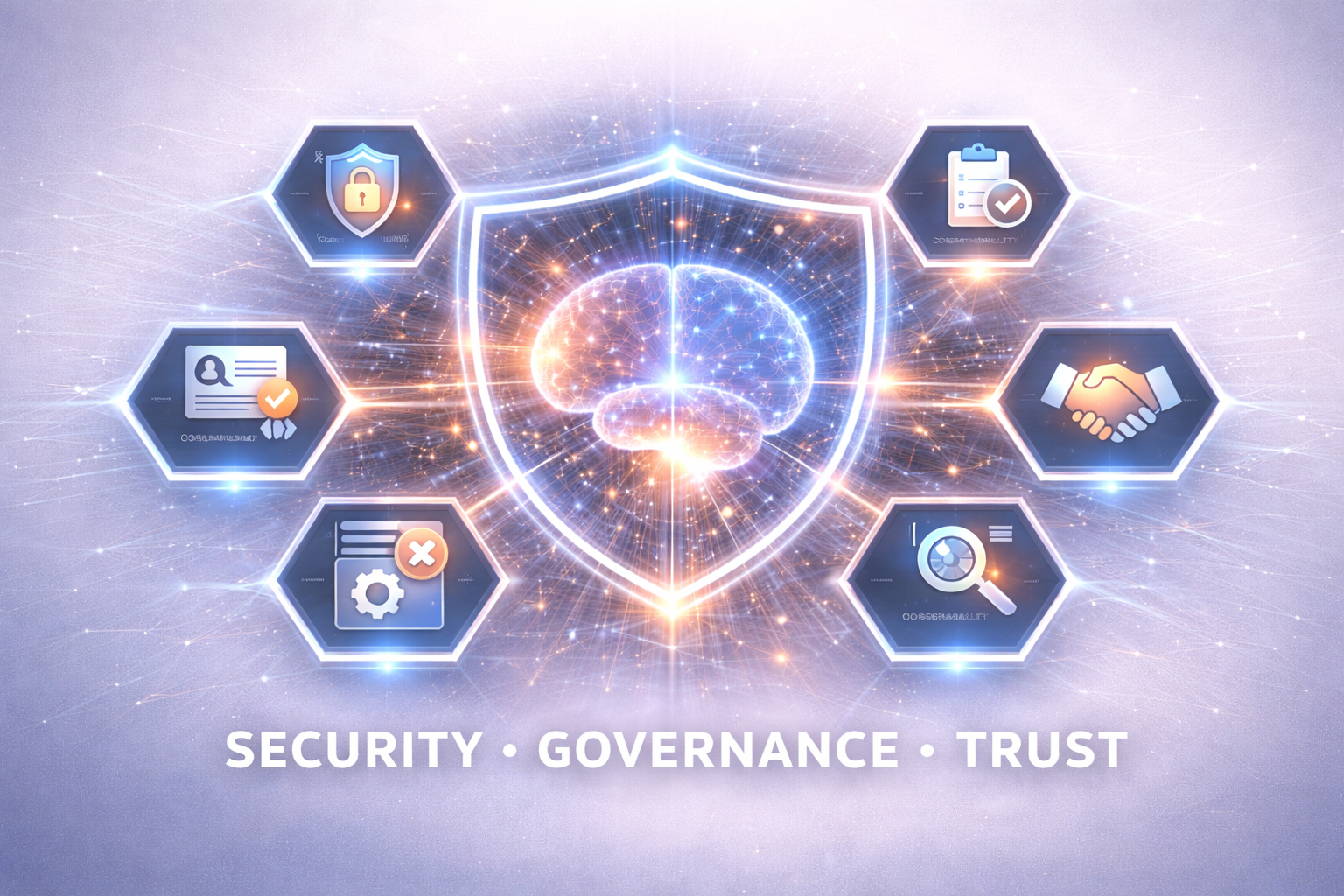
Autonomy Without Trust Is Dead on Arrival
Every executive conversation about AI autonomy eventually converges on one question:
Can we trust it?
Not just trust the model.
Trust the system.
Trust the interactions.
Trust the boundaries.
Trust the governance.
You can build the most elegant Agentic Mesh in the world.
If leadership does not trust it, it will never scale.
Security teams will block it.
Compliance teams will slow it.
Risk teams will constrain it.
Trust is not a soft concept.
It is an architectural outcome.
In this Part 5, we define how to design secure, governable, and trustworthy mesh operations without suffocating autonomy.
1. Identity-First Architecture — Every Agent Must Be Accountable
The Fundamental Rule
If an agent can act, it must have identity.
Not an API key.
Not a shared credential.
Not an anonymous service account.
A verifiable, traceable, revocable identity.
In human organizations:
- Every employee has an identity.
- Every employee has role-based permissions.
- Every action can be audited.
Digital agents require the same discipline.
The Agent Identity Framework
Every agent in the mesh must have:
- Cryptographic identity
- Role-based access control (RBAC)
- Attribute-based access control (ABAC) where needed
- Lifecycle management (creation, rotation, revocation)
- Audit trails linked to identity
No shared identities.
No implicit privileges.
Real-World Example
A healthcare enterprise deployed clinical decision agents across multiple hospital systems.
Initially, agents accessed patient data using shared service credentials.
It worked until a compliance audit exposed that no one could attribute data access to specific agent behaviors.
Trust evaporated overnight.
The redesign introduced:
- Unique digital identities per agent
- Scoped data permissions
- Access logs tied to identity tokens
After that, compliance confidence returned.
Identity created accountability.
Design Guidance
Avoid:
- Shared credentials
- Hard-coded secrets
- Long-lived static tokens
Implement:
- Short-lived identity tokens
- Zero-trust authentication
- Mutual TLS
- Identity federation across domains
Identity is the foundation of trust.
If an agent performs a high-impact action today:
- Can you identify exactly which agent instance initiated it?
- Can you revoke its authority instantly?
If not, your mesh is insecure.
2. Policy Enforcement at Decision Time
The Governance Failure Pattern
Many enterprises enforce compliance through:
- Manual review boards
- After-the-fact audits
- Periodic compliance scans
This approach collapses under autonomy.
Agents make decisions in milliseconds.
Governance must operate at the same speed.
The Decision-Time Policy Model
Every agent action must pass through:
- Pre-execution policy validation
- Context-aware rule evaluation
- Real-time constraint enforcement
Policies must be:
- Machine-readable
- Centrally managed
- Version-controlled
- Immediately distributable
A Banking Example
A bank deployed autonomous transaction monitoring agents.
Initially, suspicious activity thresholds were evaluated after transactions executed.
Regulatory risk increased.
The architecture was updated so that:
- Transactions were evaluated against compliance rules before execution.
- High-risk transactions triggered automatic holds.
- Escalation was automated.
Compliance became proactive.
Trust increased.
Design Guidance
Avoid:
- Post-action compliance
- Distributed policy duplication
- Manual threshold management
Implement:
- Centralized policy engines
- Real-time rule evaluation APIs
- Immutable audit logs
- Dynamic rule propagation
Governance must be architectural, not procedural.
If a policy changes at 9:00 AM:
- Will every agent enforce it by 9:01 AM?
- Or by next quarter?
If governance lags, risk accumulates.
3. Data Trust — Securing Context Across the Mesh
Autonomy Relies on Context
Agents make decisions based on:
- Historical data
- Real-time signals
- External integrations
- Cross-domain information
If data is compromised, autonomy is compromised.
Data trust is not only about encryption.
It is about:
- Integrity
- Lineage
- Accuracy
- Access control
- Provenance
Data Integrity Framework
The mesh must enforce:
- End-to-end encryption
- Schema validation
- Event authenticity verification
- Source verification
- Data classification enforcement
Agents must not trust data blindly.
They must validate it.
Real-World Example
A supply chain enterprise implemented autonomous demand forecasting agents.
An upstream data feed was accidentally corrupted due to a formatting error.
Forecasting agents reacted immediately.
Inventory orders surged.
Financial exposure spiked.
The postmortem revealed:
- No schema validation
- No data authenticity checks
- No anomaly detection at ingestion
After redesign:
- Data pipelines enforced strict validation
- Event signatures were verified
- Anomaly detection agents monitored ingestion
Data trust became enforceable.
Design Guidance
Avoid:
- Implicit trust in upstream systems
- Unvalidated event streams
- Opaque data transformations
Implement:
- Event signature verification
- Data lineage tracking
- Schema registries
- Real-time anomaly detection
Data integrity protects autonomy from cascading failure.
If a critical data feed becomes corrupted:
- How quickly would you detect it?
- Would agents continue acting on bad data?
If the answer is uncertain, data trust mechanisms are insufficient.
4. Observability Beyond Infrastructure — Trust Through Transparency
Infrastructure Monitoring Is Not Enough
Traditional observability focuses on:
- CPU usage
- Latency
- Error rates
- Throughput
Agentic systems require decision observability.
Leaders need to understand:
- Why decisions were made
- Which agents interacted
- What policies were evaluated
- How outcomes evolved
Transparency reduces fear.
Opacity breeds resistance.
The Trust Dashboard Model
Trustworthy mesh operations require:
- Real-time decision dashboards
- Cross-agent interaction maps
- Policy validation metrics
- Escalation frequency analysis
- KPI alignment tracking
Executives should see:
- Strategic impact
- Risk exposure
- Performance trends
Anecdote
A global telecom deployed autonomous churn mitigation agents.
Initially, executives feared uncontrolled discounting.
We implemented real-time dashboards showing:
- Discount usage
- Margin impact
- Customer retention metrics
- Escalation rates
Within months, leadership increased agent authority.
Visibility built trust.
Design Guidance
Avoid:
- Black-box AI
- Isolated logs
- Inaccessible audit trails
Implement:
- Structured reasoning logs
- Centralized decision analytics
- Cross-agent traceability
- Executive-facing transparency tools
Trust scales when insight scales.
If the CEO asks:
- “How is the mesh behaving right now?”
- Can you answer with data — not assumptions?
If not, observability must evolve.
5. Resilience and Failure Containment
The Myth of Perfect Systems
Agents will fail.
Models will drift.
Dependencies will break.
Trust does not require perfection.
It requires resilience.
Resilience in mesh systems means:
- Failure containment
- Graceful degradation
- Automated recovery
- Clear escalation pathways
Failure Containment Pattern
Each agent must:
- Fail independently
- Avoid cascading dependencies
- Trigger fallback mechanisms
- Escalate intelligently
The mesh must:
- Isolate malfunctioning agents
- Reassign responsibilities dynamically
- Maintain service continuity
Example
A financial institution deployed autonomous portfolio management agents.
One agent experienced model drift due to market volatility.
Instead of halting the system:
- Oversight detected anomaly in performance
- Authority limits were reduced automatically
- Human review was triggered
- Backup agent assumed partial responsibilities
No systemic disruption occurred.
Failure was contained.
Trust increased.
Design Guidance
Avoid:
- Single-point orchestration
- Shared state dependencies
- Silent failures
Implement:
- Health-check protocols
- Circuit breakers
- Automatic authority reduction
- Intelligent fallback routing
Resilience strengthens trust.
If one critical agent fails:
- Does your system collapse?
- Or adapt?
Run failure simulations.
Trust is built under stress.
6. Ethical Boundaries and Human Oversight
Autonomy Does Not Replace Accountability
Even the most sophisticated mesh must respect:
- Ethical standards
- Regulatory frameworks
- Human override authority
Trustworthy systems recognize when not to act.
The Human-in-the-Loop Framework
Define:
- Escalation thresholds
- Mandatory review triggers
- Override mechanisms
- Appeal processes
Autonomy is strongest when human oversight is structured.
Real-World Story
A global insurance firm deployed automated claim approval agents.
An unusual edge case involved a humanitarian disaster.
Agents processed claims strictly by policy.
Human executives intervened.
Post-event, ethical override triggers were embedded into the mesh:
- Disaster detection signals
- Temporary policy flexibility
- Executive approval channels
The mesh evolved.
Ethics became codified.
Design Guidance
Avoid:
- Blind automation
- Undefined override channels
- Ad hoc interventions
Implement:
- Structured escalation APIs
- Human oversight dashboards
- Ethical policy encoding
- Review logging
Trust requires moral clarity.
If an agent makes a legally correct but ethically questionable decision:
- Do you have a mechanism to intervene?
If not, trust will erode quickly.
Bringing It Together — The Trust Architecture
Secure, governable, trustworthy mesh operations require:
- Identity-first design
- Decision-time policy enforcement
- Data integrity controls
- Decision observability
- Failure containment
- Structured human oversight
These are not add-ons.
They are embedded layers of the mesh.
Trust is not earned through marketing.
It is earned through architecture.
A Strategic Insight
Enterprises do not fear AI capability.
They fear uncontrolled autonomy.
When governance is embedded structurally:
- Security teams become enablers.
- Compliance teams become partners.
- Executives become confident.
- Autonomy expands.
Trust unlocks scale.
Transition to Part 6
We now have:
- Defined the Agentic Mesh
- Established design patterns
- Embedded trust and governance
But one foundational layer remains to be explored deeply:
Data and event integration.
Autonomy depends on real-time, contextual intelligence flowing seamlessly across domains.
In the next part (Part 6), we move into the operational bloodstream of the mesh:
- Data Integration, Real-Time Streams, and Event-Driven Orchestration.
Without real-time context, autonomy is blind.
References & Further Reading
- The Complete Guide to Enterprise AI Governance in 2025
- Agent Governance at Scale: Policy-as-Code Approaches
- From Policy as Code to Agentic Governance in the AI-First Enterprise
- AI Observability: Monitoring and Governing AI Agents
- Agentic AI Governance: Managing Shadow AI and Risk
- Architecting Secure Enterprise AI Agents with MCP (IBM Guide)
- AI Governance for Cloud-Native AI Systems (CSA)
- Best Practices & Principles for Agent Mesh Implementations
- Agent Observability: How to Monitor AI Agents
- AI Agentic Mesh: Building Enterprise Autonomy
- Agentic Mesh Explained: Architectural Layer for Coordination
- AI Governance Tools: Selection and Security Guide
- Governance and Security for AI Agents (Microsoft)
- ModelOps — AI Model Governance & Lifecycle Management
- General-Purpose AI Code of Practice (EU AI Governance Framework)
Disclaimer: This post provides general information and is not tailored to any specific individual or entity. It includes only publicly available information for general awareness purposes. Do not warrant that this post is free from errors or omissions. Views are personal.