Architecture-wise Classification of Agentic AI Systems

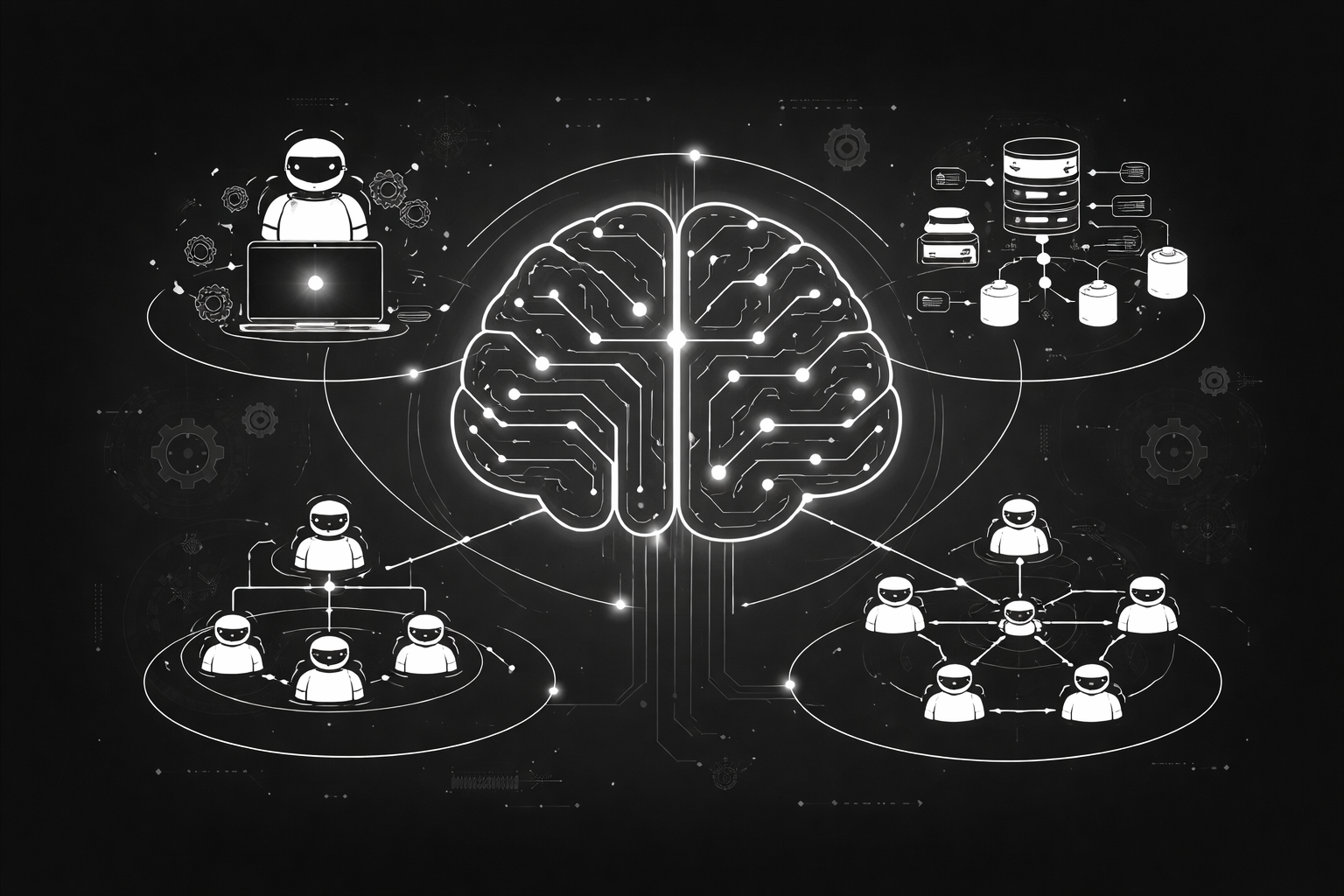
Agentic AI systems represent an evolution beyond traditional AI models by incorporating autonomy, goal-directed behaviour, and decision-making into software agents that can operate independently in dynamic environments. Unlike classical AI systems that respond to inputs with predictions or classifications, agentic AI systems synthesize perception, planning, memory, and execution to pursue complex goals with minimal human intervention. The architectural design of these systems directly influences their capabilities, scalability, and robustness. This article articulates a practical classification of agentic AI systems from an architectural standpoint, drawing on academic research and industry insights.
Single-Agent Architecture
Single-agent architecture involves a solitary autonomous AI agent that perceives its environment, reasons about tasks, plans actions, and executes decisions end-to-end.
Architectural Characteristics
- Centralized Control: A single reasoning unit handles the full sense-plan-act cycle.
- Simple Workflows: Ideal for tasks with limited complexity or constrained goal scope.
- Direct Decision Logic: Plans and executes locally without networked collaboration.
Strengths and Limitations
- Strengths: Easier to design and validate; requires fewer components and fewer coordination protocols.
- Limitations: Less scalable for tasks requiring specialized reasoning or parallel execution.
Use Cases
- Automated assistants programmed for specific tasks (e.g., single workflow document processing).
- Rule-based scheduling or single-stage task execution.
Multi-Agent Architectures
Multi-agent architectures encompass systems where multiple agents collaborate, coordinate, or compete to accomplish complex objectives. This broad class is itself differentiated by structural organization and communication dynamics.
Vertical (Hierarchical) Multi-Agent Architecture
Vertical (Hierarchical) Multi-Agent Architecture organizes agents into explicit tiers of authority, mirroring classical organizational and workflow structures. Control, decision-making, and accountability flow top-down, while execution and feedback flow bottom-up.
This is the most intuitive and governance-friendly agentic architecture, particularly for enterprises transitioning from traditional automation to agent-driven systems.
Architectural Concept
A hierarchical agentic system typically consists of:
- Leader (Supervisor / Orchestrator) Agents
- Interpret high-level goals
- Decompose objectives into tasks
- Assign responsibilities to subordinate agents
- Aggregate results and enforce policies
- Worker (Executor / Specialist) Agents
- Perform scoped tasks
- Report progress and outcomes
- Escalate exceptions or uncertainties upward
- Defined Control Plane
- Static or semi-static reporting lines
- Deterministic task routing
- Predictable execution paths
Authority is structural, not contextual.
Key Attributes
1. Hierarchical Control and DelegationDecision authority is layered:
- Strategic intent is defined at higher tiers
- Tactical execution is delegated downward
- Lower-level agents do not override upstream decisions
This ensures:
- Predictability
- Alignment with organizational goals
- Deterministic outcomes
However, adaptability is intentionally constrained.
2. Clear Reporting and Task FlowsEach agent has:
- A known supervisor
- A defined scope of responsibility
- A prescribed escalation path
Task flows are:
- Sequential or staged
- Auditable and traceable
- Easy to reason about and debug
This makes hierarchical systems particularly attractive for regulated environments.
3. Centralized GovernancePolicies, constraints, and compliance rules are enforced by:
- Leader agents
- Central policy engines
- Approval gates
This enables:
- Consistent enforcement of business rules
- Human-in-the-loop integration
- Strong auditability and observability.
Use Cases
Sequential Workflows with OversightExamples:
- Loan approvals
- Claims processing
- Legal or regulatory review pipelines
Examples:
- Order-to-cash workflows
- Procurement and vendor onboarding
- HR and compliance automation
Horizontal (Peer-to-Peer) Multi-Agent Architecture
Horizontal (Peer-to-Peer) Multi-Agent Architecture represents the purest form of decentralization in agentic AI systems. All agents operate as logical equals, with no permanent leader, coordinator, or supervisory authority. Control emerges from interaction rather than delegation.
This architecture is inspired by distributed systems, swarm intelligence, and human peer networks rather than organizational hierarchies.
Architectural Concept
In a horizontal architecture:
- Each agent has:
- Its own perception, reasoning, and action loop
- Local autonomy over decision-making
- Direct communication channels with peer agents
- System-level behavior emerges from:
- Negotiation
- Consensus
- Competition
- Cooperation
There is no single control plane. Instead, coordination is achieved through protocols and shared conventions, not commands.
Key Attributes
1. Decentralized Decision-MakingEvery agent:
- Evaluates goals independently
- Determines its own actions based on local context
- May accept, reject, or counter proposals from peers
Decision authority is fully distributed, which enables:
- High parallelism
- Fast local optimization
- Independence from central latency or failure
However, global optimality is not guaranteed unless explicitly designed into the coordination logic.
2. Peer Collaboration ProtocolsWithout hierarchy, protocols become the architecture.
Common peer-to-peer coordination mechanisms include:
- Task bidding or auction-based assignment
- Contract-net protocols
- Voting or quorum-based consensus
- Reputation and trust scoring
- Negotiation and bargaining strategies
These protocols define:
- How agents discover work
- How conflicts are resolved
- How shared goals are aligned
Tasks are not assigned; they are claimed, negotiated, or co-owned.
Patterns include:
- Opportunistic task pickup
- Cooperative task decomposition
- Parallel exploration of solution spaces
- Redundant execution for reliability
This enables dynamic load balancing without a scheduler, but increases coordination complexity.
Advantages
Flexible Problem SolvingBecause agents act independently:
- Multiple solution paths can be explored simultaneously
- Agents can adapt locally without waiting for approval
- Innovation emerges from interaction rather than design
This is particularly effective in open-ended or poorly defined problem domains.
Emergent Collaboration- Unexpected but useful behaviors can arise:
- Agents spontaneously form sub-groups
- Specialized roles emerge over time
- Successful strategies propagate organically
This mirrors natural systems such as ant colonies or open-source communities.
Reduced Bottlenecks and Single Points of FailureWith no central coordinator:
- There is no global scheduling bottleneck
- Failure of individual agents degrades performance gracefully
- The system scales horizontally by simply adding agents
Challenges
Coordination ComplexityWithout hierarchy:
- Conflicting actions are common
- Deadlocks and livelocks can occur
- Global goals may be unintentionally undermined by local optimization
Designing robust coordination protocols is non-trivial and often domain-specific.
Conflict ResolutionConflicts arise when:
- Multiple agents pursue incompatible actions
- Shared resources are contested
- Agents disagree on priorities or interpretations
Resolution mechanisms must be:
- Explicit
- Fair
- Resistant to strategic manipulation
In enterprise contexts:
- Accountability is harder to enforce
- Compliance and auditability become complex
- Unchecked autonomy can introduce risk
As a result, pure peer-to-peer architectures are rarely deployed without constraints in regulated environments.
Use Cases
Distributed Problem SolvingExamples:
- Scientific research exploration
- Optimization and search problems
- Multi-agent simulations
Examples:
- Autonomous robotics fleets
- Sensor networks
- Load-balancing or routing systems
Examples:
- Idea generation
- Design space exploration
- Competitive strategy modeling
Hybrid Multi-Agent Architecture
Hybrid Multi-Agent Architecture represents a deliberate convergence of hierarchy and decentralization. It is designed to overcome the rigidity of purely hierarchical systems and the coordination challenges of fully peer-to-peer agent networks. In this model, control is contextual rather than fixed.
At its core, the architecture allows agents to self-organize dynamically while still operating within explicit governance boundaries.
Architectural Concept
A hybrid architecture consists of:
- Supervisory or Orchestrator Agents: Responsible for goal alignment, constraint enforcement, escalation handling, and global optimization.
- Autonomous Peer Agents: Capable of independent reasoning, local decision-making, negotiation, and collaboration with other agents.
- Context-Driven Control Plane: Leadership and coordination responsibilities shift based on:
- Task complexity
- Risk level
- Domain specialization
- Runtime conditions (latency, failures, confidence thresholds)
Rather than “command and control,” this architecture operates on adaptive authority.
Key Attributes
1. Dynamic Leader Election and DelegationLeadership is not statically assigned. Instead:
- Agents may assume leadership roles temporarily based on:
- Domain expertise
- Proximity to data
- Performance history
- Confidence scores or uncertainty levels
- Leadership can dissolve once objectives are met.
This enables situational authority, similar to how human teams operate during crisis response or innovation cycles.
2. Combination of Structured and Emergent BehaviourHybrid architectures deliberately support two modes of operation:
Structured Mode- Predefined workflows
- Policy-driven approvals
- Deterministic task sequencing
- Mandatory human-in-the-loop checkpoints (when required)
- Agents negotiate task ownership
- Parallel exploration of solution paths
- Opportunistic collaboration
- Self-optimization through feedback loops
The system can transition between modes dynamically, which is critical for real-world environments that alternate between stability and volatility.
3. Enhanced Adaptability and ResilienceBecause authority is distributed but governed:
- Failure of a single coordinator does not collapse the system
- Agents can re-organize around degraded components
- New agents can be introduced without re-architecting the entire system
This makes hybrid architectures particularly well-suited for long-running, evolving systems.
Use Cases
Complex Strategic PlanningExamples:
- Enterprise transformation roadmaps
- Supply chain optimization under uncertainty
- Multi-year portfolio planning
Examples:
- Financial risk assessment
- Regulatory impact analysis
- AI-driven operations management
Examples:
- Multi-agent software engineering systems
- Research and discovery platforms
- Autonomous customer operations (sales, support, fulfillment)
Behavioral and Cognitive Frameworks
Architectural classification can also emphasize the reasoning modality and cognitive depth of agents.
Reactive Architectures
These agents map stimuli directly to actions without memory or anticipation. They are reflexive and suitable for real-time control loops.
Deliberative Architectures
Agents in this category build internal models of the environment, reason about future outcomes, and plan sequences of actions.
Cognitive Architectures
The most advanced class, cognitive architectures simulate human-like reasoning and learning by integrating perception, memory, planning, and adaptation across tasks.
Examples include belief-desire-intention models (BDI models):
- Beliefs: The agent’s current knowledge of the world.
- Desires: High-level goals (e.g., "Increase website traffic").
- Intentions: The specific, committed course of action chosen to fulfill a desire.
Conclusion
The architectural classification of agentic AI systems is multidimensional, spanning structural organization (single vs multi-agent), control paradigms (hierarchical, horizontal, hybrid), cognitive behaviour (reactive, deliberative, cognitive), and systemic patterns (protocols, shared context, workflow graphs). Each architectural class offers distinct strengths relevant to use case complexity, scalability, coordination requirements, and governance constraints. As the field matures, these classifications will continue to refine, enabling more robust enterprise deployments and more adaptive autonomous systems.
References & Further Reading
- https://link.springer.com/article/10.1007/s10462-025-11422-4
- https://www.ibm.com/think/topics/agentic-architecture
- https://www.geeksforgeeks.org/artificial-intelligence/agentic-ai-architecture/
- https://www.emergentmind.com/topics/agentic-frameworks
- https://agenticaimasters.in/agentic-ai-architecture/
- https://docs.cloud.google.com/architecture/choose-design-pattern-agentic-ai-system
- https://www.kore.ai/blog/agentic-architecture-blueprint-for-intelligent-enterprise
- https://www.emergentmind.com/topics/multi-agent-architectures
- https://www.exabeam.com/explainers/agentic-ai/agentic-ai-architecture-types-components-best-practices
- https://levelup.gitconnected.com/building-17-agentic-ai-patterns-and-their-role-in-large-scale-ai-systems-f4915b5615ce
- https://www.infosys.com/iki/research/agentic-ai-architecture-blueprints.html
- https://dev.to/knitex/common-agentic-ai-architecture-patterns-522d
Disclaimer: This post provides general information and is not tailored to any specific individual or entity. It includes only publicly available information for general awareness purposes. Do not warrant that this post is free from errors or omissions. Views are personal.