Agentic AI Mesh — Part 8 – Cross-Functional Workflows & Business Value

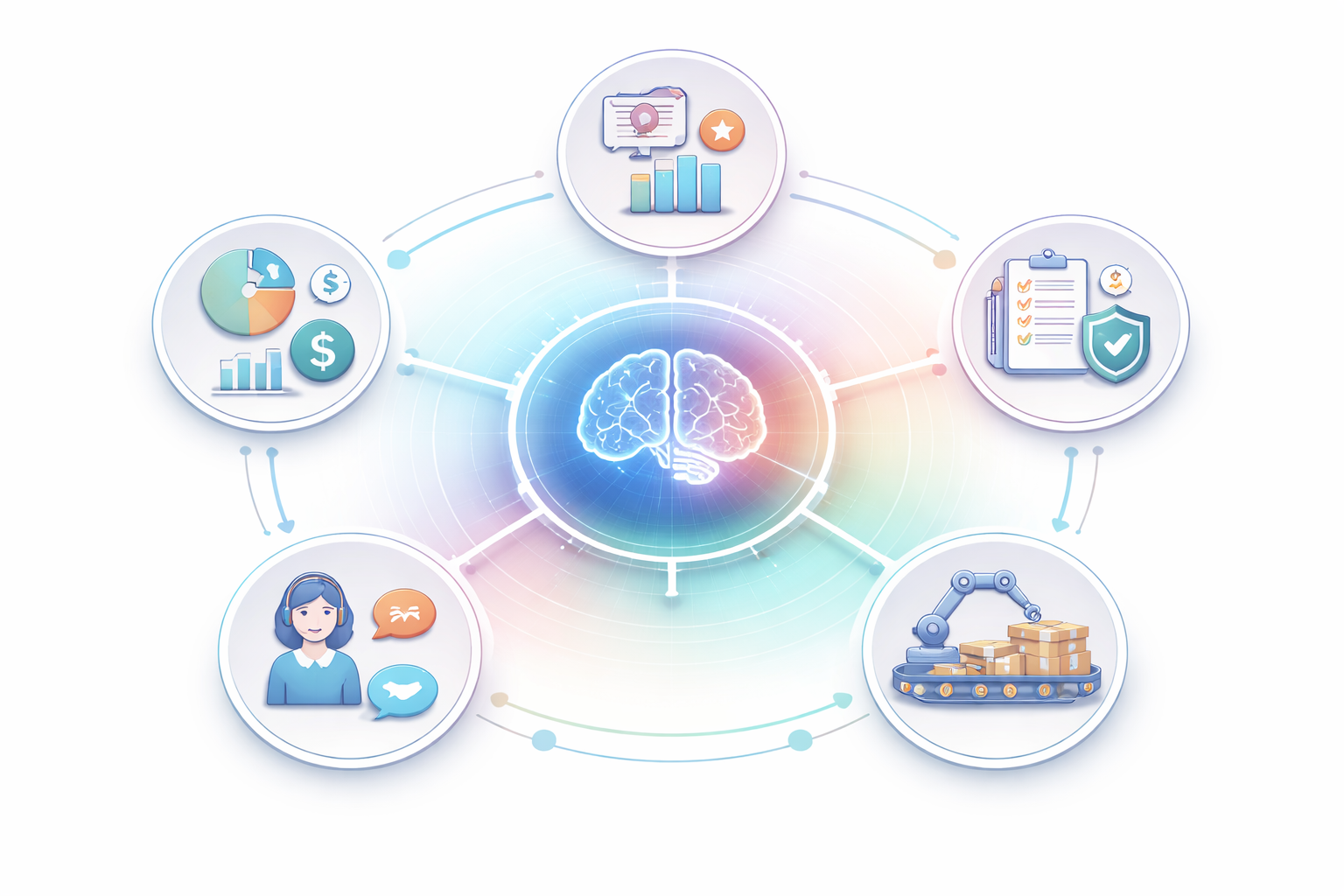
Autonomy Must Translate Into Outcomes
Architecture does not create value.
Dashboards do not create value.
Even intelligent agents do not create value unless they move business metrics.
Revenue.
Margin.
Risk exposure.
Cycle time.
Customer retention.
Innovation velocity.
If the Agentic Mesh does not change these numbers, it is an experiment.
This Part 8 moves from infrastructure to impact.
We will examine how cross-functional agent collaboration transforms real enterprise workflows instead of isolated tasks.
Autonomy becomes strategic when it coordinates across silos.
1. Revenue Optimization — Coordinated Decision-Making Across Sales, Pricing, and Risk
The Problem: Fragmented Revenue Engines
In most enterprises:
- Sales optimizes volume.
- Pricing optimizes margin.
- Risk optimizes exposure.
- Finance monitors profitability after the fact.
Each system operates independently.
Each model optimizes locally.
The result is misalignment.
The Mesh-Based Revenue Model
An Agentic Mesh enables:
- A pricing agent adjusting offers dynamically.
- A risk agent evaluating credit exposure in real time.
- A margin agent enforcing profitability thresholds.
- A retention agent assessing long-term customer value.
These agents collaborate through shared events.
They negotiate constraints.
They escalate when necessary.
Revenue decisions become coordinated.
Real-World Example
A telecom enterprise implemented cross-functional agents for contract renewals.
Previously:
- Sales offered aggressive discounts.
- Risk evaluated credit independently.
- Finance corrected margins later.
Conflicts were constant.
After mesh deployment:
- Renewal opportunity event triggered agents.
- Pricing agent proposed structured discounts.
- Risk agent adjusted limits.
- Margin agent validated profitability.
Approval cycles shortened by 35%.
Margin leakage reduced by 18%.
The breakthrough was coordination instead of better models.
Revenue optimization is not a single-agent problem.
It is a coordinated decision ecosystem.
In your organization:
- How many systems influence a single revenue decision?
- Do they coordinate in real time?
If not, revenue intelligence is fragmented.
2. Risk and Compliance — Continuous Governance Across Functions
The Problem: Reactive Risk Control
Traditionally:
- Fraud detection runs separately.
- Compliance reviews occur post-transaction.
- Risk analytics reports weekly.
Control is reactive.
Exposure accumulates between checkpoints.
Mesh-Based Risk Fabric
An Agentic Mesh enables:
- Fraud agents monitoring transaction streams.
- Compliance agents enforcing regulatory rules instantly.
- Audit agents logging decisions.
- Escalation agents triggering human review.
Risk becomes continuous.
Governance becomes embedded.
Example
A multinational bank deployed autonomous transaction agents.
Before mesh integration:
- Fraud alerts were reviewed manually.
- Compliance updates required system reconfiguration.
- Risk scoring lagged.
After integration:
- Fraud signals published as events.
- Compliance policy engine evaluated decisions instantly.
- Escalation occurred automatically above thresholds.
False positives dropped.
Regulatory response time improved dramatically.
Insight
In high-risk industries, autonomy without governance is rejected.
When risk agents collaborate under a mesh architecture, confidence expands.
Risk management shifts from bottleneck to enabler.
If a regulation changes tomorrow:
- How quickly do risk decisions adapt across departments?
If adaptation requires manual updates, governance is slow.
3. Supply Chain and Operations — Real-Time Optimization at Scale
The Problem: Siloed Operational Intelligence
In supply chains:
- Forecasting systems predict demand.
- Procurement systems place orders.
- Logistics systems manage routes.
- Warehouse systems manage capacity.
Each optimizes independently.
Coordination gaps create inefficiencies.
Mesh-Driven Operations Model
An Agentic Mesh enables:
- Forecasting agent predicting demand spikes.
- Procurement agent negotiating supplier contracts.
- Logistics agent rerouting shipments.
- Warehouse agent reallocating storage dynamically.
Events connect them.
Context synchronizes them.
No human orchestrates every step.
Real-World Example
A global consumer goods company deployed autonomous supply chain agents.
Previously:
- Forecasting errors caused overstock.
- Procurement lag created shortages.
- Logistics delays increased cost.
After mesh deployment:
- Demand spike event triggered procurement renegotiation.
- Logistics rerouted shipments automatically.
- Warehouse adjusted storage allocation.
Inventory carrying costs dropped by 22%.
Stockouts reduced significantly.
The value came from cross-functional coherence.
Operations require coordination more than prediction.
Prediction without coordination creates imbalance.
Map one operational workflow.
- How many systems must align?
- Are they event-synchronized?
If coordination is manual, optimization is limited.
4. Customer Experience — Unified Decisioning Across Touchpoints
The Problem: Fragmented Customer Interactions
Customers experience:
- Marketing messages
- Sales outreach
- Support interactions
- Billing communications
Internally, these are separate systems.
The customer sees one brand.
The enterprise sees silos.
Mesh-Based Customer Intelligence
Agents collaborate:
- Personalization agent tailors offers.
- Sentiment agent analyzes interactions.
- Retention agent predicts churn.
- Service agent triggers proactive outreach.
Events synchronize context.
Customer experience becomes coherent.
Example
An e-commerce platform deployed autonomous customer engagement agents.
Before mesh:
- Marketing emails contradicted support conversations.
- Promotions ignored recent complaints.
- Retention offers were delayed.
After mesh integration:
- Customer sentiment event triggered retention logic.
- Support resolution updated personalization engine.
- Pricing offers aligned with loyalty status.
Customer satisfaction scores increased.
Repeat purchase rates improved.
Customers reward coherence.
Agentic Mesh enables it.
Without coordination, AI amplifies fragmentation.
If a customer interaction changes sentiment today:
- Do all relevant systems adjust immediately?
If not, customer intelligence is disconnected.
5. Innovation and Strategic Agility
The Problem: Slow Strategic Response
Market shifts occur rapidly:
- Competitor pricing changes
- Regulatory updates
- Supply disruptions
- Consumer behavior shifts
Traditional systems respond slowly.
Decision loops are long.
Autonomy shortens them.
Mesh-Enabled Strategic Adaptation
With mesh infrastructure:
- Market signals trigger agent recalibration.
- Policy updates propagate instantly.
- New decision agents plug into registry seamlessly.
- Authority boundaries adjust dynamically.
Strategic agility becomes structural.
Example
A financial services firm faced sudden interest rate changes.
Previously:
- Risk teams recalculated exposures manually.
- Pricing adjustments lagged.
- Customer communication delayed.
With mesh integration:
- Interest rate event triggered risk recalculation.
- Pricing agent updated loan terms.
- Communication agent notified affected customers.
Response time reduced from weeks to hours.
Strategic agility improved dramatically.
The true value of the mesh is not incremental efficiency.
It is adaptive capacity.
- How quickly can your enterprise adapt to external shocks?
If adaptation requires multi-week coordination, agility is limited.
6. Measuring Business Value in a Mesh Environment
Value Must Be Quantified
Autonomy must demonstrate:
- Revenue lift
- Margin improvement
- Risk reduction
- Cost savings
- Cycle time reduction
- Customer retention improvement
Without measurable impact, autonomy is theoretical.
Value Measurement Framework
Track:
- Pre-mesh baseline metrics
- Post-mesh performance shifts
- Authority scaling impact
- Escalation reduction trends
- Cross-functional latency improvements
Measure before and after coordination.
Anecdote
A retail enterprise initially celebrated agent deployment based on model accuracy improvements.
But business metrics barely moved.
After focusing on cross-functional workflows instead of isolated optimizations:
- Revenue per customer increased.
- Decision cycle time decreased.
- Escalations dropped.
The difference was integration instead of intelligence.
Design Guidance
Avoid:
- Measuring isolated agent performance only
- Ignoring cross-functional metrics
- Celebrating accuracy without outcome
Implement:
- End-to-end workflow KPIs
- Cross-agent impact analysis
- Executive-level reporting
Value emerges at system level.
Are you measuring autonomy by model metrics or business outcomes?
Only outcomes justify architecture.
The Strategic Transformation
Cross-functional mesh deployment transforms:
- Local optimization → systemic optimization
- Siloed AI → collaborative intelligence
- Reactive governance → continuous oversight
- Static workflows → adaptive operations
The enterprise becomes:
- More coherent
- More responsive
- More resilient
- More profitable
Autonomy scales when it coordinates across boundaries.
Strategic Insight
The Agentic Mesh is not a technology upgrade.
It is an operating model upgrade.
It shifts value creation from isolated improvements to systemic optimization.
This is where enterprise advantage compounds.
Transition to Part 9
We have now demonstrated business value.
But one final structural concern remains:
Vendor dependency.
Technology ecosystems evolve rapidly.
No enterprise can rely on a single model, provider, or platform indefinitely.
In the next part (Part 9), we address a critical architectural principle:
Mesh Interoperability & Vendor Agnosticism.
Because true autonomy requires freedom instead of lock-in.
References & Further Reading
- Artificial Intelligence’s Great Potential — Harvard Business Review
- Embedding AI Into Business Processes — McKinsey & Company
- How AI Can Enable Cross-Functional Collaboration (Forbes Tech Council)
- AI Adoption & Business Value — Deloitte Insights
- How to Measure the Business Impact of AI — Gartner
- AI in Business: Key Drivers and Use Cases — IBM
- AI & Business Value — Accenture Research
- How AI is Transforming Supply Chain Management — McKinsey
- AI in Customer Service — Deloitte Insights
- The AI Workforce Gap and How to Fill It — HBR
- AI and Customer Experience — McKinsey
- AI-Enabled Organizations Transforming Enterprises — Bain & Company
- The Impact of AI on Business — Deloitte
- Competing in the Age of AI — Harvard Business Review
- AI-Enabled Operating Models for Business Value — Deloitte
Disclaimer: This post provides general information and is not tailored to any specific individual or entity. It includes only publicly available information for general awareness purposes. Do not warrant that this post is free from errors or omissions. Views are personal.