Agent Runtime Environment (ARE) in Agentic AI — Part 6 – Orchestration and Workflow Management

 This is the sixth article in the comprehensive series on the Agent Runtime Environment (ARE). You can have a look at the previous installations at the below links:
- Agent Runtime Environment (ARE) in Agentic AI — Part 5
- Agent Runtime Environment (ARE) in Agentic AI — Part 4
- Agent Runtime Environment (ARE) in Agentic AI — Part 3
- Agent Runtime Environment (ARE) in Agentic AI — Part 2
- Agent Runtime Environment (ARE) in Agentic AI — Part 1
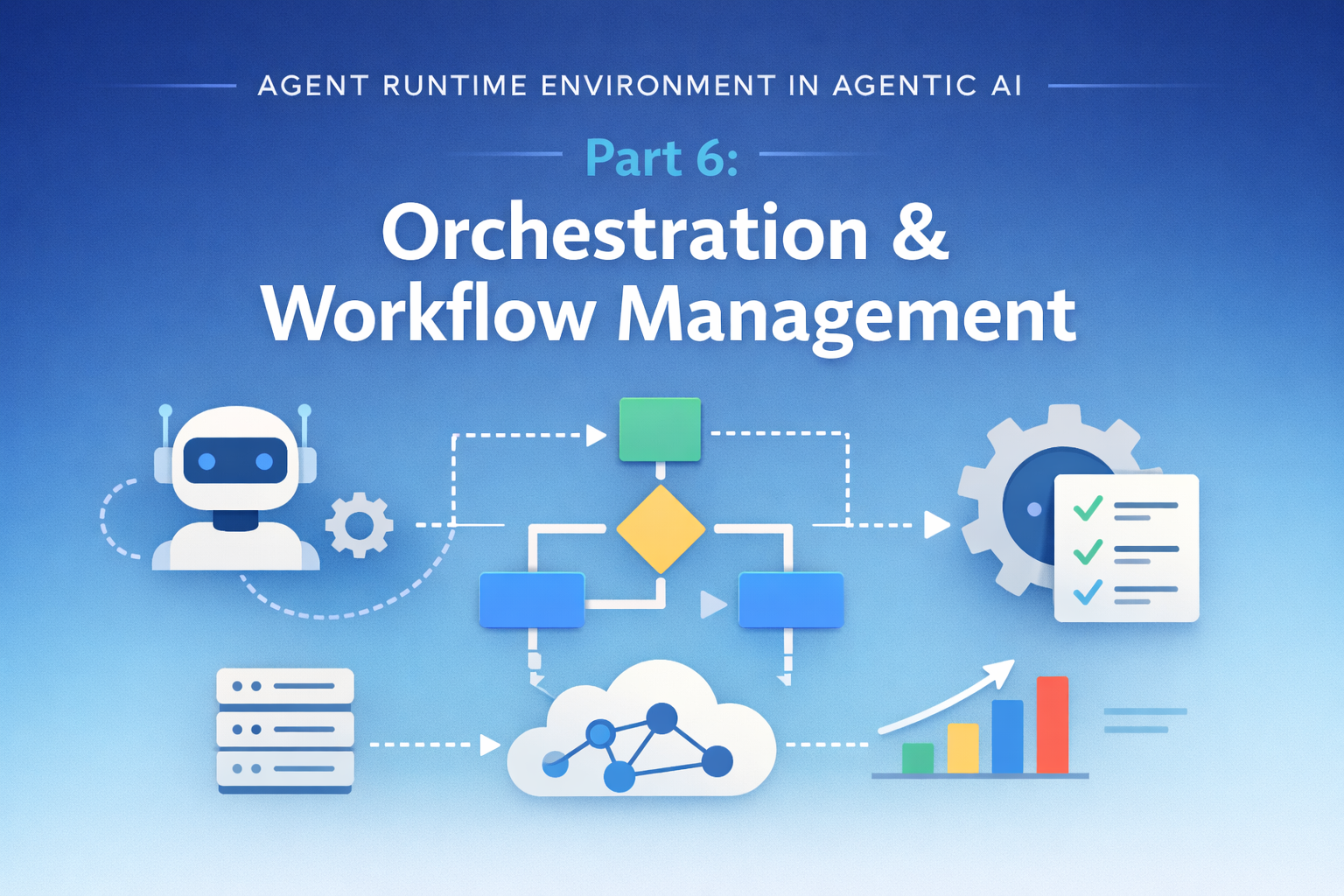
In the evolving world of Agentic AI, orchestration is where raw reasoning and execution meet disciplined, scalable workflow management. It’s the conductor behind an army of autonomous agents, translating high-level objectives into sequenced steps, coordinating dependencies, managing state, and optimizing resource usage in real time. If earlier parts of this series focused on what the ARE is and how agents remember and act, this article focuses on how systems of agents coordinate reliably and efficiently.
Why Orchestration Matters in Agentic AI
Orchestration in agentic systems is analogous to an operating system scheduler combined with a workflow engine. It needs to:
- Sequence multi-step tasks across potentially hundreds of agents
- Manage inter-agent dependencies and error propagation
- Parallelize where possible to improve throughput
- Coordinate tool and API calls efficiently, minimizing redundant work
- Monitor cost and performance over dynamic workloads
Unlike simple AI pipelines where a linear chain of operations suffices, agentic workflows are often dynamic, branching, and high-variance. They require an orchestration substrate that can adapt at runtime as contexts change.
According to IBM’s definition of AI agent orchestration, this orchestration layer “manages specialized agents effectively so they can autonomously complete tasks, share data flow and optimize workflows,” with phases including agent selection, workflow coordination, execution, and continuous optimization.
 This is the fifth article in the comprehensive series on the Agent Runtime Environment (ARE). If you missed the previous installments, we covered the