Agent Runtime Environment (ARE) in Agentic AI — Part 12 – Canonical Knowledge Management

· 14 min read
Sanjoy Kumar Malik
Solution/Software Architect & Tech Evangelist
Agent Runtime Environment (ARE) in Agentic AI — Part 12 – Canonical Knowledge Management This is the twelveth article in the comprehensive series on the Agent Runtime Environment (ARE). You can have a look at the previous installation at the below link:

Introduction

By the time organizations reach Part 12 of the Agent Runtime Environment (ARE) journey, something subtle but dangerous usually appears.

Agents are working. They are reasoning. They are learning.

And yet they begin to disagree with each other.

One agent believes a policy was updated last week. Another cites an outdated version with confidence. A third improvises because “the information seems incomplete.”

This is not a model problem. It is not a prompt problem. It is not even a memory problem.

It is a canonical knowledge problem.

As agentic systems scale, knowledge entropy becomes inevitable unless the ARE deliberately introduces a Canonical Knowledge Management (CKM) layer — a governed, authoritative, versioned source of truth that all agents can trust.

Without it, autonomy accelerates confusion.

Agent Runtime Environment (ARE) in Agentic AI — Part 11 – Performance Optimization and Cost Efficiency

· 28 min read
Sanjoy Kumar Malik
Solution/Software Architect & Tech Evangelist
Agent Runtime Environment (ARE) in Agentic AI — Part 11 – Performance Optimization and Cost Efficiency This is the eleventh article in the comprehensive series on the Agent Runtime Environment (ARE). You can have a look at the previous installation at the below link:

Introduction

In the early days of Generative AI, the focus was purely on capability. But as we graduate from chat interfaces to autonomous agents, the definition of success has shifted. In the context of Agentic AI, the Agent Runtime Environment (ARE) is no longer just a passive scheduler or a simple orchestrator of tasks. It has evolved into the performance backbone of the entire system.

Think of the ARE not as the traffic cop merely directing cars, but as the engine and transmission system that determines how fast the car can actually go. It dictates how quickly an agent can perceive a stimulus (like a customer support ticket or a security alert), how efficiently it can reason through a decision tree, and how rapidly it can interact with external APIs to execute a solution.

As enterprises move these agents out of the innovation lab and into mission-critical automation, the stakes get higher. In a real-time workflow, a 10-second latency for a simple query isn't just an annoyance; it’s a system failure. The performance characteristics of your ARE — specifically its latency, throughput, and error handling — directly correlate to user retention and operational viability.

To operationalize this, we must view the ARE through two competing yet complementary lenses:

1. Performance Optimization (The "Speed" Lens) - This is the pursuit of snappiness and scale. It focuses on:

  • Reducing Response Times (Latency): Shaving milliseconds off every step of the agent's loop, from context retrieval to token generation.

  • Improving Throughput: Ensuring the ARE can handle 10,000 concurrent agents as gracefully as it handles ten.

  • Eliminating Bottlenecks: Identifying where the agent gets "stuck"—is it waiting on a slow vector database search? Is it blocked by a rate-limited API? Optimization means smoothing these friction points to ensure a fluid user experience.

2. Cost Efficiency (The "Sustainability" Lens) - This is the pursuit of economic viability. An agent that solves a problem perfectly but costs $4.00 per interaction is unscalable for most businesses. Cost Efficiency focuses on:

  • Minimizing Computational Overhead: Using Model Cascading to route simple tasks to cheaper, faster models (like Llama-3-8B) and reserving expensive "reasoning" models (like GPT-4) only for complex problems.

  • Infrastructure Reduction: Optimizing memory usage and vector storage to lower cloud bills.

  • Token Economy: Ruthlessly pruning prompts and context windows to ensure you aren't paying for tokens that don't add value to the result.

The "Holy Grail" of Agentic AI isn't just being fast, and it isn't just being cheap. It is about sustainable efficiency. Balancing these two forces creates an Agent Runtime Environment that is robust enough to handle enterprise-scale spikes in traffic, yet efficient enough to maintain healthy profit margins. This balance is what separates a fun demo from a viable product.

Core Components of Performance Optimization in ARE

1. Smart Resource Allocation: The Engine of Efficiency

In traditional software architectures, resource allocation was often a "set it and forget it" exercise. You provisioned a server with 16GB of RAM and hoped it was enough for peak traffic but not too wasteful during the quiet hours. In the world of Agentic AI, this static model is obsolete.

Autonomous agents are not consistent workers; their workloads are inherently bursty and heterogeneous. One moment, an agent is idling, waiting for a user prompt. The next moment, it is spinning up five parallel threads to search the web, generating complex code, and running a local Python interpreter — all while holding a massive context window in memory.

Static allocations in this environment lead to two fatal outcomes:

  • The Bottleneck: During a complex reasoning task (e.g., "Analyze this 50-page PDF and cross-reference it with our SQL database"), the agent hits a memory ceiling or GPU limit, causing latency to spike or the process to crash.

  • The Waste: During simple tasks (e.g., "Hello, how are you?"), the agent is sitting on expensive GPU clusters that are burning money doing nothing.

Modern AREs must be dynamic. They need to act like a high-frequency trading algorithm for compute resources — constantly buying and selling capacity based on immediate need.

Core Strategies for Smart Allocation

  • Auto-scaling with "Headroom": It is not enough to scale up when you hit 90% CPU usage — by then, latency has already degraded. Smart AREs use predictive auto-scaling. If the system sees a surge in "Research" intents (which are compute-heavy), it pre-provisions additional GPU pods before the queue fills up.

  • Predictive Allocation via AI: Advanced AREs use Reinforcement Learning (RL) to learn the "rhythm" of your business. If your agents typically see a spike in complex financial queries every Monday morning at 9:00 AM, the RL model learns to spin up extra resources at 8:55 AM. This moves the system from reactive (fighting fires) to proactive (preventing them).

  • Priority Tiers (The "VIP Lane"): Not all agent tasks are created equal.

    • Tier 1 (Latency-Sensitive): A user chatting in real-time needs an instant response. These tasks get routed to high-performance, warm GPUs.
    • Tier 2 (Cost-Sensitive/Batch): A background agent tasked with "summarizing last week's logs" can afford to wait. The ARE allocates this to cheaper, slower resources (like Spot Instances or CPU-only nodes) to save money.

The Impact

By moving from static to intelligent allocation, enterprises can see dramatic efficiency gains. Reinforcement learning-based allocators have been shown to reduce resource waste (under-provisioning or over-provisioning) by 30-40%. In cloud terms, that is directly slashing 30-40% off the infrastructure bill while simultaneously ensuring that no user is left waiting during a demand spike.

2. Efficient Execution Paths: Optimizing the "Thought Loop"

In a standard web application, a request travels a predictable path: Request → Database → Response. In an Agent Runtime Environment (ARE), the path is far more complex and perilous. An agent’s "thought process" involves a chain of dependencies: input parsing, long-term memory retrieval, multi-step reasoning, tool selection, and finally, response generation.

If any link in this chain is slow, the entire agent feels sluggish. Efficient Execution Paths focus on streamlining this pipeline, treating the agent’s reasoning loop like a manufacturing line where every millisecond of "friction" must be eliminated.

Core Optimization Methods

  • Response Caching (The "Semantic Shortcut"): Traditional caching relies on exact matches (e.g., User types "Hello" → Cache hit). But in AI, users rarely type the exact same sentence twice.

    • The Upgrade: AREs use Semantic Caching. By converting user queries into vector embeddings, the system can identify that "How do I reset my password?" and "I forgot my login credentials, help with reset" are semantically identical (e.g., 95% similarity).

    • The Gain: The ARE serves a pre-computed answer instantly, bypassing the expensive LLM inference entirely. This can reduce latency from 3 seconds to 50 milliseconds for common queries.

  • Model Routing & Cascading (The "Right Tool for the Job"): Not every problem requires a genius-level IQ. Using a massive model (like GPT-4 or Claude 3.5 Opus) to acknowledge a greeting or extract a date is overkill — both financially and computationally.

    • The Strategy: Implement a Router or Gateway layer.

      • Simple/Router Tasks: Sent to lightweight, ultra-fast models (e.g., Llama-3-8B, Haiku).

      • Complex Reasoning: Only difficult prompts (e.g., "Analyze this legal contract") are escalated to the heavy-weight "Reasoning" models.

    • The Result: A significant drop in average response time and cost, as the "heavy machinery" is only engaged when absolutely necessary.

  • Prompt Optimization & Streaming (Perceived Performance):

    • Optimization: Techniques like Prompt Compression (removing stop words, summarizing context) reduce the payload size sent to the LLM. Fewer tokens in = faster processing out.

    • Streaming: Instead of waiting for the entire answer to be generated (which might take 10 seconds), the ARE should stream tokens to the user interface as they are generated.

    • The Metric: This improves Time to First Token (TTFT). Even if the full answer takes the same amount of time, the user feels the agent is instant because they see activity immediately.

By combining these techniques, an ARE reduces the reliance on heavy compute calls while maintaining the illusion of instantaneous intelligence. It transforms a clunky, thoughtful agent into a snappy, responsive assistant.

Agent Runtime Environment (ARE) in Agentic AI — Part 10 – Scalability and Distribution

· 15 min read
Sanjoy Kumar Malik
Solution/Software Architect & Tech Evangelist
Agent Runtime Environment (ARE) in Agentic AI — Part 10 – Scalability and Distribution This is the tenth article in the comprehensive series on the Agent Runtime Environment (ARE). You can have a look at the previous installations at the below links:
In the rapidly evolving world of agentic AI, simply building intelligent agents is no longer enough. Performance at scale, resilience under varied workloads, and distributed execution are now central to delivering agentic systems that can meet real-world enterprise demands. This article explores how the Agent Runtime Environment (ARE) evolves to orchestrate large-scale, distributed agentic workloads — leveraging dynamic resource allocation, clustering, and load balancing — to support elastic intelligence that’s both efficient and robust.

Why Scalability & Distribution Matter in Agentic AI

To understand why scalability and distribution are the "make or break" factors for Agentic AI, we have to stop thinking of AI as a simple chatbot and start thinking of it as a distributed workforce.

In traditional software, you scale to handle more users. In Agentic AI, you scale to handle more thinking. Here is a deeper look at why this architectural shift is so critical.

The Shift from "Stateless" to "Stateful" Scaling

Traditional web apps are mostly stateless; if a server dies, the user just refreshes the page. Agents, however, are stateful. They carry context, past interactions, and "chain-of-thought" reasoning that can last for hours.

  • The Problem: If an agent is mid-way through a 20-step autonomous task and the node hosting it fails, you don't just lose a connection—you lose the "cognitive progress" of that task.

  • The Solution: A distributed ARE allows for state-checkpointing across a cluster. By distributing the agent’s memory and execution state, the system can "resurrect" an agent on a healthy node without missing a beat.

Handling "Spiky" Cognitive Load

Unlike a database that has predictable read/write patterns, agents exhibit unpredictable bursts of reasoning. One prompt might require a simple answer (low load), while the next might trigger an agent to spawn five sub-agents to perform a market analysis (massive load).

FeatureTraditional Web ScalingAgentic AI Scaling
Unit of ScaleRequests per secondAgents/Reasoning Loops
Resource FocusNetwork I/O & DatabaseGPU/TPU & Local Compute
DurationMilliseconds to SecondsMinutes to Days (Long-running)
DependencyMostly IndependentHigh (Agents talking to Agents)

Elasticity

In a non-distributed environment, you might over-provision 100 high-RAM servers to handle a potential peak. But agents are often idle while waiting for an API response or human feedback (HITL).

Horizontal distribution allows the ARE to:

  • Reclaim resources instantly when an agent enters a "wait state."
  • Shuffle agents to different nodes to balance the thermal and compute load on GPUs.
  • Scale-to-zero when no autonomous tasks are in the queue, saving massive operational costs.

Scalability in Agentic AI isn't just about growth; it's about survival. Without a distributed backbone, a complex multi-agent system becomes a house of cards—one resource bottleneck can cause a cascading failure across the entire reasoning chain.

Agent Runtime Environment (ARE) in Agentic AI — Part 9 – Monitoring, Observability, and Evaluation

· 17 min read
Sanjoy Kumar Malik
Solution/Software Architect & Tech Evangelist
Agent Runtime Environment (ARE) in Agentic AI — Part 9 – Monitoring, Observability, and Evaluation This is the ninth article in the comprehensive series on the Agent Runtime Environment (ARE). You can have a look at the previous installations at the below links:
In the unfolding era of Agentic AI, where autonomous systems reason, plan, and execute decisions across distributed environments, seeing what happens at runtime is essential. Monitoring, observability, and evaluation form the bedrock of reliability, trust, safety, and continuous improvement in modern AREs.

This article explores why these functions are critical to agentic systems, how they differ from traditional software observability, and the emerging best practices and tooling that make them actionable.

Why Monitoring & Observability Matter for Agents

From Black Boxes to Transparent Intelligence

Traditional software monitoring tells you whether a service is up. But an AI agent can be running perfectly and still produce wrong, harmful, or suboptimal decisions. Classic health checks like uptime and error rates simply aren’t enough. Agentic systems operate through probabilistic processes and multi-step reasoning that involve internal decision loops, tool invocations, model memory, and dynamic context shifts — none of which are visible through conventional logs alone.

Unique Risks Without Observability

Without visibility into why an agent took a particular path:

  • Hidden failures may quietly degrade performance.
  • Silent hallucinations can propagate incorrect outcomes.
  • Compliance and audit requirements go unmet.
  • Debugging becomes guesswork instead of precise intervention.

As one cloud observability expert recently noted, modern AI observability goes beyond uptime to inspect model accuracy, data integrity, hallucination detection, and prompt injection risks.

Core Concepts: Monitoring vs. Observability vs. Evaluation

TermFocusTypical Outputs
MonitoringRuntime health and metricsLatency, errors, throughput
ObservabilityUnderstanding internal state & reasoningTraces, cognitive steps, tool selection
EvaluationGrading output quality & alignmentAccuracy scores, human/automated feedback

Monitoring

In agentic AI, monitoring captures essential operational metrics such as latency, token usage, API performance, cost, and system health but also metrics specific to reasoning workflows, like step success rates and hallucination counts.

Observability

Observability means seeing inside the agent’s cognitive process: reasoning spans, tool calls, context retrievals, memory state changes, and inter-agent communication. It answers questions around why a particular decision or action occurred rather than merely that it did.

A mature observability stack captures traces at multiple layers, from the entire session down to individual spans that represent reasoning outcomes, tool invocations, and even model-internal parameters.

Evaluation

Evaluation complements observability by assigning quality metrics to agent behaviors. This includes both automated evaluations — such as LLM judges or synthetic benchmarks — and human assessments for alignment, ethical compliance, and task success.

Agent Runtime Environment (ARE) in Agentic AI — Part 8 – Human-in-the-Loop Integration

· 10 min read
Sanjoy Kumar Malik
Solution/Software Architect & Tech Evangelist
Agent Runtime Environment (ARE) in Agentic AI — Part 8 – Human-in-the-Loop Integration This is the eigth article in the comprehensive series on the Agent Runtime Environment (ARE). You can have a look at the previous installations at the below links:
As agentic AI systems evolve toward deeper autonomy and more sophisticated decision-making, one structural question emerges with ever-greater urgency: Where and how should humans be integrated into the agent’s runtime environment? Human-in-the-Loop (HITL) integration is not merely a safety checkbox — it is a foundational architectural layer that ensures trustworthy, accountable, and human-aligned autonomous systems.

In this article, we examine HITL from the perspective of the Agent Runtime Environment (ARE), articulating both why it matters and how it gets engineered for high-assurance, real-world deployments.

Why Human-in-the-Loop Matters in Agentic AI

Agentic AI agents — by design — execute complex, multi-step tasks, synthesize data from diverse sources, and perform autonomous actions that can affect business processes, compliance outcomes, and even physical infrastructure. However, despite dramatic advances in LLMs, reasoning engines, and contextual memory, autonomy without oversight inevitably magnifies risk, especially in high-stakes environments.

Some of the core motivations for HITL in an ARE are:

Trust, Transparency & Accountability:

Models make probabilistic decisions. Without human review at key checkpoints, outcomes may be opaque, harder to audit, and potentially misaligned with business or regulatory expectations. HITL provides structured checkpoints where humans validate decisions before they are committed.

Agent Runtime Environment (ARE) in Agentic AI — Part 7 – Security & Sandboxing

· 24 min read
Sanjoy Kumar Malik
Solution/Software Architect & Tech Evangelist
Agent Runtime Environment (ARE) in Agentic AI — Part 7 – Security & Sandboxing This is the seventh article in the comprehensive series on the Agent Runtime Environment (ARE). You can have a look at the previous installations at the below links:
In an era where autonomous AI systems can make decisions, execute code, and interact with critical infrastructure, the runtime security of these agents becomes mission-critical. Unlike traditional applications where user actions trigger operations, agentic AI systems act autonomously — with the potential to access data, invoke APIs, and perform real-world actions. This autonomy introduces a new attack surface: prompt injection, unauthorized action execution, data exfiltration, and even “AI escapes” when an agent transcends its permitted boundaries. Therefore, security and sandboxing are foundational pillars of any robust Agent Runtime Environment (ARE).

In this article, we’ll explore how security is architected into an ARE — particularly through sandboxing and isolation mechanisms — to ensure agents operate securely, compliantly, and within predefined risk boundaries in enterprise settings.

Why Security in Agent Runtime Matters

To understand the security risks of Agentic AI, we must first appreciate a fundamental shift in the landscape: The transition from "Chat" to "Action."

When you interact with a standard LLM (like ChatGPT), the worst-case scenario is usually "hallucination"—the model says something factually incorrect or offensive. But in Agentic AI, the model is no longer just a speaker; it is a doer. It has "hands" in the form of APIs, database connectors, and command-line interfaces.

As you noted, an agent doesn’t just suggest a code fix; it writes the code, compiles it, and pushes it to the repository. This capability transforms the security profile entirely. If the Agent Runtime Environment (ARE) is the "operating system" for these agents, then a security failure isn't just a bug—it’s a potential catastrophe.

Here is why a hardened ARE is non-negotiable.

Unauthorized Tool or System Access (The "Confused Deputy")

In traditional security, we trust the user. In Agentic AI, the "user" is a probabilistic model that can be tricked. Without a secure runtime, an agent designed for "Customer Support" might be manipulated into accessing "Billing Tools" simply because a malicious user asked it to "check the refund status by querying the admin SQL database."

  • The Runtime Role: The ARE acts as the gatekeeper, enforcing strict Role-Based Access Control (RBAC) at the function level, ensuring a support agent literally cannot see the admin tools, no matter how persuasively it is asked.

Data Leakage & Exfiltration

Agents often process sensitive data (PII, financial records) and then send outputs to external users or systems. The danger is side-channel exfiltration. An agent might inadvertently include a user's credit card number in a log file, or worse, "summarize" a confidential internal document and send that summary to a public, third-party API for processing.

  • The Runtime Role: A secure ARE implements Data Loss Prevention (DLP) hooks on all egress traffic, scanning the agent's outgoing payloads for sensitive patterns (like social security numbers or API keys) before they leave the secure perimeter.

Agent Runtime Environment (ARE) in Agentic AI — Part 6 – Orchestration and Workflow Management

· 15 min read
Sanjoy Kumar Malik
Solution/Software Architect & Tech Evangelist
Agent Runtime Environment (ARE) in Agentic AI — Part 6 – Orchestration and Workflow Management This is the sixth article in the comprehensive series on the Agent Runtime Environment (ARE). You can have a look at the previous installations at the below links:
In the evolving world of Agentic AI, orchestration is where raw reasoning and execution meet disciplined, scalable workflow management. It’s the conductor behind an army of autonomous agents, translating high-level objectives into sequenced steps, coordinating dependencies, managing state, and optimizing resource usage in real time. If earlier parts of this series focused on what the ARE is and how agents remember and act, this article focuses on how systems of agents coordinate reliably and efficiently.

Why Orchestration Matters in Agentic AI

Orchestration in agentic systems is analogous to an operating system scheduler combined with a workflow engine. It needs to:

  • Sequence multi-step tasks across potentially hundreds of agents
  • Manage inter-agent dependencies and error propagation
  • Parallelize where possible to improve throughput
  • Coordinate tool and API calls efficiently, minimizing redundant work
  • Monitor cost and performance over dynamic workloads

Unlike simple AI pipelines where a linear chain of operations suffices, agentic workflows are often dynamic, branching, and high-variance. They require an orchestration substrate that can adapt at runtime as contexts change.

According to IBM’s definition of AI agent orchestration, this orchestration layer “manages specialized agents effectively so they can autonomously complete tasks, share data flow and optimize workflows,” with phases including agent selection, workflow coordination, execution, and continuous optimization.

Agent Runtime Environment (ARE) in Agentic AI — Part 5 – Tool and API Invocation

· 9 min read
Sanjoy Kumar Malik
Solution/Software Architect & Tech Evangelist
Agent Runtime Environment (ARE) in Agentic AI — Part 5 – Tool and API Invocation This is the fifth article in the comprehensive series on the Agent Runtime Environment (ARE). If you missed the previous installments, we covered the Operating Layer, Execution Engine, Memory Management, and Memory Operationalization.
As autonomous intelligence continues to evolve, teaching an agent how to think is only part of the story. The real leap happens when the agent can act. Truly agentic systems go beyond producing well-written text. They connect with real-world systems, live data sources, and computational tools in ways that are reliable, efficient, and properly governed. This article focuses on one of the most critical, yet often overlooked, elements of the Agent Runtime Environment (ARE): tool and API invocation. We look closely at practical tooling, proven invocation patterns, indexing approaches that scale with memory and retrieval demands, and the real cost-performance tradeoffs that determine whether an agent is ready for production.

Why Tool and API Invocation Matters in ARE

Tool invocation — sometimes called tool calling or function calling — is the mechanism by which an agent interacts with the external world. Instead of staying confined to purely generative outputs, agents use APIs and functions to:

  • Retrieve live data (e.g., weather, inventory, analytics)
  • Execute real actions (e.g., schedule meetings, trigger workflows)
  • Query internal systems (e.g., CRM records, ERP functions)
  • Orchestrate complex multi-step tasks involving databases, services, and external applications

This shifts AI agents from passive interpreters of language to proactive executors of intelligent actions.

In architectural terms, tool invocation lives at the Action Execution Layer of the agent stack, where planning converges with effectors that change state, whether digital or physical.

Agent Runtime Environment (ARE) in Agentic AI — Part 4 - Memory Operationalization

· 11 min read
Sanjoy Kumar Malik
Solution/Software Architect & Tech Evangelist
Agent Runtime Environment (ARE) in Agentic AI — Part 4 - Memory Operationalization

In Parts 1–3 of this series, we laid the groundwork for understanding the Agent Runtime Environment (ARE) as the engine that powers autonomous intelligence: how it operates, manages execution context, and handles memory at a conceptual level. In this fourth installment, we move from theory to practice. We explore how memory is operationalized within the ARE — what tools and frameworks make it real, how indexing strategies shape retrieval behavior, and how to balance cost–performance considerations when engineering memory for agents.

“Memory operationalization” is about turning abstract memory models into working systems that support fast, context-rich retrieval, robust persistence, and efficient scaling inside an agentic runtime.

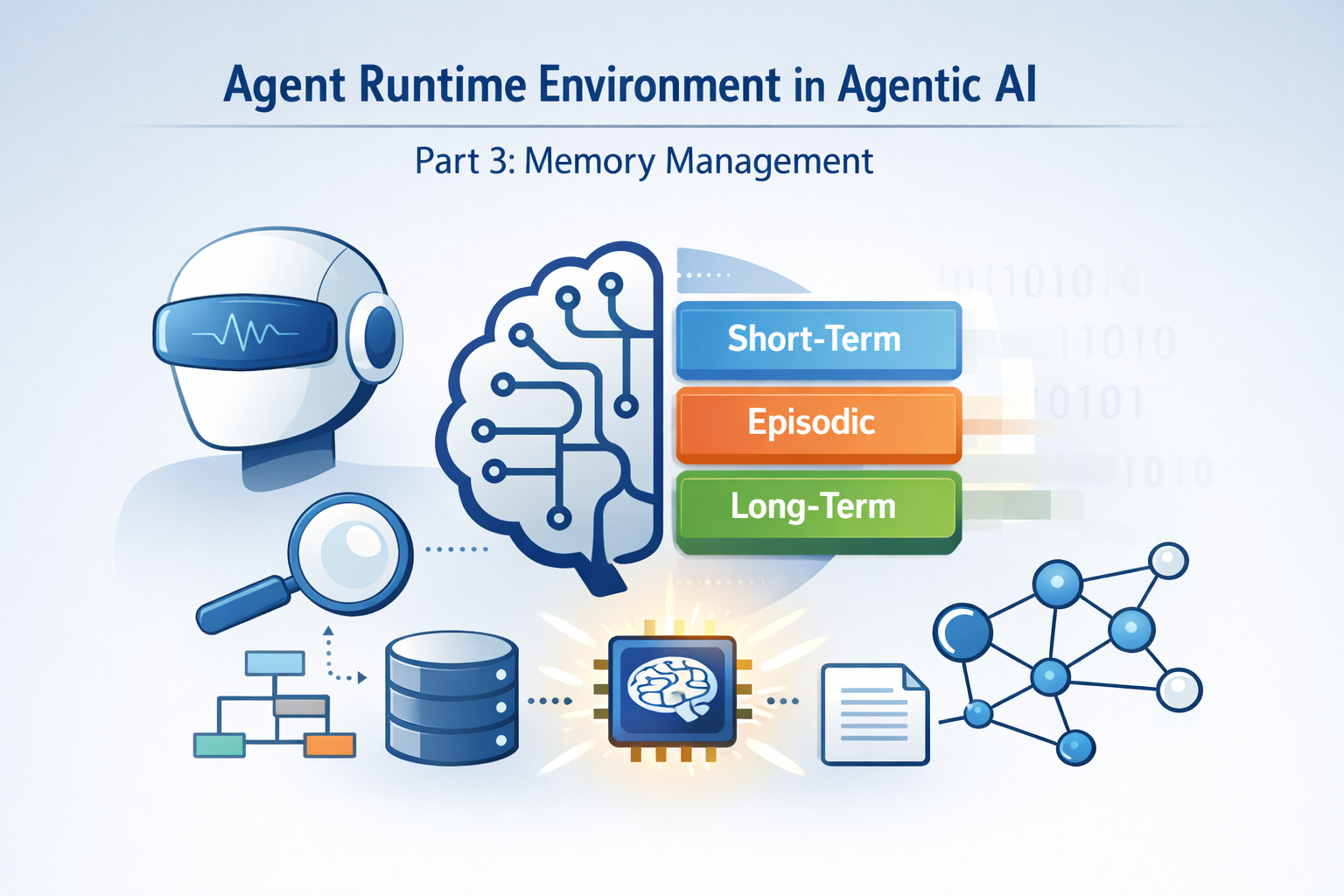
Agent Runtime Environment (ARE) in Agentic AI — Part 3 - Memory Management

· 21 min read
Sanjoy Kumar Malik
Solution/Software Architect & Tech Evangelist
Agent Runtime Environment (ARE) in Agentic AI — Part 3 - Memory Management

In the first part of this series, we defined the Agent Runtime Environment (ARE) as the "operating system" for autonomous intelligence. In Part 2, we explored the Execution Engine — the motor system that turns reasoning into action. Now we confront a central truth of agentic intelligence: if an agent cannot remember, it cannot meaningfully reason, plan, or act over time.

Memory management in agentic systems isn’t a “nice to have.” It’s the backbone of persistence, continuity, personalization, and reasoning. And it fundamentally distinguishes a stateless LLM wrapper from a true agentic AI system.

In this article, we will:

  • Define what memory means in agentic AI.
  • Explore its variants and architectural implications within an ARE.
  • Explain practical patterns and implementation strategies.
  • Highlight real-world challenges and emerging research.