 This article is the first in a multi-part series, Agentic AI – Agent Runtime Environment (ARE), which explores the architectural, operational, and governance foundations required to run AI agents safely and at scale.
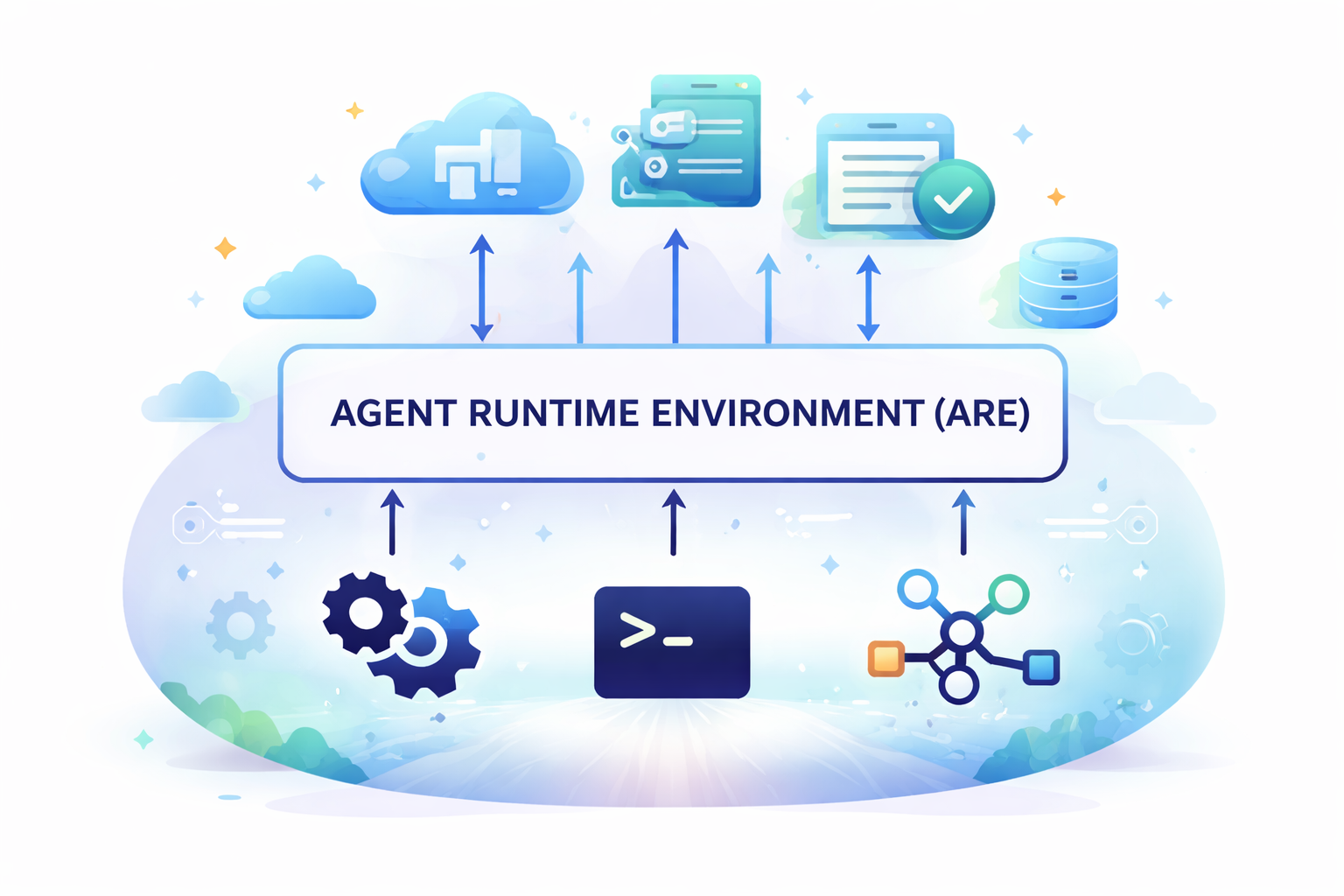
As Agentic AI moves from academic novelty to enterprise reality, the Agent Runtime Environment (ARE) emerges as a foundational layer that determines whether autonomous agents operate reliably, safely, and at scale. Simply put, ARE is the execution substrate that turns static models into dynamic, goal-driven systems capable of prolonged action, composability, and interaction with systems outside themselves.
In the world of agentic AI — where autonomy, context, planning, and tool use replace one-shot prompt/response models — ARE is not optional infrastructure: it’s the runtime backbone that enables intelligent agents to live in production systems.
What is an Agent Runtime Environment?
At its core, an ARE is a software execution environment purpose-built for AI agents rather than traditional applications. It provides the services, operational guarantees, and governance primitives that let agents instantiate, run, communicate, access tools, and interact with external systems over extended periods. This goes far beyond the ephemeral execution models of classic serverless or microservices workloads.
“The Agent Runtime Environment (ARE) is the foundation where... AI agents operate and execute their tasks. It provides the necessary computational resources, interfaces, and security layers that allow agents to run smoothly, interact with users, and access required data securely.”
In distributed frameworks like AutoGen, a runtime also manages agent identities, lifecycles, and communication channels, effectively coordinating how agents interact with each other and the world.
ARE is not just a dispatcher — it’s the execution canvas for autonomous reasoning and action.
Why are runtimes critical for Agentic AI
Unlike stateless LLM interfaces, agentic AI systems:
- Run autonomously over long durations, reasoning across steps rather than answering in one shot.
- Maintain memory & context, required for coherent multi-step workflows.
- Invoke external tools, APIs, and unbounded operations, including code execution if permitted.
- Collaborate across multiple agents, forming multi-agent systems with emergent behaviors.
These characteristics introduce operational dimensions that no generic web framework, container cluster manager, or serverless platform can handle by default — hence the need for ARE.
Technical definers like OpenAI explicitly include runtime as one of four core agent components:
Agent = Model + Instructions + Tools + Runtime
designed to support dynamic, continuous execution with statefulness and tool interactions.